
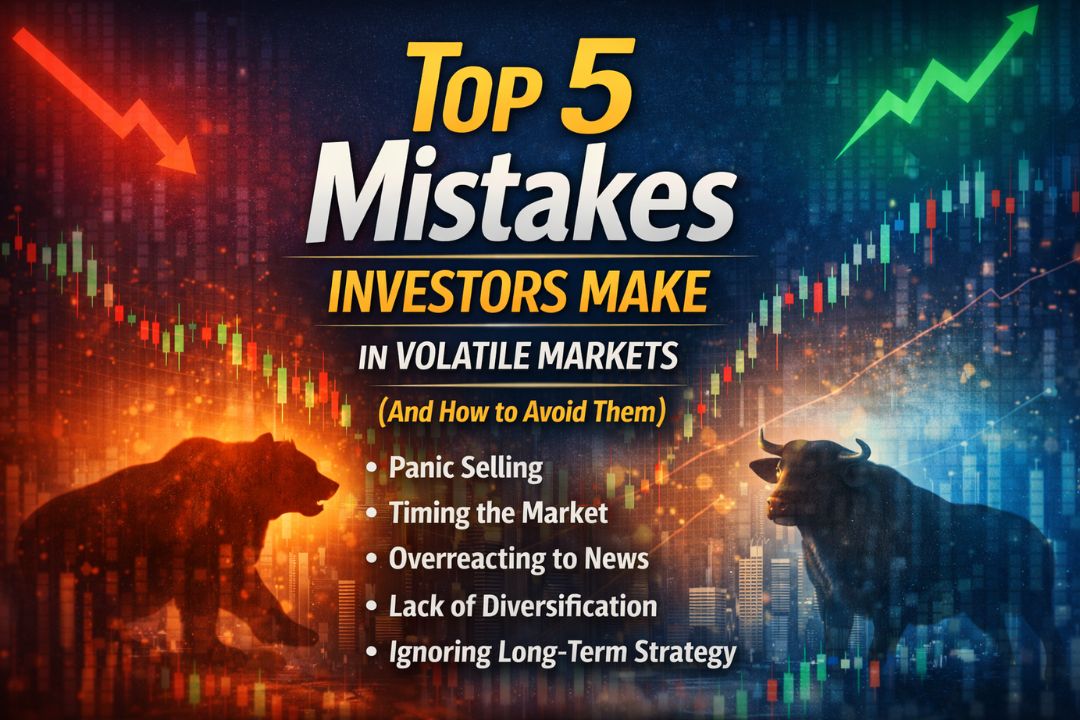
Volatility is a natural part of financial markets. Prices rise and fall, sometimes gradually and sometimes with sharp, unpredictable movements. For experienced investors, volatility is expected and often welcomed as an opportunity. But for many individuals especially beginners it can feel overwhelming, confusing, and even frightening.
When markets become unstable, emotions tend to take over logic. Fear, greed, panic, and uncertainty start influencing decisions, often leading to costly mistakes. Instead of sticking to a well-thought-out strategy, investors react impulsively to market movements, headlines, and social media noise.
This is where most investors go wrong.
Understanding the common mistakes made during volatile markets is the first step toward becoming a smarter and more disciplined investor. In this article, we’ll explore the top five mistakes investors make in volatile markets, why they happen, and most importantly, how you can avoid them. Along the way, we will also look deeper into investor psychology, real-world scenarios, and practical strategies that can help you stay confident even when markets are unstable.
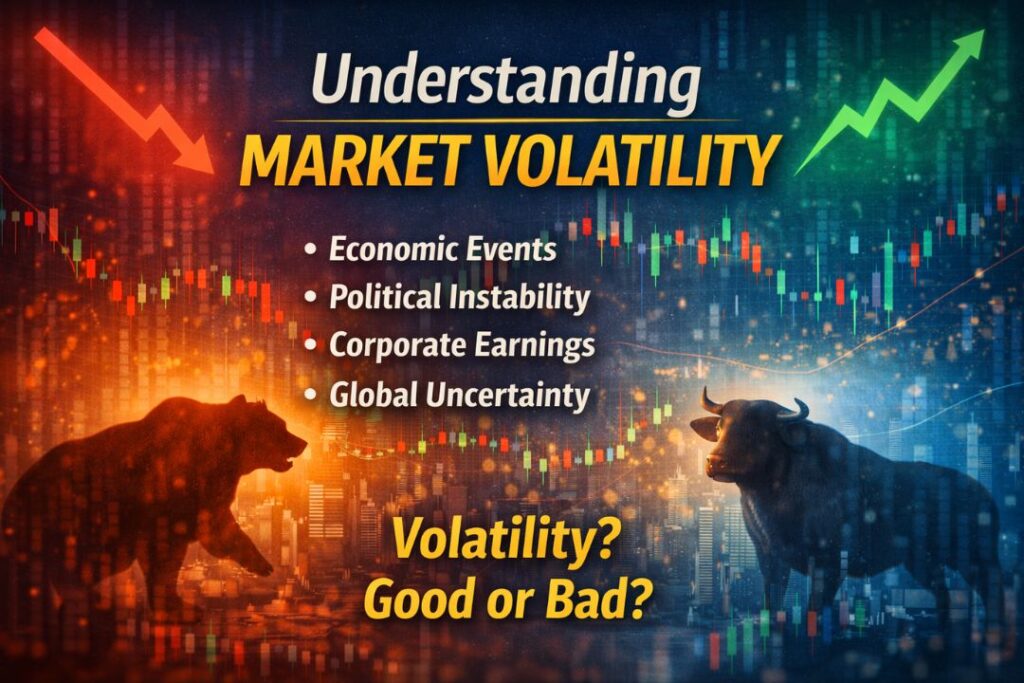
Understanding Market Volatility
Before diving into the mistakes, it’s important to understand what volatility actually means.
Market volatility refers to the rate at which the price of assets increases or decreases over a certain period. High volatility means prices are moving rapidly in either direction, while low volatility indicates more stable price movements.
Volatility can be caused by several factors:
- Economic events (inflation, interest rates, GDP data)
- Political instability or global conflicts
- Corporate earnings announcements
- Unexpected global events (like pandemics)
While volatility is often seen as negative, it is actually a normal and essential part of market behavior. Without volatility, there would be no opportunity for profit.
The problem is not volatility itself it’s how investors react to it.
1. Panic Selling During Market Drops
What Happens?
One of the most common and damaging mistakes investors make is panic selling when the market starts falling. As stock prices drop, fear begins to build. News channels highlight losses, social media spreads negativity, and suddenly it feels like everything is collapsing.
Investors rush to sell their holdings to stop further losses.
Why It’s a Mistake
Selling during a market downturn locks in your losses. Markets are cyclical what goes down often comes back up. Historically, markets have recovered from every major crash over time.
When you sell in panic:
- You exit at low prices
- You miss the eventual recovery
- You turn temporary losses into permanent ones
Psychological Reason
This behavior is driven by loss aversion, a concept where the pain of losing money feels stronger than the pleasure of gaining money. As a result, investors act quickly to avoid further pain, even if it harms them long-term.
How to Avoid It
- Stay calm and avoid reacting to short-term movements
- Focus on long-term goals rather than daily price changes
- Remind yourself why you invested in the first place
- Avoid checking your portfolio too frequently
A simple rule: Don’t sell just because prices are falling.
2. Trying to Time the Market
What Happens?
In volatile markets, many investors try to predict:
- When the market will hit the bottom
- When it will start rising again
They sell when they think the market will fall further and wait to buy back at the “perfect” moment.
Why It’s a Mistake
Timing the market consistently is extremely difficult even for professionals. Markets are influenced by countless variables, many of which are unpredictable.
Most investors who try to time the market:
- Sell after a decline has already happened
- Wait too long to re-enter
- Miss strong recovery rallies
Data Insight
Studies have shown that missing just a few of the best-performing days in the market can drastically reduce long-term returns. These best days often occur during periods of high volatility.
How to Avoid It
- Invest regularly using strategies like SIP (Systematic Investment Plan)
- Accept that you cannot predict market bottoms or tops
- Focus on consistency rather than perfection
Instead of timing the market, focus on time in the market.
3. Overreacting to News and Social Media
What Happens?
In today’s fast-paced digital world, investors are constantly exposed to:
- Breaking news alerts
- YouTube analysis
- Twitter trends
- Influencer opinions
During volatile markets, this information overload becomes even more intense.
Why It’s a Mistake
Most of this information is short-term focused and often exaggerated. Media outlets aim to capture attention, which leads to sensational headlines.
This creates:
- Fear during market declines
- Overconfidence during market rallies
As a result, investors make impulsive decisions without proper analysis.
Example Scenario
A headline like “Market Crash Incoming!” can trigger panic selling, even if there is no strong fundamental reason behind it.
How to Avoid It
- Limit consumption of financial news to once or twice a day
- Follow credible and experienced analysts
- Focus on long-term trends rather than daily updates
- Avoid acting immediately on any news
Remember: Noise is not knowledge.
4. Lack of Proper Diversification
What Happens?
Many investors make the mistake of concentrating their investments in a single area:
- One stock
- One industry
- One asset type
While this may lead to high returns in a good market, it also increases risk significantly during volatile periods.
Why It’s a Mistake
If your investments are not diversified, a single negative event can have a major impact on your portfolio.
For example:
- If you invest only in IT stocks and the tech sector declines, your entire portfolio suffers
- If one company underperforms, your overall returns drop drastically
The Concept of Risk Management
Diversification is one of the simplest and most effective ways to manage risk. It ensures that not all your investments react the same way to market changes.
How to Avoid It
- Spread investments across sectors like banking, FMCG, pharma, IT
- Include different asset classes like mutual funds, bonds, gold
- Rebalance your portfolio periodically
A diversified portfolio may not give the highest returns, but it provides more stable and consistent growth.
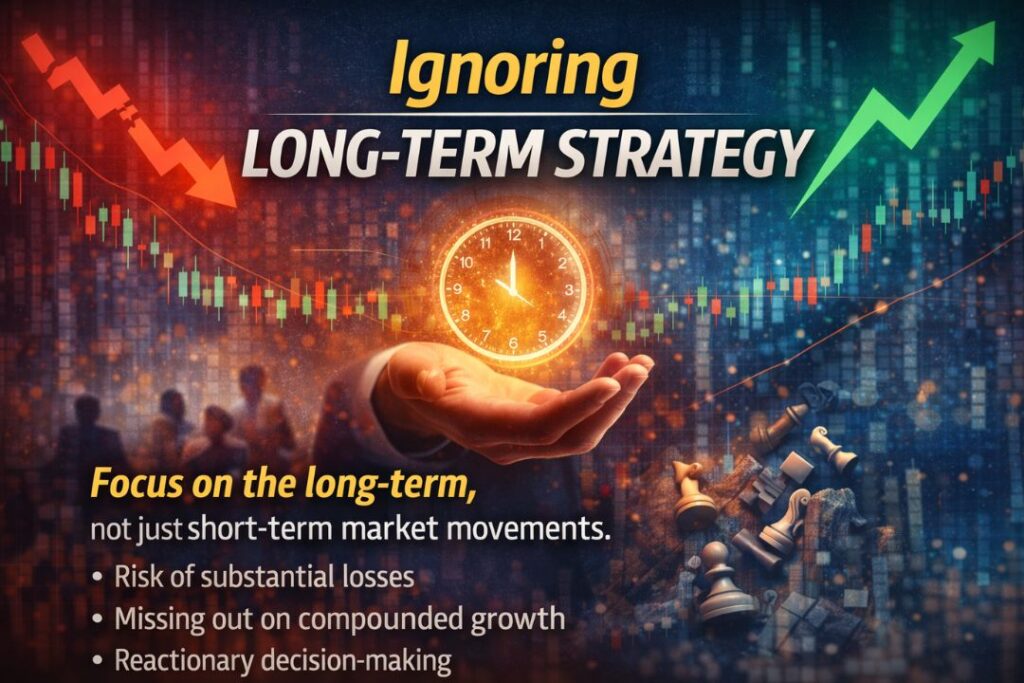
5. Ignoring Long-Term Strategy
What Happens?
During periods of volatility, investors often lose sight of their long-term goals. They start focusing only on short-term market movements.
They:
- Change strategies frequently
- Shift from investing to trading
- Make emotional decisions
Why It’s a Mistake
Wealth is created over time, not overnight. Constantly changing strategies disrupts compounding and leads to inconsistent results.
The Power of Patience
Long-term investing allows you to benefit from:
- Market recovery
- Compound growth
- Reduced emotional stress
How to Avoid It
- Clearly define your financial goals
- Stick to your investment plan
- Avoid checking your portfolio daily
- Review your strategy quarterly or yearly
Always ask:
“Am I investing for today or for the future?”
6. Not Having an Emergency Fund
What Happens?
Many investors put all their money into the market without keeping any emergency savings. When volatility hits and markets fall, they may suddenly need cash for personal reasons.
This forces them to sell investments at a loss.
Why It’s a Mistake
Investments should not be your first source of emergency money. Without a safety buffer, you are more likely to make poor decisions during market downturns.
How to Avoid It
- Maintain an emergency fund covering 3–6 months of expenses
- Keep this money in a liquid and safe instrument (like savings account or liquid fund)
- Invest only surplus money in the market
This gives you confidence to stay invested even during volatile periods.
7. Overconfidence After Small Gains
What Happens?
Sometimes, investors experience quick profits during volatile markets. This leads to overconfidence.
They start believing:
- They can predict the market
- They have mastered investing
- They can take bigger risks
Why It’s Dangerous
Overconfidence often leads to:
- Excessive trading
- Ignoring risk management
- Investing without proper research
Eventually, this results in losses.
How to Avoid It
- Stay humble and realistic
- Understand that markets are unpredictable
- Stick to your strategy regardless of short-term success
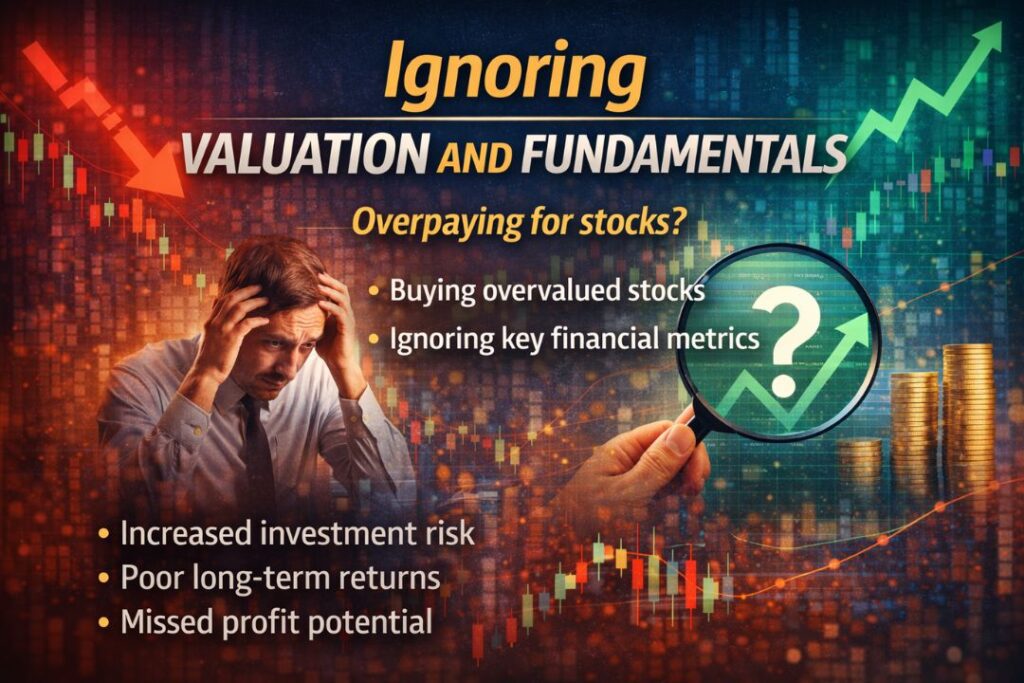
8. Ignoring Valuation and Fundamentals
What Happens?
During volatile periods, investors often chase trending stocks without analyzing their fundamentals.
They buy based on:
- Hype
- Tips
- Social media discussions
Why It’s a Mistake
Price movements without strong fundamentals are not sustainable. Investing without understanding a company increases risk.
How to Avoid It
- Study basic financial metrics (revenue, profit, debt)
- Understand the company’s business model
- Avoid investing based purely on hype
Good investing is based on value, not noise.
Key Takeaways
Let’s quickly summarize the major mistakes:
- Panic selling during market drops
- Trying to time the market
- Overreacting to news and social media
- Lack of diversification
- Ignoring long-term strategy
- Not maintaining an emergency fund
- Overconfidence after small gains
- Ignoring fundamentals
Avoiding these mistakes can significantly improve your financial journey.
Conclusion
Volatile markets are not something to fear they are something to understand.
Every investor faces uncertainty, but successful investors respond with discipline, patience, and strategy. They do not let emotions control their decisions. Instead, they use volatility as an opportunity to learn, grow, and invest wisely.
Remember:
- Market ups and downs are temporary
- Emotional decisions lead to long-term losses
- Discipline and patience create wealth
If you can stay calm when others panic and stay focused when others are confused, you will already be ahead of the majority of investors.
Frequently Asked Questions (FAQs)
1. What should I do when the market is highly volatile?
During high volatility, the best approach is to stay calm and avoid making impulsive decisions. Review your investment goals and stick to your long-term strategy. Instead of reacting emotionally, focus on fundamentals and consider continuing systematic investments like SIP.
2. Is it a good idea to stop investing during market downturns?
No, stopping investments during a downturn can be a mistake. Market declines often provide opportunities to buy quality assets at lower prices. Continuing to invest regularly helps in averaging costs and improving long-term returns.
3. How can I reduce risk in volatile markets?
You can reduce risk by diversifying your portfolio across different sectors and asset classes, maintaining an emergency fund, and avoiding overexposure to a single stock or industry. A balanced approach helps protect your investments from sudden market swings.
4. Should beginners invest during volatile market conditions?
Yes, beginners can invest during volatile markets, but they should start with proper knowledge and a clear strategy. It’s better to begin with diversified options like mutual funds or index funds and avoid risky or speculative investments.
5. How often should I check my portfolio in a volatile market?
Checking your portfolio too frequently can lead to stress and emotional decisions. Instead, review it periodically such as monthly or quarterly and focus on long-term performance rather than daily fluctuations.
Disclaimer
This article is for informational purposes only and does not constitute financial or investment advice. Investing in markets involves risks, and readers should conduct their own research or consult a qualified financial advisor before making any decisions. The author is not responsible for any financial losses.
