
Introduction
Dividend investment has always been one of the most powerful and reliable wealth-building strategies in the stock market. Whether you are a novice investor or an experienced trader managing a diversified portfolio, understanding Dividend Yield is essential.
Dividend yield helps investors gauge how much income they are earning from a stock relative to its current market price. It is particularly important for:
- Retirement planners
- Passive income seekers
- Conservative investors
- Portfolio diversification strategy
In this full guide, we will deeply understand:
- What dividend yield is
- How to calculate it
- Why it matters
- What is a good dividend Return
- High versus low dividend Return stocks
- Risks of chasing high yields
- Dividend Return versus dividend payout ratio
- Real world examples from Indian and global markets.
- Dividend investing strategies
- FAQs and expert insights
Let’s begin.

What is Dividend?
Before understand dividend yield, we must understand dividends.
A dividend is a portion of a company’s profit that is distributed to its shareholders. When a company earnings profits, it can:
- Reinvest the profits back into the business.
- Paying off debt
- Keep reserves for future growth.
- Distribute portion of the profits to shareholders
When profits are shared with stakeholders, it is called a dividend.
Dividends are usually paid:
- Quarterly (common in the US)
- Yearly or semi-annually (common in India)
Companies that pay dividends regularly are often financially stable and mature.
What is Dividend Yield?
Dividend Yield is a financial ratio that shows how much a company pays in dividends every year relative to its stock price.
Simple Definition:
Dividend Return tells you how much income you earn from a stock compared to its present market price.
Formula:
Dividend Yield = (Annual Dividend Per Share/Current Market Price) × 100
Example of Dividend Return Calculator
Let us take a simple example.
Suppose:
- Company A pays Rs 20 per share annually
- Current market price = ₹400
Dividend Yield=(20/400)×100
Dividend Yield = 5%
This means you earn 5% yearly income on your investment, excluding price appreciation.
Real Company Example-India
Coal India Limited
Coal India is known for higher dividend payouts.
Suppose:
- Share price = ₹350
- Annual dividend = ₹28
Dividend Yield=(28/350)×100=8%
This means investors earn 8% income annually if the dividend remains stable.
Real Company Example-Global
Johnson & Johnson
Johnson & Johnson is a well-known dividend elite.
Suppose:
- Share price = $160
- Annual dividend = $4.80
Dividend Yield=(4.80/160)×100=3%
Even though yield is lower than Coal India, J&J offers sustainability and consistent growth.
Why dividend Return is important
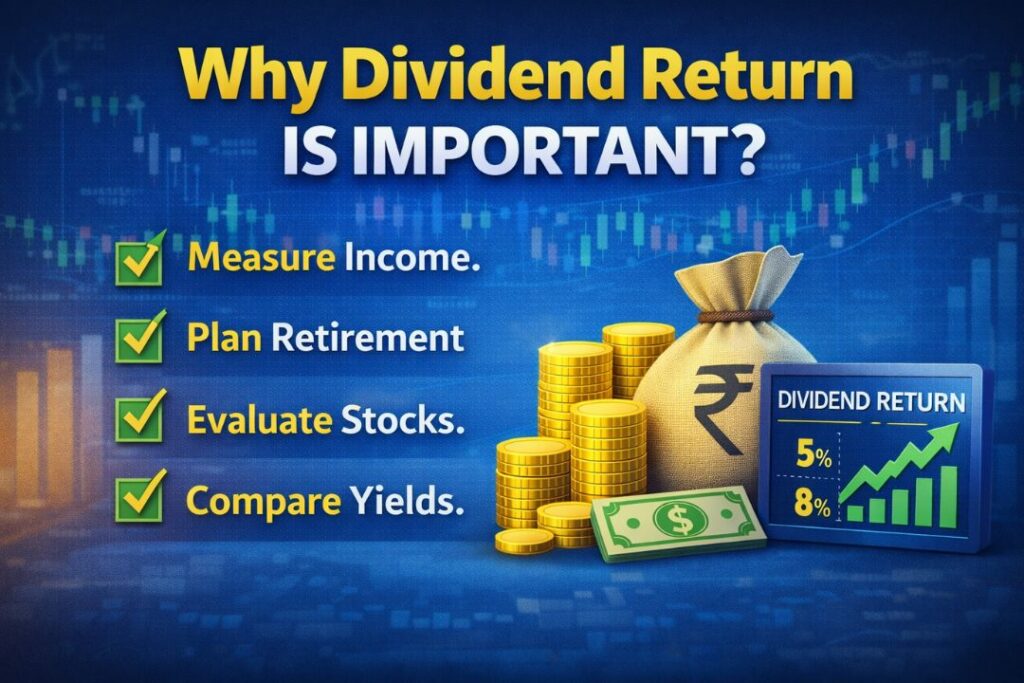
Dividend Return helps investors :
Measure Income Potential
Shows how much income you earn yearly.
Compare Stocks
You can compare multiple dividend-paid stocks easily.
Evaluate Value
High yields may indicate undervaluation—or financial trouble.
Retirement Plan
Retirees rely on dividend income.
What is a good dividend yield?
There is no fixed number, but usually:
- 1%–2% → Low yield
- 2%–4% → Moderate yield
- 4%–6% → High yield
- 7%+ →Very high(risk may be involved)
In India, many PSU companies offer 5%-9% yield.
In the US, 2%-4% is considered strong.
High Dividend Return- Good or Bad?
High dividend Return can be attractive, but it also can be dangerous.
Why High Yield May Be Risky:
- Stock price may have fallen sharp
- Company profits may be decreasing
- Dividends may not be sustainable
- High payout ratio
Always check:
- Earnings stability
- Cash flow
- Debt Level
- Business future
Dividend Yield vs Dividend Payout Ratio
Many beginners confusion these two.
| Dividend Yield | Dividend Payout Ratio |
|---|---|
| Based on stock price | Based on earnings |
| Measures income return | Measures sustainability |
| Investor-focused | Company-focused |
Payout Ratio Formula:
Dividend Payout Ratio = (Dividend/Net Profit) × 100
If payout ratio is 90%+, company may struggle to growth.
Dividend Return Vs Fixed Deposit
In India, many investors compared dividend yield with bank FD.
Example:
- FD interest = 6.5%
- Stock dividend yield = 5%
Difference:
FD – Fixed & Guaranteed
Dividend – Not guaranteed
But stocks also provide capital appreciation.
Types of Dividend Stocks
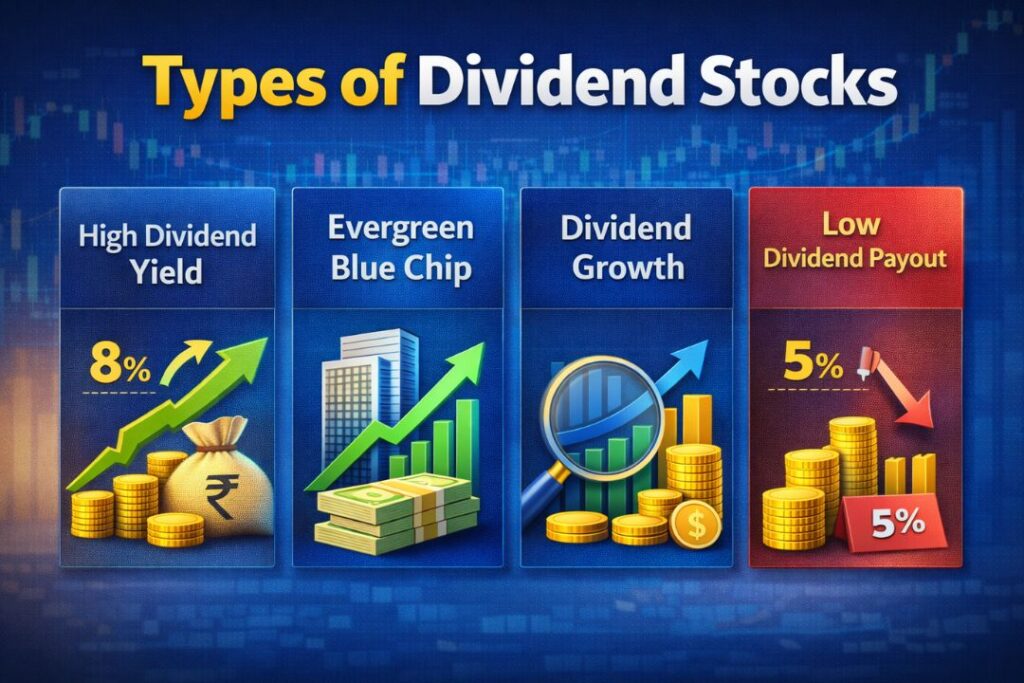
High Yield Stocks
Providing high income but may have slow growth.
Dividend Growth Stocks
Lower yield but increase dividend yearly.
Blue Chip Dividend Stocks
Stable, large companies.
What happens when the stock price changes?
Dividend Return changes daily because stock price changes.
Example:
Dividend = ₹20
If price=₹400 – Yield=5%
If price falls to Rs.300 – Yield = 6.67%
Therefore falling price increases yield.
Dividend Return Trap
A dividend trap happens when:
- Stock price crashes
- Yield looks very high
- Company cuts dividend later
Many beginners fall in this trap.
Always analyze fundamentals before investment.
Factors that affect dividend Return
Company profit
Cash flow
Industry Stability
Debt Level
Economic conditions
Government policies
Dividend Yield in Bear Market
During market crashes:
- Stock prices fall
- Dividend Return rises
But companies may cut dividends during downturn.
Such high yield in bear market requires careful analysis.
Taxation on Dividends (India)
In India:
- Dividends are taxable as per income tax bracket.
- No DDT(Dividend Distribution Tax now removed)
Always consider post tax yield.
Dividend Return Strategy
Buy and Hold Strategy
Buy steady dividend stocks and hold long term.
Dividend Reinvestment(DRIP)
Reinvest profits to compound wealth
Diversified Dividend Portfolio
Mix high yield + growth dividend shares.
Benefits of Dividend Yield Investment
- Passive Income
- Lower volatility
- Compounding benefit
- psychological comfort
Disadvantages
- Not guaranteed
- Limited growth in certain companies
- High yield risk
FAQs
Q1:Is higher dividend yield always better?
No. Very high yield may indicate financial trouble.
Q2:Do growth companies pay dividends?
Usually no. They reinvest profits.
Q3:Can the dividend yield change?
Yes, it changes with stock price and dividend declarations.
Q4: Is dividend safe income?
Safer than price speculation but not guaranteed.
Final Thoughts
Dividend yield is a powerful tool for investors seeking income and sustainability. Nevertheless, it should never be the only factor in investment decisions.
Before investment, always check:
- Company earnings
- Cash flow
- Debt
- Business Outlook
- Dividend history
A balanced strategy combining dividend Return and growth potential can help create long-term wealth.
Conclusion
Dividend Yield is one of the most important metrics for income-oriented investors. This helps you understand how much return you earn from dividends relative to the stock price.
However, blindly chasing high dividend Return can be dangerous.
The smart approach is:
- Analyze fundamentals
- Check sustainability
- Diversify your portfolio
- Think long term
Invest wisely, remain disciplined, and let compounding work for you.
Disclaimer
This article is for educational purposes only and does not constitute investment advice. Stock market investments carry risk please consult a financial advisor before investing.
