
Introduction
Inflation is one of the most significant challenges faced by any economy. While moderate inflation is considered healthy for economic growth, high or uncontrolled inflation can seriously harm purchasing power, savings, investment decisions, and overall economic stability.
This is where central banks play a vital role. Central banks are responsible for maintenance price stability and ensuring that inflation remains under control.
This article explains how central banks control inflation, the tools they use, why inflation targeting matters, real-world examples, limitations of financial policy, and the future of inflation management.
What Is Inflation?
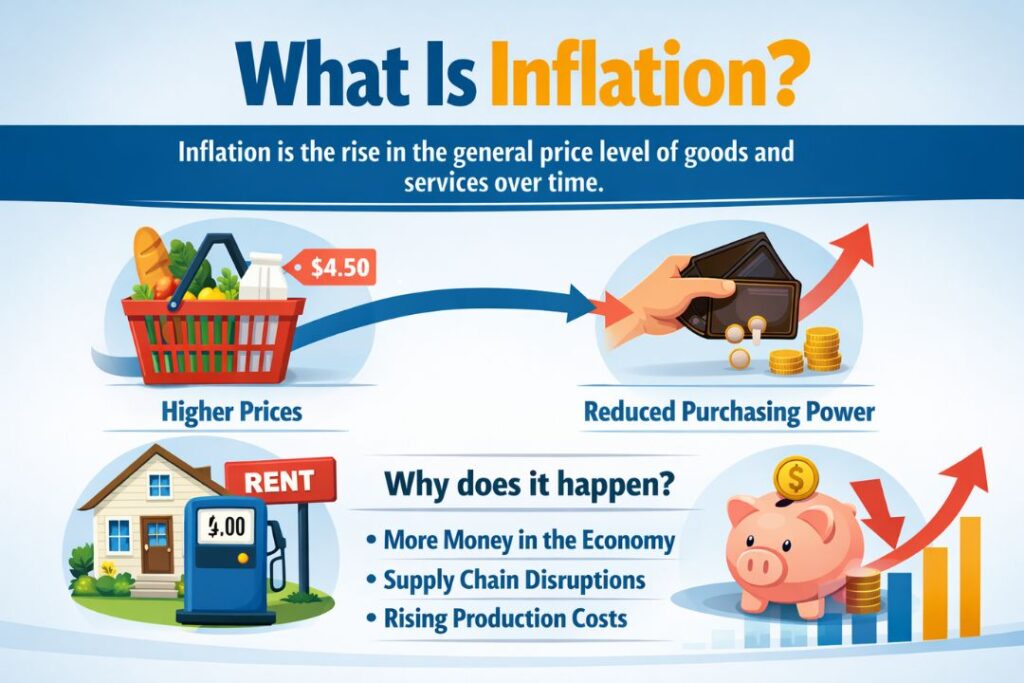
Inflation refers to a sustained increase in the general price level of goods and services over time, leading to a decline in the buying power of money.
Example:
If a basket of goods costs Rs 100 today and Rs 120 next year, inflation has reduced the value of money.
Main Types of Inflation:
Demand-Pull Inflation– Demand exceeds supply
Cost-Push Inflation – Rising input costs like fuel and wages.
Built-In Inflation – Inflation driven by expectations and wage increases.
What is a Central Bank?
A central bank is the apex monetary authority of a country responsible for controlling money supply and credit conditions.
Major Central Banks:
- India-Reserve Bank of India
- United States-Federal Reserve
- Eurozone-European Central Bank
Core Functions:
- Control inflation
- Maintain financial stability
- Regulate banking system
- Manage currency and liquidity
Why controlling inflation is so important
Central banks concentrate on inflation control because:
- High inflation erodes buying power
- Savings lose real value
- Economic uncertainty discourages investments.
- Income inequality increases
- Currency credibility weakens
Price stability is essential for sustainable economic development.
Inflation Targeting Framework
Most modern central banks follow inflation targeting, where a specific inflation rate is announced publicly.
Common Targets:
- India: 4% ± 2%
- USA: Around 2%
- Eurozone: Around 2%
Advantages of Inflation Targeting:
- Anchor inflation expectations
- Improves transparency
- Reduce political interference.
- Improves central bank credibility
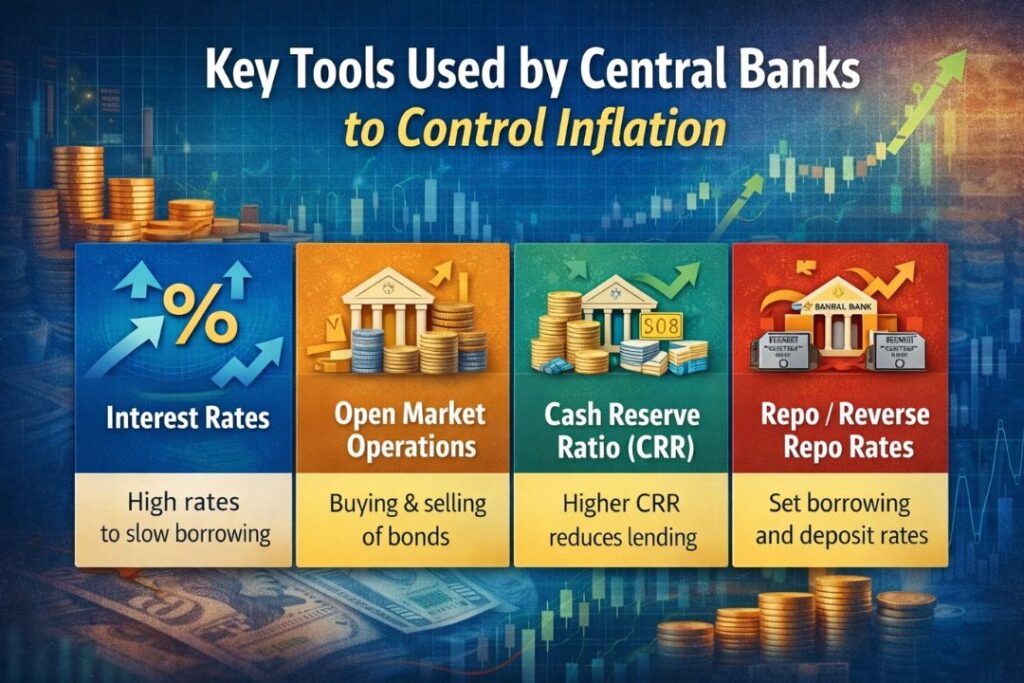
Key Tools used by Central Banks to Control Inflation
Interest Rate Policy
Interest rates are the most powerful instrument of monetary policy.
How It Works:
- central bank increases policy rates
- Borrowing becomes expensive
- Consumption and investment slowed down.
- Demand Reduces
- Inflation pressure declines
Higher interest rates discourage excess spending and credit growth.
Open Market Operations(OMO)
Open market operations involve buying or selling government securities.
- Selling securities – reduced liquidity – inflation control
- Buying securities – increased liquidity – growth support
Cash Reserve Ratio (CRR)
CCC
- Higher CRR-less lending capacity
- Slower credit growth-lower inflation
Statutory Liquidity Ratio(SLR)
SLR requires banks to hold a portion of deposits in government securities and secured assets.
This indirectly controls excess credit creation.
Repo and reverse repo rates
- Repo Rate: Rate at which banks borrow from the central bank.
- Reverse Repo Rate: Rate at which banks park surplus funds
Increasing these rates helps absorb liquidity and reduce inflation.
Money Supply Management
Excess money supply leads to inflation when too much money chases limited products.
Central banks monitor:
- Broad money supply
- Credit growth
- Velocity of money
Controlling money growth is necessary for price stability.
Inflation Expectations and Central Bank Credence
Inflation is affected not only by current prices but also by expectations.
If people expect inflation:
- Workers demand higher wages
- Firms raise prices in advance
- Inflation becomes self-reinforced
Central banks manage expectations via credibility and clear communication.
communication and forward guidance
Modern central banking depends heavily on communication.
- Policy statements
- Press conferences
- forward guidance on future actions
Clear messages stabilize markets and expectations.
Exchange rates and imported inflation
Currency depreciation makes imports costly, increasing inflation.
Central banks may:
- Raise interest rates
- Intervention in foreign exchange markets
Inflation Control in India Case Study
India follows an inflation-targeting regime headed by the RBI.
Key features:
- Financial Policy Committee (MPC)
- Repo rate adjustments
- Liquidity management tools
This framework has helped steady inflation expectations over time.
Case Study :United States Federal Reserve
The Federal Reserve uses:
- Aggressive rate hikes
- Balance sheet reduction(quantitative tightening)
Delayed action could make inflation harder to control, as seen post-pandemic.
Central Bank Inflation Control Limitations
Central banks cannot control:
- Supply-side shocks (oil and food prices)
- Global disruptions
- Fiscal policy decisions
Financial policy also works with time lags.
Financial Policy vs Fiscal Policy
Inflation control is most efficient when:
- Financial policy and fiscal policy are coordinated.
Excess government spending can neutralize central bank efforts.
Can inflation be eliminated completely?
No.
Controlled and predictable inflation is desired.
Moderate inflation:
- Encourages spending
- Prevents deflation
- Supports economic growth
Future of Inflation Control
Future trends include:
- Central Bank Digital Currency (CBDCs)
- Advanced data analytics
- Faster policy transmission
- Greater global coordination
The Role of Data, Technology, and Real-Time Indicators in Inflation Control
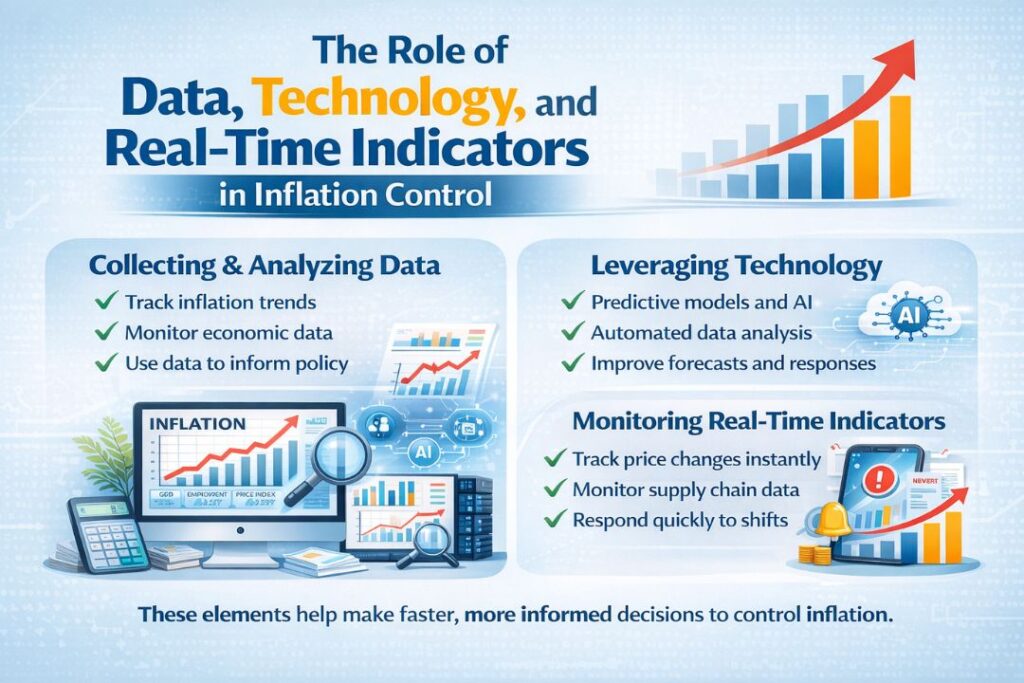
In the modern economy, central banks no longer depend only on traditional inflation indicators such as consumer price index (CPI) or wholesale price index (WPI). Instead, they increasingly use real-time data, advanced analytics, and technology-driven tools to improve the accuracy and pace of inflation control.
High-frequency data such as digital payments, satellite imagery, fuel consumption, logistics movement, and online price tracking help central banks detect inflationary pressures much earlier than earlier. This allows policymakers to act proactively rather than reacting after inflation has already risen.
Big data and artificial intelligence also play a significant role. By analyzing massive datasets, central banks can identify hidden patterns in consumer behavior, supply chain interruptions, and sector-specific price pressures. These insights improve forecasting models and reduce policy mistakes caused by delayed or incomplete information.
Another significant development is the use of real-time inflation expectations surveys. Central banks regularly track how families, businesses, and financial markets perceive future inflation. When expectations begin rising, policymakers can tighten monetary conditions early to prevent a wage-price spiral.
Technology also has improved transparency. Economic dashboards, policy reports, and public data portals permit investors and citizens to understand inflation trends and central bank actions more clearly. This transparency strengthens trust and enhance policy effectiveness.
In an increasingly complicated global economy, data-driven decision-making has become essential. While technology cannot eliminate inflation, it significantly improves a central bank’s ability to anticipate risks, react faster, and maintain price stability in an uncertain environment.
Conclusion
Central banks play a vital role in maintaining economic stability by controlling inflation. Through interest rates, liquidity management, communication, and reliability, they balance growth and price stability.
Inflation cannot be eliminated, but with strong institutions and disciplined policy, it can be managed effectively.
Frequently Asked Questions (FAQs)
1.What is inflation and why is it damaging?
Inflation is the constant rise in the general price level of goods and services. High inflation reduces buying power, lowers savings value, increases cost of living, and creates economic uncertainty.
2.Who is responsible for controlling inflation in a nation?
Inflation is primarily controlled by the country’s central bank.
For instance, in India it is controlled by the Reserve Bank of India, while in the United States it is managed by the Federal Reserve.
3.How do interest rates help control inflation?
When a central bank increases interest rates, borrowing becomes more costly. This reduces spending and investment, reduces demand, and helps slow down inflation.
4.What is inflation targeting?
Inflation targeting is a policy framework where the central bank set a specific inflation goal (for example, 4% in India). Financial policy decisions are taken to keep inflation close to this target.
5.Can central banks completely eliminate inflation?
No. Fully eliminating inflation is neither possible nor desirable. Moderate and steady inflation is healthy for economic growth and helps avoid deflation.
6.Why doesn’t a central bank always raise interest rates to control inflation?
Higher interest rates can slow economic growth, increase unemployment, and hurt businesses. Central banks must balance inflation control with economic development.
7.What is the role of money supply in inflation?
If money supply increases faster than the production of goods and services, inflation increases. Central banks control money supply through instruments like repo rates, CRR, and open market operations.
8.How long does it take for financial policy to control inflation?
Financial policy works with a time lag. It may take several months for interest rate changes to completely affect inflation.
9.Can inflation be caused by factors beyond Central Bank control?
Yes. Supply-side factors such as oil price shocks, food shortages, wars, and global disruptions can cause inflation that central banks cannot completely control.
10.Why is central bank credentials important for inflation control?
If people trust the central bank, inflation expectations stay stable. Strong credibility makes inflation control more effective with less policy actions.
Disclaimer
This content is for educational and informational purposes only and does not constitute financial, investment, or professional advice. Economic conditions and monetary policies may change over time. Readers should verify information from official sources and consult qualified professionals before making any financial or investment decisions. The author is not responsible for any losses arising from the use of this information.
Stay connected for more such information https://stockhubnews.com
