
Introduction
In trading and investing, making money is important but protecting money is necessary. Many traders enter the stock market with enthusiasm, strategies, and indicators, yet they ignore the most critical tool for survival: stop loss.
A Loss Limit is not simply a trading rule; This is the foundation of risk management. Traders who fail to use Loss Limit often face large, uncontrollable losses, while disciplined traders use Loss Limit to remain consistent and profitable over the long term.
This complete guide explains what Loss Limit is, why Loss Limit is important, types of Loss Limit, how to calculate stop loss, psychology behind Loss Limit, advanced strategies, real-life examples, and commonly asked questions all in simple, practical English.
What is Stop Loss?
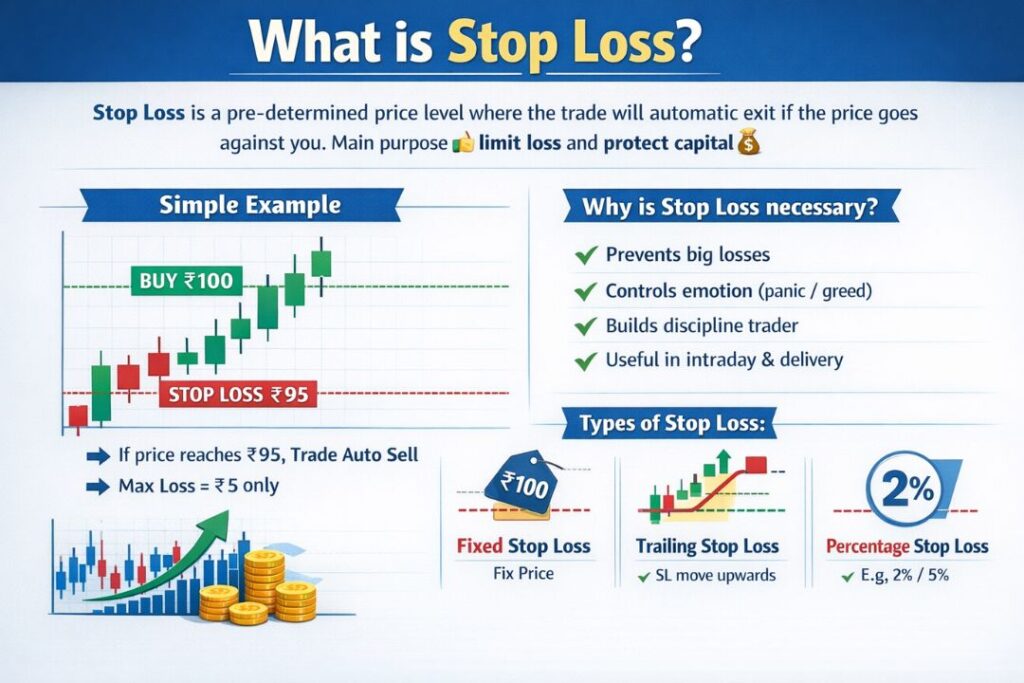
A Loss Limit is a predetermined price level at which a trader exits a trade to limit potential loss.
In simple terms:
Loss Limit is the maximum loss a businessman is willing to accept on a trade.
Example:
- You buy a stock at ₹100
- You place a stop loss at Rs.95
- If the price reaches Rs 95, the trade is closed.
Your loss is controlled, regardless of how far the price falls subsequently.
Why is stop loss so important?
Prevent loss is important because markets are unpredictable. Even the best analysis can failure.
Key reasons Loss Limit is essential:
Capital Protection
Loss Limit protects trading capital from big losses. Without Loss Limit, one bad trade can ruin months or years of profits.
Emotional Control
Fear, hope, and greed frequently force traders to make poor decisions. Loss Limit eliminates emotional involvement by defining risk in advance.
Consistency
Consistent use of Loss Limit ensures that losses remain small and managed, allowing profits to grow over time.
Professional Discipline
All professional merchants and institutions use Loss Limit. Trading without Loss Limit is gambling, not strategy.
Loss Limit versus Target: What Matters More?
Most beginners focus on targets, but professionals concentrate on Loss Limit.
If you do not know where your Loss Limit is, you should not take the trade.
Targets depend upon market movement.
Loss Limit depends upon discipline
Types of Loss Limit
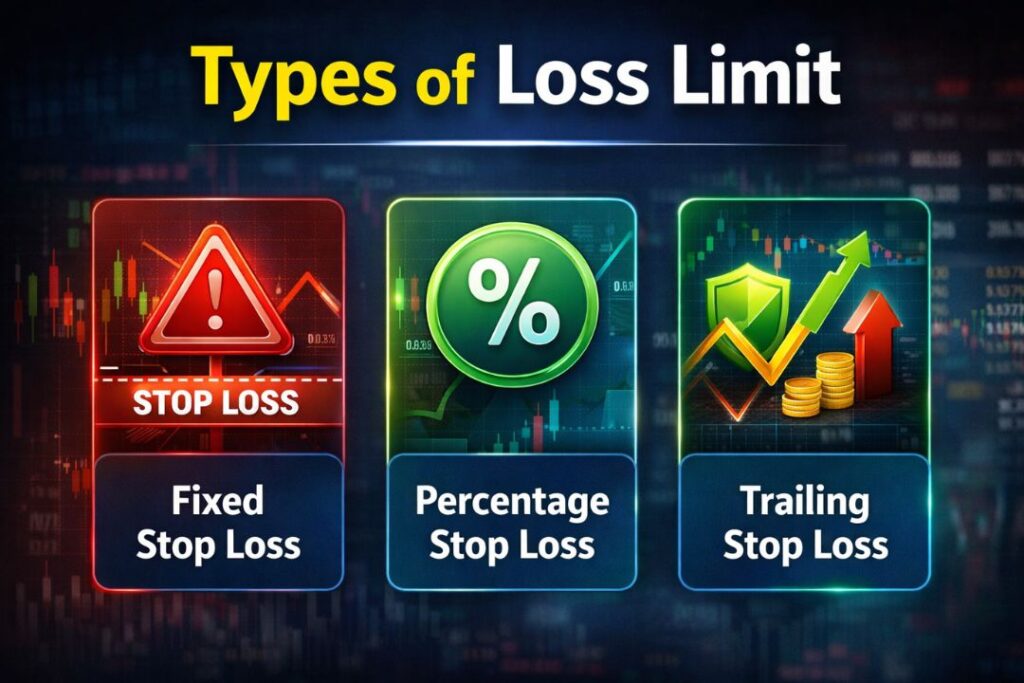
1.Fixed Loss Limit
A fixed Loss Limit is set at a specific price or point price.
Example:
Entry at ₹200
Stop loss at ₹190
Best for: Beginners and intraday merchants
Limitation: Doesn’t adjust to volatility
2.Percentage-Based Loss Limit
Loss Limit is computed as a percentage of entry price.
Example:
Entry at ₹500
Stop loss at 2% = ₹490
Best for:Swing traders and investors
Advantage : Uniform risk control
3. Technical Loss Limit
Technical Loss Limit is placed using chart-based levels such as:
- Support and resistance
- Trendlines
- Moving averages
- Chart patterns
This Loss Limit is based on market structure, not emotions.
4.Time-Based Loss Limit
If price does not move within a specified time, the trade is exited.
Best for : Intraday traders and scalpers
Purpose: Avoids capital getting stuck in slow trades
5.Trailing Loss Limit
Trailing Loss Limit moves in the direction of profit as the price moves favorable.
Benefits:
- Protects profits
- Allows winning trades to run
Trailering Loss Limit is one of the most powerful tools in trend trading.
How to Calculate Stop Loss Properly
Risk Per Trade Method
Professional traders risk only 1%–2% of total capital per trade using Loss Limit.
Example:
- Capital: ₹1,00,000
- Risk per trade: 1% = ₹1,000
- Stop loss distance: ₹10
Quantity = 100 shares
This method ensures controlled and consistent exposure.
Chart-based Loss Limit calculation
- Identification key support or resistance
- Put Loss Limit slightly beyond that level
- Adjust the position size accordingly
This approach aligns technical analysis with risk management.
Loss Limit and Risk – Reward Ratio
Loss Limit is essential for calculating risk – reward ratio.
Example:
- Entry: ₹500
- Stop loss: ₹ 490 (₹ 10 risk)
- Target: ₹530 (₹30 reward)
Risk–Reward Ratio = 1:3
Even with a low win rate, traders can remain profitable by maintaining favorable risk–reward using Loss Limit.
Stop Loss in Various Trading Styles
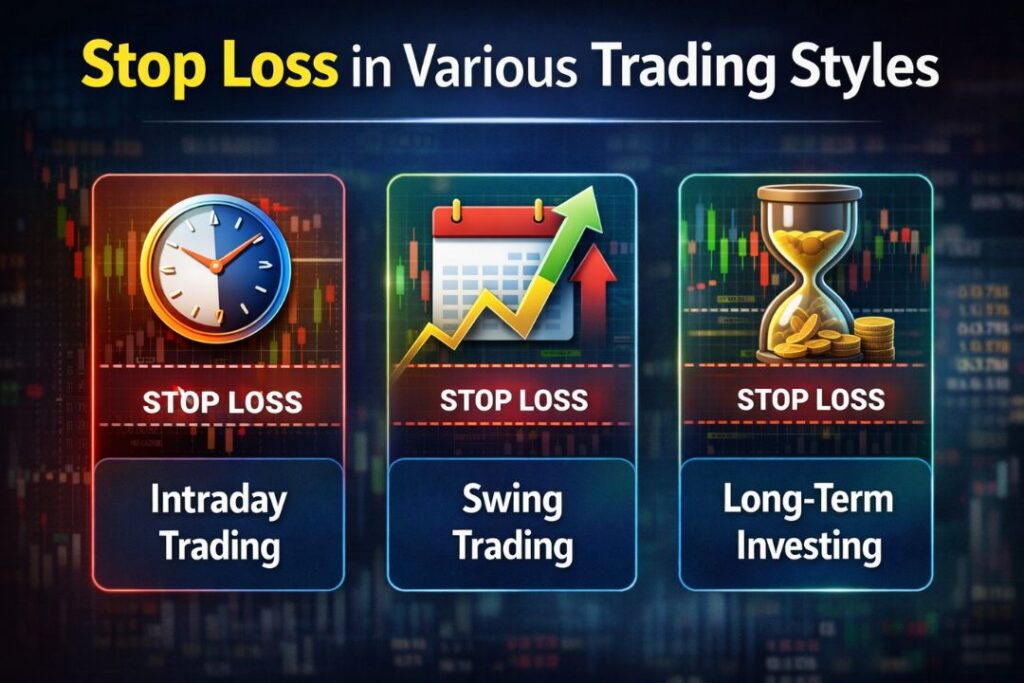
Intraday Trading
- Tight Loss Limit
- Fast execution
- High discipline required
Swing Trading
- Wider Loss Limit
- Based on daily charts
- Holding duration of days or weeks
Long-Term Investing
- Loss Limit based on major trend or fundamentally
- Used to avoid permanent capital loss
Common Loss Limit Mistakes
No Stop Loss
The most dangerous mistake. Unlimited risk can ruin trading accounts
Stop Losing Too Tight
Leads to common Loss Limt this due to market noise.
Stop Moving Loss Emotionally
Increasing Loss Limit to avoid booking loss usually results in larger losses.
Revenge trading after stop loss
Emotional trades after a Loss Limit frequently multiply losses.
The Psychology Behind Stop Loss
Many traders avoid Loss Limit due to
- They hate being wrong
- They hope price will reverse
- They become emotionally attached to trades.
Successful traders acknowledge that:
Losses are part of trading business, not personal failures.
Loss Limit protects mentality as much as it protects money.
Advanced Loss Limit Strategies
ATR-Based Stop Loss
Uses Average True Range to adjust Loss Limit based on instability.
Volatility-Based Loss Limit
The wider the Loss Limit, the smaller the position size.
Multiple Timeframe Stop Loss
Entry on lower timeframe, Loss Limit from higher timeframe structure.
Real-Life Example
Trader A:
- No Loss Limit
- One wrong trade
Trader B:
- Uses 1% stop loss
- 10 losing trades = -10% capital
Trader B survived and improved.
Trader A exits the market.
Loss Limit is a business expense
Losses are not failures-they are costs of doing business.
Think like a professional:
- Stop loss = insurance
- Risk management = survival
- Discipline = success
Frequently Asked Questions
What is Loss Limit in simple words?
Loss Limit is a predetermined exit point used to limit losses in trading.
Is Loss Limit mandatory in trading?
Yes. Trading without Loss Limit exposes traders to infinite risk.
Which stop loss is best for beginners?
Fixed or percent based Loss Limit is best for beginners.
Why does my Loss Limit hit frequently?
Due to tight Loss Limit, unstable markets, or poor entry timing.
Can I move my Loss Limit?
Yes, but only to protect profits — not to increase risk.
What is trailing stop loss?
A Loss Limit that moves in profit direction to lock profits.
Is Loss Limit helpful for investors?
Yes. It protects long-term capital from major trend collapses.
How much capital must I risk per trade?
Ideally, only 1%-2% of total capital using Loss Limit.
Does stop loss guarantee profit?
No. Loss Limit guarantees controlled losses, not profits.
What happens if I ignore stop loss?
Ignoring Loss Limit frequently leads to emotional trading and account blow-up.
Conclusion
Stop loss is not a weakness; this is the strongest expression of discipline. Traders who honor Loss Limit survive long enough to learn, adapt, and grow. Those who ignore it generally leave the market early.
The goal of trading is not to win every trade, but to stay in the game long enough for the probabilities to work in your favour.
Control risk first. Profits will follow.
Disclaimer
This material is for educational purposes only and does not constitute financial or investment advice. Stock market trading involves risk, and past performance does not guarantee future outcomes. Always conduct your own research and consult a certified financial adviser before making trading or investing decisions. The author and publisher are not liable for any financial losses arising from the use of this information.
Stay connected for more such information https://stockhubnews.com
