
Introduction
In recent years, the Indian stock market has witnessed a sharp increase in SME IPOs. Whereas most investors are familiar with large Mainboard IPOs, many are still confused about SMEs IPOs what they are, how they work, and whether they are worth investing in.
An small and medium enterprise IPO ( initial public offering) allows small and medium-sized companies to raise capital from the public by listing their shares on dedicated SME platforms of stock exchanges.
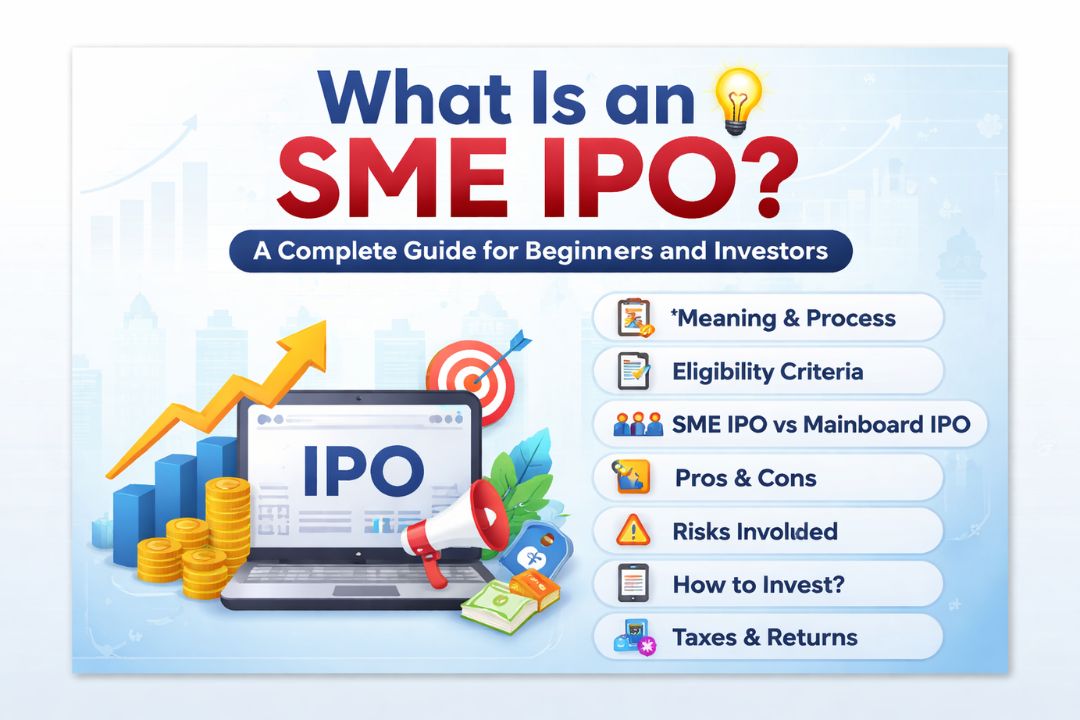
This blog explains SMEs IPOs in plain English, covering:
- Meaning and concept
- How SMEs IPOs work
- Eligibility Criteria
- SMEs IPO vs Mainboard IPO
- Advantages and disadvantages
- Risks involved
- How can retail investors apply?
- Listing
- FAQs and real-world insights
What Is an SME IPO?
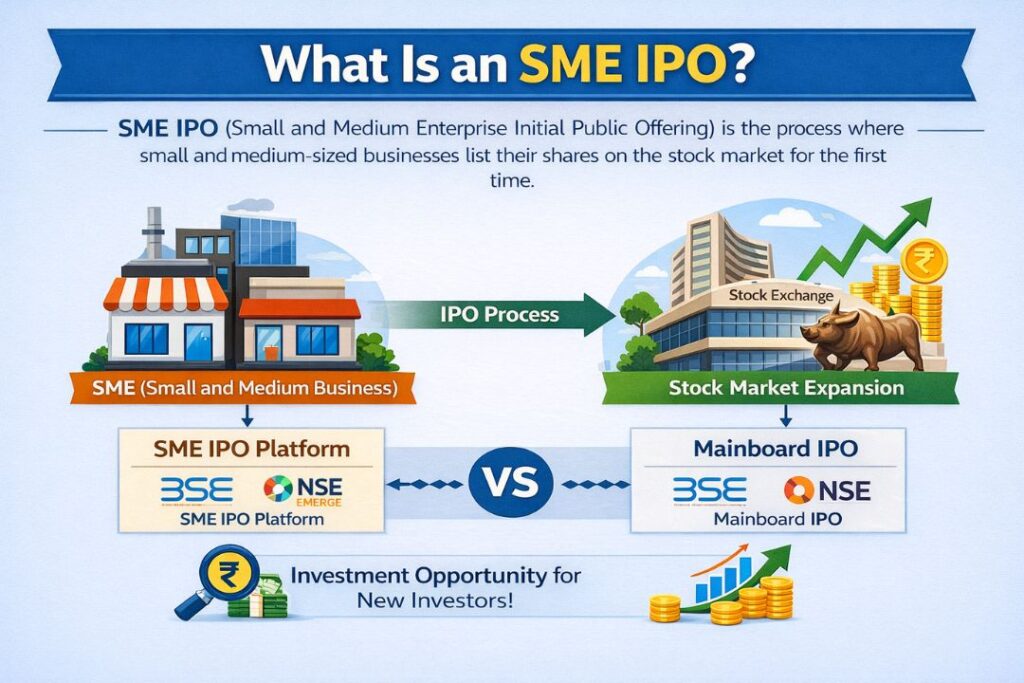
An SMEs IPO is an Initial Public Offering launched by a Small or Medium Enterprise to raise funds from the public and get listed on a specialized SME platform of a stock exchange.
In India, SMEs IPOs are listed on:
- BSE SME Platform
- NSE Emerge Platform
These platforms were created to help smaller companies access capital markets with simplified regulations and lower compliance costs compared to Mainboard IPOs.
What is an SME (Small and Medium Enterprise)?
An SME is a business that operates on a smaller scale than larger corporations but plays a vital role in economic growth, employment, and innovation.
In India, SMEs typically:
- Have lower revenue and profits compared to larger companies
- Are in early or growth stages
- Need capital for expansion, working capital, or debt reduction.
SME IPOs provide such companies visibility, credibility, and access to long-term capital.
Why was the SMEs IPO concept introduced?
- Before small and medium enterprise IPO platforms existed:
- Small companies depend heavily on bank loans or private investors
- Listing on the main stock exchange was costly and complex.
- Compliance requirements were difficult for small businesses
To solve this, Indian stock exchanges introduced devoted SME platforms to:
- Encourage entrepreneurship
- Improve transparency
- Providing growth capital to SMEs
- Allow investors to participate in high-growing early-stage companies
How Does an SME IPO Work?
The small and medium enterprise IPO process is similar to a Mainboard IPO but with simplified rules.
Step-by-Step SMEs IPO Process
Merchant Banker Appointment
The company appoints a merchant banker to manage the IPO.
Preparing Draft Prospectus
Details like business model, financials, risks, and goals are disclosed.
Exchange Approval
The draft is reviewed and approved by the SMEs exchange platform.
IPO Opens for Subscription
Investors applied during the IPO period.
Allotment of Shares
Shares are allotted on demand basis.
Listing on SME Platform
Shares begin trading on the SME exchange.
Eligibility Criteria for SMEs IPO
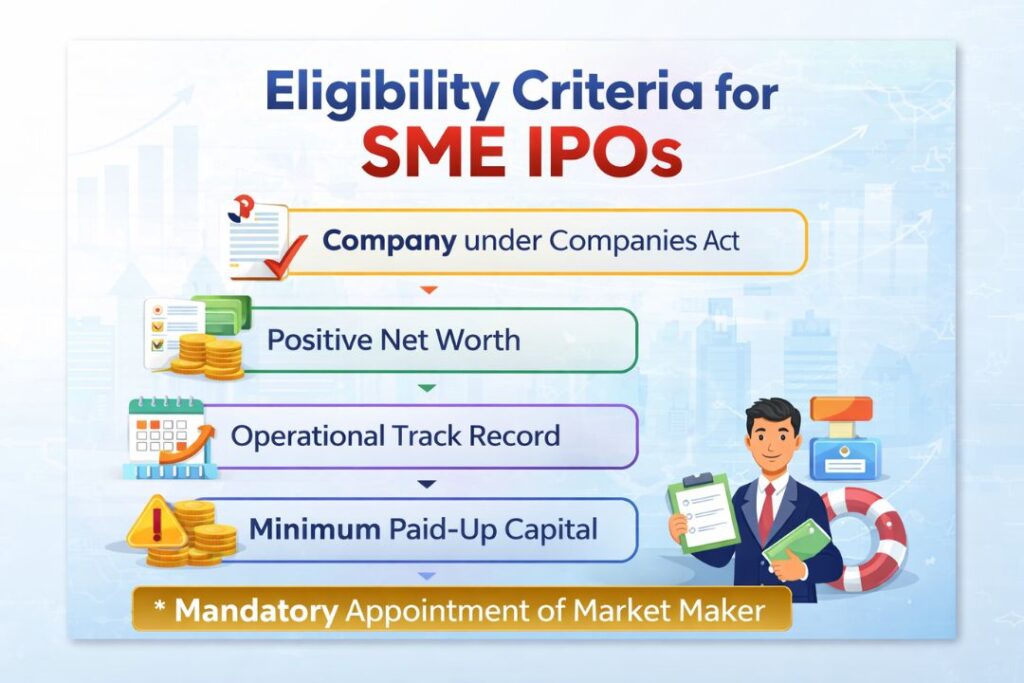
To list on an SEM platform, a company must meet specific criteria, such as:
- Companies must be incorporated under the Companies Act.
- Positive net worth
- Track record of operations
- Minimum paid up capital(lower than mainboard)
- Mandatory Market Maker Appointment
These relaxed criteria make small and medium enterprise IPOs more affordable for growing businesses.
SME IPO vs Mainboard IPO
| Feature | SME IPO | Mainboard IPO |
|---|---|---|
| Company size | Small & Medium | Large companies |
| Investment size | High minimum investment | Small retail investment |
| Trading | Lot-based trading | Single share trading |
| Liquidity | Low to moderate | High |
| Risk | High | Moderate |
| Growth potential | Very high | Moderate |
Minimum Investment in SMEs IPO
One important distinction is the minimum investment amount.
- small and medium enterprise IPOs require lot-based investments
- Minimum investment frequently ranges from ₹1 lakh to ₹15 lakh
- Not suitable for small investors.
This is done to ensure informed participation and minimize speculative trading.
Role of market makers in SME IPOs
Market makers are assigned to
- Provide liquidity
- Make sure buy and sell orders are available
- Reduce price volatility
They play a vital role because SME stocks usually have lower trading volume.
Why do companies choose SME IPOs?
SMEs prefer IPOs because:
- Access to long-term capital
- Lower cost than mainboard listing
- Enhanced brand credibility
- Better valuation
- Exit opportunity for initial investors
Advantages of SME IPO for Investors
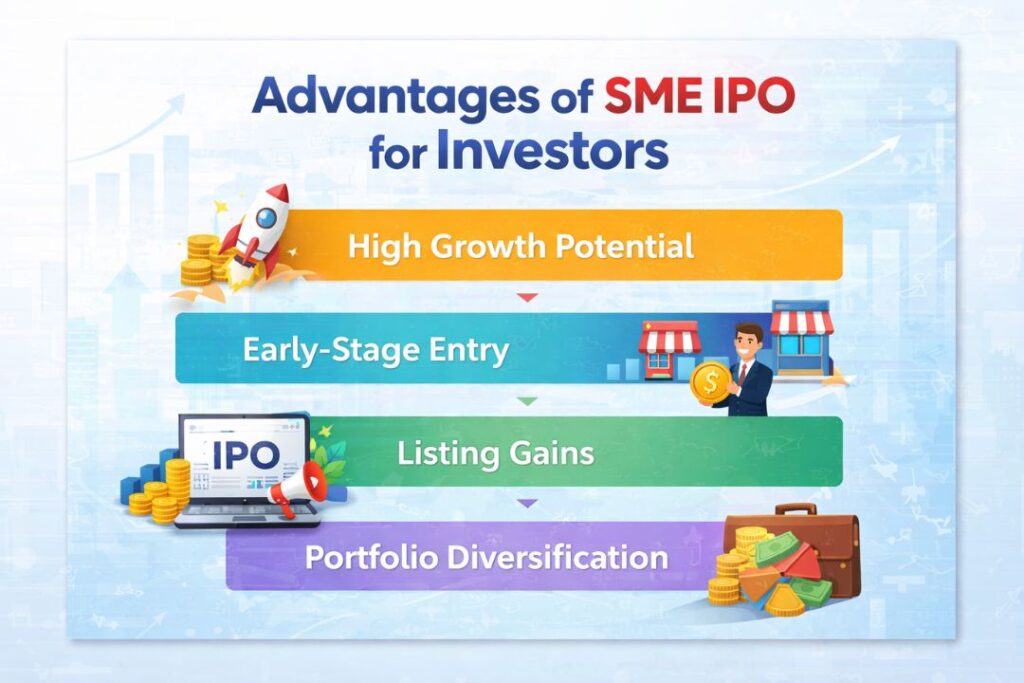
High Growth Potential
SMEs are frequently in early growth stages and can deliver multibagger returns.
Early-Stage Entry
Investors get a opportunity to invest before the company becomes large.
Listing Gains
Many small and medium enterprise IPOs list at a premium due to restricted supply.
Portfolio Diversification
Adds exposure to rising businesses.
Risks of Investing in SME IPO
small and medium enterprise IPOs are high-risk, high-rewards investments.
Major Risks Include:
Low Liquidity
Selling stocks can be difficult.
High Volatility
Prices may fluctuate sharply.
Limited Information
Less analyst coverage than large companies
Business Risk
SMEs may depend on limited customers or products.
Corporate Governance Risk
Smaller companies may have stronger governance structures.
Who should invest in SME IPOs?
small and medium enterprise IPOs are suitable for:
- Experienced investors
- High-risk appetite investors
- Long-term investors
- Investors with excess capital
They are not ideal for conservative or first time investors.
How to Apply for an SME IPO?
You can apply through:
- Online trading platforms
- Net Banking (ASBA)
- Broker IPO section
Requirements:
- Demat account
- Trading account
- Adequate funds for full lot value
SME IPO Allotment Process
- Allotment is usually proportional
- Oversubscription may reduce allotment chances.
- Refunds are processed for unallocated shares.
Trading After Listing
- SME stocks trade in lots, not single shares
- Liquidity is lower
- Market makers ensure minimum trading activity.
Can SME Shares Move to Mainboard?
Yes.
If an SME company:
- Grows significantly
- Meets mainboard criteria
- Follows the regulatory requirements
It can migrate from SME platform to Mainboard, frequently resulting in value unlocking.
taxation on SME IPO investments
Tax rules are similar to equities shares:
- Short-Term Capital Gains (STCG): Taxed if sold within 1 year.
- Long-Term Capital Gains(LTCG): Tax benefits after 1 year
- STT is applicable
Always consult a tax advisor for clarification.
Common Myths About SME IPOs
Myth 1: SME IPOs are scams
Reality: Many are genuine growth companies, but require research.
Myth 2: Guaranteed listing benefits
Reality : No IPO guarantees profit
Myth 3: Only promoters benefit
Reality: Informed investors can benefit too.
How to Analyze an SME IPO?
Before investing, check:
- Business Model
- Revenue and profit growth
- Debt levels
- Promoter background
- Use of IPO funds
- Industry outlook
SME IPOs in India : Growing Trend
The number of small and medium enterprise IPOs in India has increased quickly due to:
- Startup growth
- Investor awareness
- Supportive regulations
- Strong Domestic Capital Market
Benefits and Disadvantages Summary
Advantages
- High growth potential
- Early investment opportunity
- Lower valuation entry
Disadvantages
- High risk
- Low liquidity
- Large minimum investment
Frequently Asked Questions (FAQs)
Q1. Is SME IPO safe?
SME IPOs are riskier than mainstream IPOs but can be rewarding.
Q2. Can retail investors apply?
Yes, but minimum investment is high.
Q3. Are SME IPOs regulated?
Yes, they are regulated by stock exchange and SEBI.
Q4. Can SME stocks give multibapper returns?
Yes, but not all. Proper research is essential.
Final Thoughts: Should you invest in SME IPOs?
small and medium enterprise IPOs offer a unique opportunity to invest in emerging businesses, but they are not for everybody. If you have:
- Strong risk appetite
- Long-term vision
- Ability to research business
SMEs IPOs can become a powerful wealth-creation tool.
However, always remember:
Higher return potential comes with higher risk. Invest wisely.
Conclusion
SME IPOs have emerged as an important part of the Indian capital market, giving small and medium enterprises the opportunity to raise funds and grow their businesses, while also letting investors to participate in early-stage companies with high growth potential. These IPOs can deliver stronger returns, including listing gains and long-term wealth creation, but they also come with higher risks compared to mainboard IPOs.
Low liquidity, high volatility, and limited public information make small and medium enterprise IPOs suitable predominantly for investors with a high risk appetite and a long-term investment horizon. Before investing, it is necessary to carefully analyze the company’s business model, financial performance, promoter background, and future growth prospects.
In summary, small and medium enterprise IPOs are not “quick profit” opportunities but strategic investments. With proper research, patience, and disciplined risk management, small and medium enterprise IPOs can be a valuable addition to a diverse investment portfolio.
Disclaimer
The information provided in this article is for educational and informational purposes only and should not be considered as financial, investing, or legal advice. Stock market investments, including SME IPOs, are subject to market risks, and past performance is not indicative of future outcomes.
Readers are advised to conduct their own research and consult with a certified financial advisor before making any investment decisions. The author and the website shall not be responsible for any financial losses or investment decisions made based on the information provided in this article.
Stay connected for more such information https://stockhubnews.com
