
Introduction
In modern economies, the service sector plays a central role in everyday life as well as national development. From the moment we wake up and check our mobile phones to the time we travel, study, receive medical care, or use banking facilities, we rely heavily on services. These activities do not produce physical goods, yet they are necessary for economic growth and social well-being.
Traditionally, economies were dominated by farming and manufacturing. However, with technological advancement, urbanization, and increasing income levels, the service sector has become the largest and fastest-growing sector in many countries, including India.
This blog explains the service sector in detail its meaning, characteristics, types, examples, significance, advantages, disadvantages, and its role in economic development.
What is the Service Sector?
The service sector is the part of the economy that provides services rather than tangible goods. Services are activities or benefits offered by one party to another that are invisible, meaning they cannot be seen, touched, or stored like physical products.
In simple words:
The service sector includes all economical activities where value is created by providing services rather than manufacturing goods.
Definition of Service Sector
- The service sector consists of activities that support people, businesses, and industries by offering non-physical outputs.
- It is also known as the secondary sector of the economy.
Examples of Service Sector Activity
Some common examples include:
- Banking and Financial Services
- Education and training
- Health and medical services
- Transportation and logistics
- Tourism and hospitality
- Information Technology (IT) Services
- Communication and media
- Insurance services
- Legal consultancy services
Features of the Service Sector
The service sector has several unique characteristics that distinguish it from agriculture and industry.
Intangibility
Services must not be physically touched or stored. For example, education, medical advice, or banking services are experiences instead of products.
Inseparability
Services are manufactured and consumed at the same time. A haircut or medical consultation occurs while the service provider is present.
Variability
The quality of services may differ depending on the provider, location, and time.
Perishability
Service cannot be stored for future use An vacant hotel room or an unused airline seat is a lost opportunity.
Customer Interaction
Most services require direct interactions between the service provider and the consumer.
Types of Service Sector
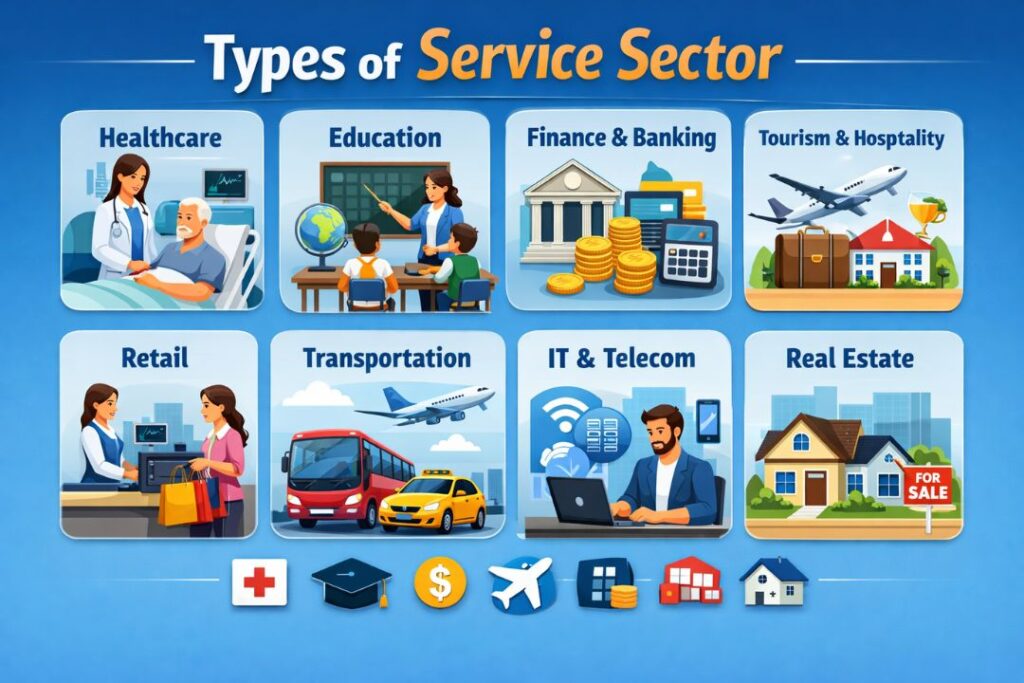
The service sector can be broadly categorized into several categories:
1.Financial Services
These services deal with money management and financial operations.
Examples:
- Banking
- Insurance
- Stock markets
- Mutual Funds
- Loans and credit services
Importance:
- Supports business growth
- Encourages savings and investments
- Facilitates smoother economic transactions
2.Education Services
Educational services focus on knowledge and skill development.
Examples:
- Schools and colleges
- Universities
- Coaching centers
- Online learning platforms
Importance:
- Builds skilled human capital
- Improves productivity
- Supports Innovation and Development
3.Healthcare Services
Healthcare services assure physical and mental well-being.
Examples:
- Hospitals
- Clinics
- Diagnostic centers
- Pharmacies
Importance:
- Improves quality of life
- Increases life expectancy
- Reduces disease burden
4.Transport and Logistics
These services help move people and products from one place to another.
Examples:
- Railways
- Airlines
- Road transport
- Shipping and courier services
Importance:
- Supports trade and commerce
- Connections rural and urban areas
- Boosts tourism and business
5.Information Technology(IT) and Communication Services
This sector offers digital and technological solutions.
Examples:
- Software development
- IT support services
- Internet and telecom services
- Data processing
Importance:
- Drives digital transformation
- Creates high-skill employment
- Increases global competitiveness.
6.Tourism & Hospitality Services
These services cater to travel, leisure, and lodging needs.
Examples:
- Hotels
- Restaurants
- Travel agencies
- Tourist guides
Importance:
- Generates foreign exchange
- Creates employment
- Promotes cultural exchange
7.Professional and business services
These services supported business operations.
Examples:
- Legal Services
- Accounting and auditing
- Management Consultancy
- Advertising and marketing
Importance:
- Improves business efficiency
- Supports entrepreneurship
- Enhances corporate governance
Role of the service sector in the economy
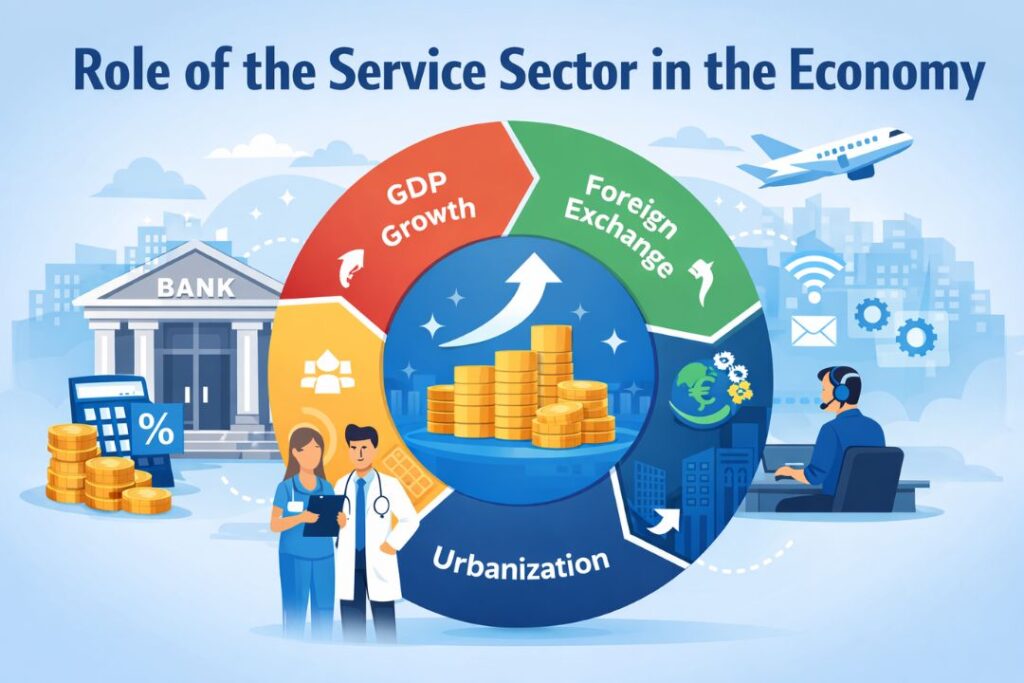
The service sector plays a vital role in economic development.
Contribution to GDP
In many countries, the services sector contributes the largest share to Gross Domestic Product (GDP).
Employment Generation
It provides jobs to millions of people across skills levels—from unskilled workers to highly trained professionals.
Support to Other Sectors
The service sector supports agriculture and industry by providing transportation, finance, communications, and marketing services.
Urbanization and infrastructure growth
Growth in services leads to development of cities, infrastructure, and modern amenities.
Foreign Exchange Earnings
It services, tourism, and financial services help earn foreign exchange through exports.
importance of service sector in india
India’s economy has seen rapid growth in the services sector over the last few decades.
Key points:
- The services sector contributes more than half of India’s GDP.
- IT and software services has made India a global outsourcing hub.
- Banking, telecom, education and healthcare services are expanding rapidly.
- This sector has created large-scale employment opportunities in urban areas.
Benefits of the Service Sector
Employment Opportunities
The service sector absorb a large workforce and offers diverse job roles.
Lower Environmental Impact
Services generally cause less pollution than manufacturing industries.
Faster Growth Potential
Service activities can grow rapidly with technology and innovation.
Skill Development
Promotes education, training, and professional skills.
Global Reach
Many services, such as IT and consultation, can be exported digitally.
Disadvantages of service sector
Job Insecurity
Some service jobs, particularly in informal sectors, lack stability and benefits.
Unequal Income Distribution
High-skill service jobs pay well, whereas low-skill service jobs offer low wages.
Dependence on Technology
Over-dependence on technology can lead to job losses due to automation.
Quality Variations
Service quality may vary widely between providers.
difference between goods and services
| Basis | Goods | Services |
|---|---|---|
| Nature | Tangible | Intangible |
| Storage | Can be stored | Cannot be stored |
| Production | Separate from consumption | Produced and consumed together |
| Example | Car, phone | Education, healthcare |
Future of the Service Sector
The future of the service sector looks strong owing to:
- Digitalization
- Artificial Intelligence and Automation
- Growth of online services
- Growing demand for healthcare and education
- Expansion of global services trade
Nations investing in skill development and digital infrastructure are likely to benefit the most.
Conclusion
The service sector is the spine of modern economies. It supports individuals, businesses, and governments by providing essential services that improve the quality of life and drive economic growth. While it faces challenges such as job insecurity and skill gaps, its advantages and growth potential far outweigh the shortcomings.
With increasing incomes, technological progress, and globalization, the service sector will continue to expand and shape the future of the economy.
Frequently Asked Questions (FAQs)
What is the service sector in simple words?
The service sector is the part of the economy that provides services rather than physical goods. It includes activities like education, healthcare, banking, transportation, tourism, and IT services that help people and businesses.
Why is the service sector important for economical growth?
The service sector is important because it creates employment, contributes significantly to GDP, supports agriculture and industry, improves living standards, and helps a nation grow faster through innovation and technology.
What are some common examples of service sector jobs?
Common service sector jobs include teachers, doctors, nurses, bank workers, software engineers, hotel staff, drivers, insurance agents, consultants, and customer service executives.
How is the service sector different from the industrial sector?
The service sector provides intangible services like education and healthcare, while the industrial sector produces tangible goods such as machines, clothing, and vehicles. Services cannot be stored but goods can be stored and sold later.
Is the service sector increasing in India?
Yes, the service sector is the fastest growing sector in India. It contributes the largest share to India’s GDP and plays a major role in employment generation, especially in IT, banking, telecom, healthcare, and education.
Disclaimer
This article was written for educational and informational purposes only. The information provided here is based on common knowledge and publicly available sources. This should not be considered professional, financial, legal, or business advice. Readers are advised to verify facts from official or expert sources before making any decisions based on this material.
