
Introduction
In today’s interconnected world, countries rely heavily on each other for trade, technology, raw materials, and finished goods. When this balance is disrupted due to political or economic conflicts, it can lead to a global trade war. Over the past few decades, trade wars have become one of the biggest threats to global economic stability.
From increasing tariffs and import bans to currency pressure and supply chain disruptions, trade wars affect not only governments and corporations but also ordinary consumers, investors, and workers. Prices rise, jobs become uncertain, markets become volatile, and economic growth slows down.
This blog explains what a global trade war is, why it happens, its causes, types, real-world examples, and its impact on the global economy, stock markets, and India all in simple, easy-to-understand language.
What Is a Global Trade War? (Simple Meaning)
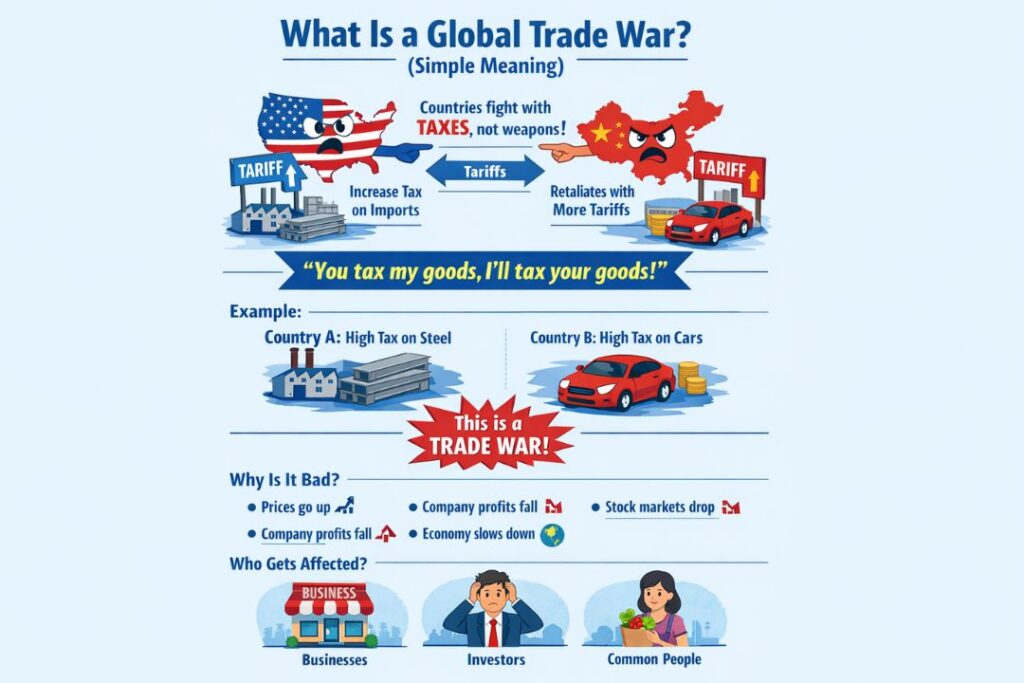
A global trade war is an economic conflict where nations impose trade barriers—such as higher import tariffs, quotas, sanctions, or export restrictions—against each other to protect their domestic industries or gain strategic advantage.
When one country takes such action, the affected country usually retaliates with similar measures, leading to a cycle of sanctions. This ongoing conflict between multiple nations disruptions international trade and global economic growth.
One-Line Definition:
A global trade war occurs when countries restrict trade with each other through tariffs and barriers, damaging global commerce and economic stability.
How a Trade War Starts
A trade war usually starts in stages:
- One country charges another with unfair trade practices
- Import taxes or restrictions have been imposed
- The other country reacts with retaliatory measures
- More countries get involved
- Global trade slows down
Once retaliation starts, resolving the conflict becomes difficult.
Main causes of global trade wars
Trade Deficit Concerns
Countries frequently start trade wars to reduce large trade deficits. When imports are much higher than imports, governments may impose tariffs to protect local industries.
protection of domestic industries
Governments impose barriers to shield local producers, farmers, and workers from cheaper foreign products.
Political and strategic rivalries
Trade wars are occasionally driven by geopolitical tensions, not just economics. Economic pressure is used as a political instrument.
intellectual property disputes
Disagreements over technology transfer, patents, and intellectual property theft frequently trigger trade conflicts.
Currency Manipulation Charges
Countries may accuse others of intentionally weakening their currency to make exports cheaper, leading to trade restrictions.
Types of trade barriers used in trade wars
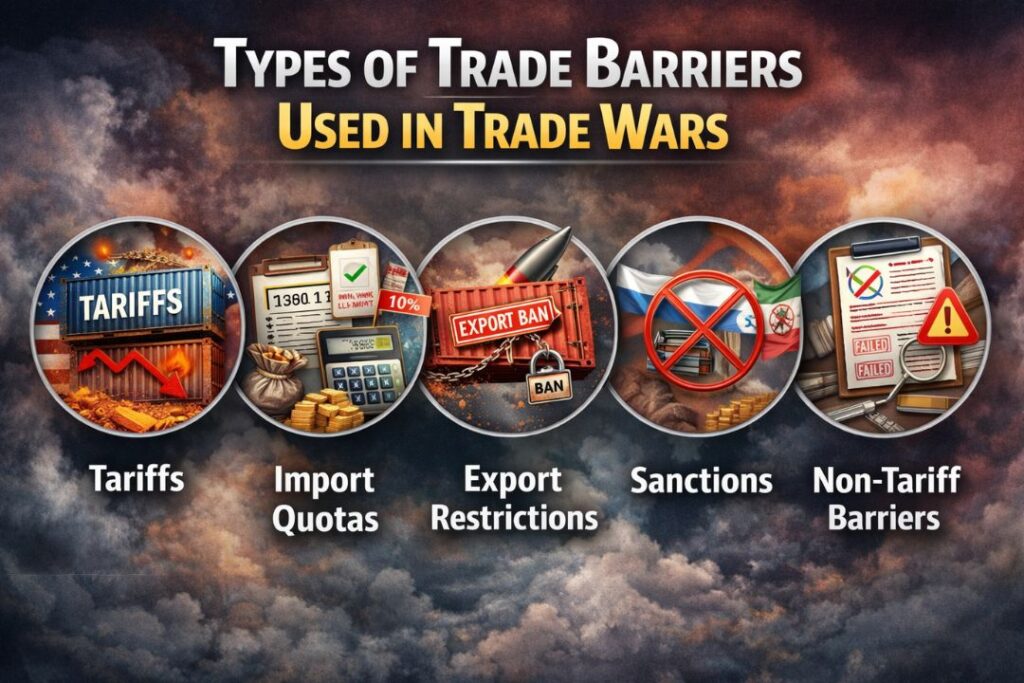
1.Tariffs
Taxes imposed on imported goods, making them more costly.
2.Import Quotas
Limits on the amount of goods that can be imported.
3.Export Restrictions
Restrictions on exporting certain goods, particularly strategic items.
4.Sanctions
Complete or partial bans on trade with specific nations.
5.Non-Tariff Barriers
Strict rules, quality standards, or licensing requirements.
Famous examples of global trade wars
US–China Trade War
One of the most significant trade disputes in modern history. Both countries imposed tariffs worth hundreds of billions of dollars on each other’s goods, affecting global supply chains.
Trade Conflicts Between Developed and Developing Countries
Disputes over farming subsidies, steel imports, and technology access have repeatedly triggered trade tensions.
Impact of a global trade war on the world economy
1.Slower global economic growth
Trade restrictions reduce international trade volumes, slowing GDP growth across nations.
2.Higher prices for consumers
Tariffs increase the cost of imported goods, resulting in higher inflation.
3.Disrupted Supply Chains
Modern manufacturing relies on global supply chains. Trade wars breaks these networks, increasing costs and delays.
4.Decreased Business Investment
Uncertainty discourages companies from expansion or investing in new projects.
5.Job Losses
Export-oriented industries suffer, leading to layingoffs and unemployment.
Impact of trade wars on global stock markets
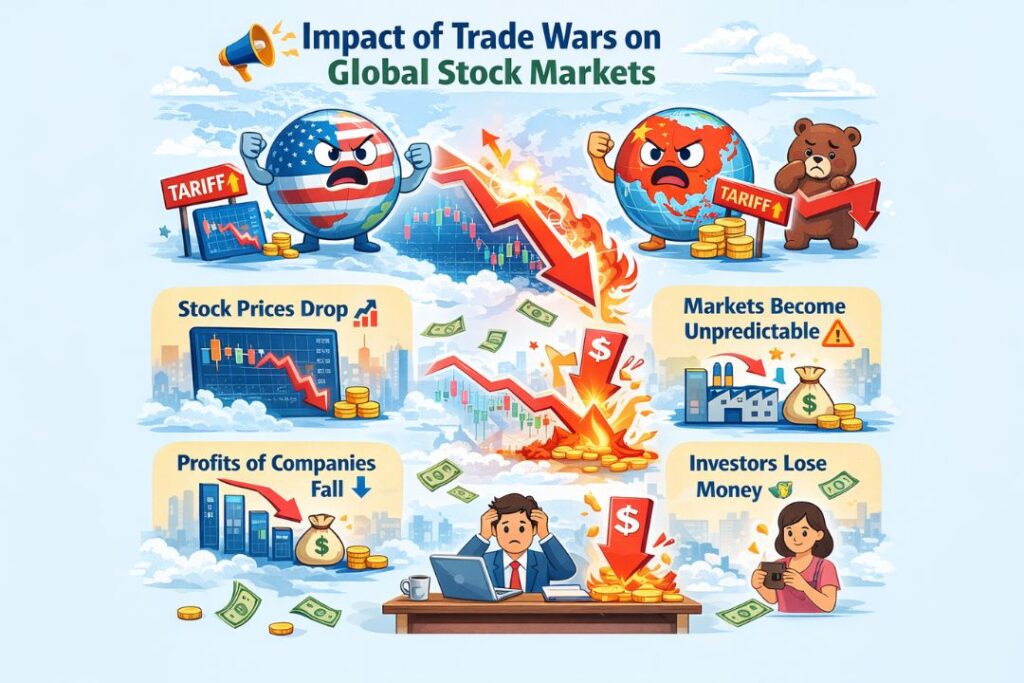
- Increased volatility
- Sharp market corrections
- Sector-specific losses
- Investor confidence weakens
- Markets react adversely to uncertainty, and trade wars create prolonged uncertainty.
Sector-wise impact of global trade wars
Manufacturing
Higher raw material costs and export limitations reduce profit margins.
Technology
Restrictions on components and technology transfer interrupt innovation.
Agriculture
Farmers suffer because of reduced exports and falling prices.
Commodities
Prices vary due to demand uncertainty and supply disruptions.
Effect of Global Trade War on India
Exports and Imports
Indian exporters may face decreased demand, while import costs may rise.
Stock Market Volatility
Global trade tensions increase instability in Indian equity markets.
Currency Fluctuations
Capital flows become unstable, influencing the rupee.
Sector-Specific Effects
- IT and pharma can benefit from diversification
- Metals and manufacturing can face pressure.
Could Trade Wars Ever Be Beneficial?
In the short term:
- Domestic industries may receive protection
- Local employment may increase
In the long term:
- Efficiency declines
- Innovation slows
- Consumers suffer
Overall, trade wars are more harmful than advantageous in the long run.
How countries try to resolve trade wars
- Diplomatic negotiations
- Trade agreements
- Arbitration via global trade bodies
- Bilateral talks
Resolution often takes years.
How Investors Should Respond During Trade Wars
For Traders
- Expected volatility
- Focus on risk management
For Long-Term Investors
- Avoid panic selling
- Stick to quality assets
For Diversification
- Spread investment across sectors and geographies
Global trade wars and the future economy
As globalization slows and nations focus more on self-reliance, trade tensions may continue. However, complete insulation is not practical in today’s interconnected world. Cooperation remains essential for sustainable development.
Key Takeaways
- Trade wars disruption global trade and growth
- Consumers, businesses and investors all suffer.
- Short-term protection leads to long-term inefficiencies
- Stability comes from collaboration, not conflict.
Conclusion
A global trade war is one of the biggest threats to economic sustainability in the modern world. While countries may initiate trade conflicts to protect domestic interests, the long-term consequences often include slower growth, higher prices, market volatility, and weakened global collaboration.
Understanding trade wars helps investors, policymakers, and citizens make better decisions during unsure times. In a globally connected economy, cooperation remains the strongest path to sustainable progress.
FAQs
Q1. What is a global trade war?
A global trade war happens when nations restrict trade with each other by imposing tariffs and bans.
Q2. Do trade wars impact common people?
Yes, they increase prices, decrease job opportunities, and slow economic growth.
Q3. Could a trade war cause a recession?
Yes, prolonged trade wars can contribute to economic recessions or recessions.
Q4. How does a trade war impact stock markets?
It increases volatility and decreases investor confidence, leading to market corrections.
Q5. Is India safe from global trade war?
India is less exposed than export-heavy economies, but global trade wars still influence growth and markets.
Disclaimer : This article is for informational and educational purposes only and does not constitute financial, economical, or investment advice. Readers should conduct their own research or consult professionals before making decisions based on this material.
Stay connected for more such information https://stockhubnews.com
