
In today’s fast-moving financial markets, options trading has become one of the most popular ways to generate profit, hedge risk, and diversify investment strategies. Among all derivatives, Call and Put options are the most widely used tools by both beginners and professional traders.
But many people still feel confused when they hear terms like:
- “Buy a call option.”
- “Make a profit with Put options.”
- “Is the market bullish or bearish??”
If you are one of them, don’t worry.
This complete guide will explain everything in simple, human-friendly language, with real-life examples, so you can clearly understand how call and put options actually work.
What Are Options?
Options are financial contracts that give you the right (but not obligation) to buy or sell an asset at a fixed price within a certain time.
That means:
- You can choose to use the option
- You are not forced to use it
The asset can be:
- Stocks (Reliance, TCS, etc.)
- Index (Nifty, Bank Nifty)
- Commodities
What is a Call Option?
A Call Option gives you the right to buy an asset at a fixed price (called Strike Price) before expiry.
Simple Meaning:
You buy a Call option when you expect the market to go UP (Bullish)
Real-Life Example (Easy to Understand)
Suppose:
- Nifty is at 22,000
- You think it will go up to 22,300
So you buy:
- Call Option (22,000 CE) at ₹100
Now two situations:
Case 1: Market goes UP
- Nifty reaches 22,300
- Your option value becomes ₹250
Profit = ₹150 per lot
Case 2: Market goes DOWN
- Nifty stays below 22,000
- Your option becomes worthless
Loss = ₹100 (premium you paid)
Key Point:
In Call option, loss is limited, profit is unlimited
What is a Put Option?
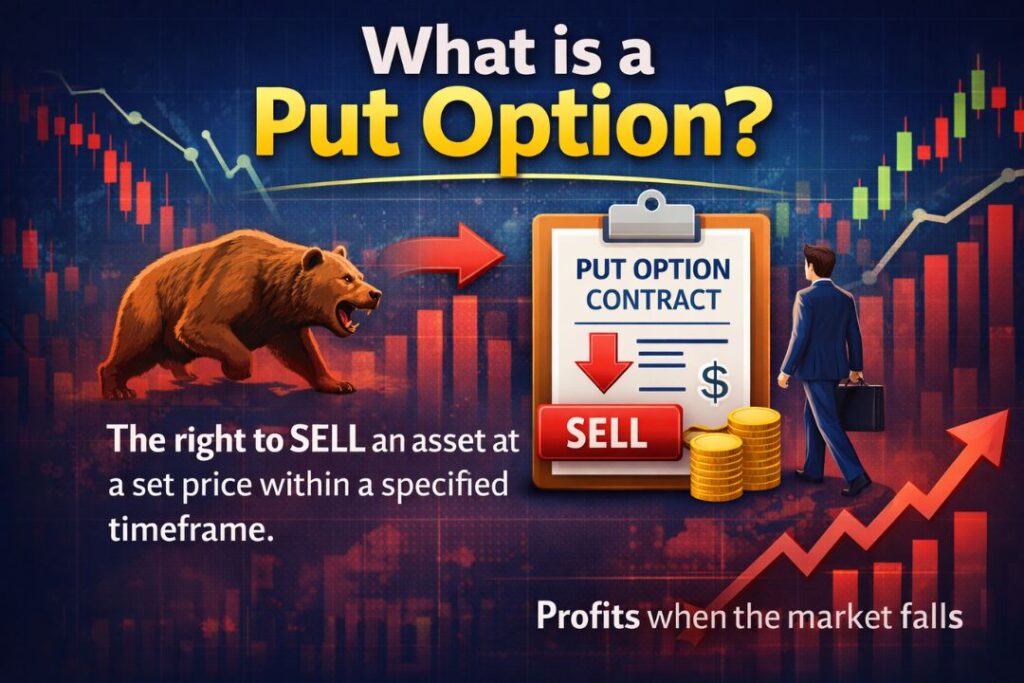
A Put Option gives you the right to sell an asset at a fixed price.
Simple Meaning:
You buy a Put option when you expect the market to go DOWN (Bearish)
Real-Life Example
Suppose:
- Nifty is at 22,000
- You think it will fall to 21,700
You buy:
- Put Option (22,000 PE) at ₹120
Case 1: Market falls
- Nifty goes to 21,700
- Option value becomes ₹300
Profit = ₹180
Case 2: Market rises
- Nifty goes to 22,200
- Option becomes zero
Loss = ₹120
Key Point:
In Put option also, loss is limited, profit can be big
Types of Options
There are mainly two types:
1. Call Option (CE)
- Buy when market is bullish
- Profit when price increases
2. Put Option (PE)
- Buy when market is bearish
- Profit when price decreases
Important Terms You Must Know
1. Strike Price
The fixed price at which you can buy/sell
Example:
- 22,000 CE → strike price is 22,000
2. Premium
The amount you pay to buy option
Example:
- Option price ₹100 = premium
3. Expiry
Last date of option
- Weekly expiry (Thursday)
- Monthly expiry
4. Lot Size
Options are bought in lots
Example:
- Nifty lot = 50
Difference Between Call and Put Option
| Feature | Call Option | Put Option |
|---|---|---|
| Direction | Bullish | Bearish |
| Profit when | Price goes up | Price goes down |
| Right | Buy | Sell |
| Risk | Limited | Limited |
| Usage | Uptrend | Downtrend |
Real-Life Practical Scenario
Let’s say you are trading in the Indian market.
Situation:
- Nifty at 22,100
- News is positive (budget, earnings, global market strong)
- Best move: Buy CALL
Situation 2:
- Nifty at 22,100
- Negative news (war, inflation, crash fear)
- Best move: Buy PUT
Intraday vs Positional Trading
Intraday:
- Buy and sell same day
- Fast profit/loss
Positional:
- Hold for few days
- Less stress but more risk
Advantages of Options Trading
1. Low Investment
You can trade with small capital
2. High Return Potential
Small move → big profit
3. Limited Risk
You only lose premium
4. Hedging Tool
Used to protect investment
Disadvantages of Options Trading
1. High Risk for Beginners
Wrong direction = full loss
2. Time Decay
Option value decreases with time
3. Volatility Impact
Price depends on multiple factors
Common Mistakes Beginners Make
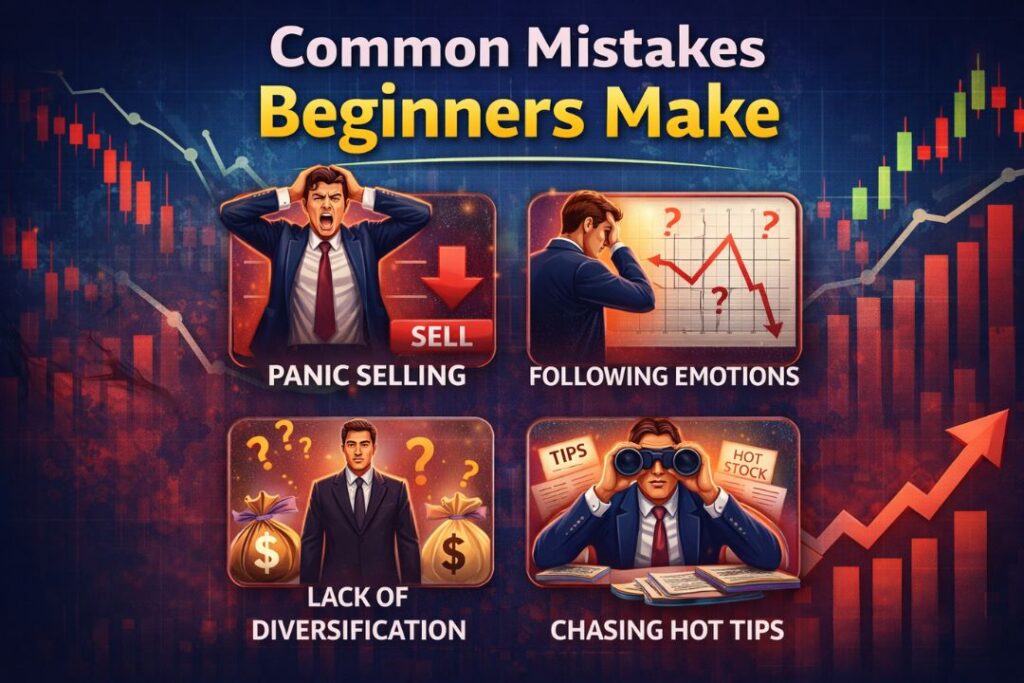
1. Blind Following Tips
Don’t depend fully on apps or Telegram
2. No Stop Loss
Always keep stop loss
3. Overtrading
Too many trades = more loss
4. Full Capital in One Trade
Never do this
Best Strategy for Beginners
Step 1: Learn Basics
Support & resistance
Step 2: Start Small
Use small capital
Step 3: Follow Trend
Trend is your friend
Step 4: Use Stop Loss
Protect your capital
Simple Trading Rule
- Market up → Call
- Market down → Put
- Confused → No trade
Advanced Understanding (Optional)
In The Money (ITM)
Already profitable option
At The Money (ATM)
Near current price
Out of The Money (OTM)
Far from current price
Real Trader Example
i am is a beginner trader.
- Capital: ₹5,000
- He buys 1 lot Nifty Call at ₹100
Trade 1:
Market goes up → profit ₹2,000
Trade 2:
Market falls → loss ₹5,000
Lesson:
Without risk management, profit doesn’t matter
Psychology in Options Trading
Trading is not just strategy, it’s mindset.
Important Points:
- Control emotions
- Avoid greed
- Accept small losses
- Stay disciplined
When NOT to Trade
- Market sideways
- No clear trend
- Major news confusion
- Low confidence
Tips for Consistent Profit
- Follow trend only
- Avoid overconfidence
- Book profit early
- Don’t hold losing trades
Practical Deep Dive: Real Market Thinking, Mistakes & Smart Approach
Many beginners believe that if they correctly predict the market direction, they will definitely make a profit. But in options trading, that is not always true. You might choose the right direction (Call or Put) and still lose money. Why does this happen?
The answer is simple: options pricing does not depend only on direction. It also depends on time, volatility, and demand-supply.
Let’s understand this with a real scenario.
Suppose Nifty is at 22,000 and you buy a 22,000 Call option at ₹120. The market moves slightly upward, but not strongly. Meanwhile, expiry is near. In this case, even if the market goes up a little, your option premium may fall instead of rising. This is called time decay.
Key Lesson:
Even if your direction is correct, timing is equally important.
Real Trader Mistake Story (Ground Reality)
Let’s take an example of a beginner trader named Manoj.
He saw a trading signal on Telegram:
- Entry: ₹150
- Target: ₹300
- No stop loss
He bought a Nifty Call option at ₹150. Initially, the market moved slightly upward, but then suddenly reversed and started falling.
Instead of exiting, Manoj thought:
“Let me wait, it will go back up.”
But the market kept falling.
Final result:
- Option dropped from ₹150 to ₹20
- Almost full capital loss
What went wrong?
- Blindly following tips
- No stop loss
- Trading based on hope
In the market, hope does not make money — discipline does.
What Does a Smart Trader Do?
A smart trader approaches the same situation differently:
- Has a clear entry plan
- Defines stop loss before entering
- Calculates risk in advance
For example:
- Entry: ₹150
- Stop loss: ₹110
If the trade goes wrong:
Small, controlled loss
If the trade goes right:
Profit is booked without greed
Real Example with a Simple Strategy
Let’s take a practical scenario:
- Nifty: 22,100
- Strong support: 22,000
- Resistance: 22,300
Situation:
The market comes near support and shows signs of a bounce (green candle, strong volume).
Trade Plan:
- Buy 22,100 Call at ₹100
- Stop loss: ₹70
- Target: ₹160–₹200
Why this works:
- Risk is limited (₹30)
- Reward is higher (₹60–₹100)
This is called a risk-reward ratio, and successful traders always focus on this.
Emotional Control – The Biggest Secret
In trading, your biggest enemy is not the market — it is your emotions.
Common emotional mistakes:
- “I must recover today’s loss”
- “Let me double my money in this trade”
- “I’ll wait more for bigger profit”
These thoughts usually lead to bigger losses.
Golden Rule:
Protect your capital first, profits will follow.
The Reality of Options Trading
On social media, you often see:
- “₹1,000 turned into ₹10,000”
- “One trade jackpot”
But the real truth is:
- 7 out of 10 traders lose money
- Only disciplined traders succeed long-term
Options trading may look easy, but it is actually a high-skill game.
Advice for Small Capital Traders
If your capital is small (₹2,000–₹5,000):
- Take only one trade at a time
- Avoid far out-of-the-money options (very risky)
- Prefer ATM or near-ATM options
- Keep small targets (even ₹50–₹100 profit is good)
Golden Rules to Remember
- Always trade with the trend
- Use stop loss in every trade
- Avoid overtrading
- Be careful during news events
- Book profits on time (avoid greed)
Conclusion
Call and Put options are powerful tools that can help you make money in both rising and falling markets.
But remember:
Options trading is not gambling
It requires knowledge, discipline, and patience
If you understand the basics and trade wisely, you can grow your capital steadily.
FAQs
1. Call or Put – which is better?
Depends on market direction. No one is always better.
2. Can beginners trade options?
Yes, but start with small capital and proper learning.
3. Is options trading risky?
Yes, but risk can be controlled with strategy.
4. How much money is required?
You can start with ₹1,000–₹5,000, but risk management is key.
Disclaimer
The information provided in this blog is for educational and informational purposes only and should not be considered as financial, investment, or trading advice. Options trading involves a high level of risk and may not be suitable for all investors.
Before making any trading decisions, you should:
- Do your own research (DYOR)
- Consult with a qualified financial advisor if needed
- Fully understand the risks involved
The examples shared in this article are for learning purposes only and do not guarantee any future results or profits. Market conditions can change rapidly, and past performance is not an indicator of future performance.
The author and publisher are not responsible for any financial losses or damages that may occur as a result of using the information provided in this content.
By reading this blog, you agree that you are solely responsible for your own trading and investment decisions.
Trade wisely, manage your risk, and never invest money you cannot afford to lose.
