
If you’re just starting your investment journey, you’ve probably heard the term index fund many times. It’s one of the most recommended investment options by financial experts worldwide—and for good reason.
But what exactly is an index fund? How does it work? And is it the right choice for you?
Let’s break it down in a simple and practical way.
🔑 Key Points of Index Funds
- Index fund is a passive investment option that tracks a market index like Nifty 50 or Sensex.
- No stock picking required — it automatically invests in top companies included in the index.
- Low cost investment because there is no active fund management involved.
- Returns are market-linked, meaning your profit or loss depends on overall market performance.
- Highly diversified, as your money is spread across multiple companies, reducing risk.
- Best suited for beginners who want simple and stress-free investing.
- Ideal for long-term wealth creation, especially when combined with SIP.
- Compounding plays a major role, helping your money grow faster over time.
- Market ups and downs are normal, so patience is very important.
- You cannot beat the market, but you can match its performance consistently.
- Lower risk compared to direct stocks, but still affected by market crashes.
- SIP (Systematic Investment Plan) is the safest way to invest regularly.
- Expense ratio and tracking error are important while choosing a fund.
- Best strategy is to stay invested for 5–10+ years without panic selling.
What is an Index Fund?
An index fund is a type of mutual fund or exchange-traded fund (ETF) that aims to copy the performance of a specific market index.
A market index is a collection of stocks that represents a particular segment of the stock market.
For example:
- In India: Nifty 50, Sensex
- In the US: S&P 500
Instead of trying to beat the market, Passive fund aim to mirror the market’s performance.
In simple terms:
You are not betting on one company—you are investing in the entire market.
How Does an Index Fund Work?
Index funds follow a passive strategy, meaning there is no active stock picking.
Here’s how it works:
1. Selecting an Index
The fund tracks a specific index like Nifty 50.
2. Replicating the Portfolio
The fund buys the same stocks in the same proportion as the index.
3. Automatic Adjustment
Whenever the index changes, the fund updates its holdings accordingly.
4. Performance Matching
Your returns move in line with the index performance.
Real-Life Example
Let’s say you invest ₹10,000 in a Nifty 50 index fund.
- If the market grows by 12% → Your investment becomes ₹11,200
- If the market drops by 8% → Your investment becomes ₹9,200
There’s no guessing involved—it simply follows the market.
Why Passive funds Are So Popular Today
Over the last decade, Passive funds have gained massive popularity, especially among new investors.
Here’s why:
Less Stress
You don’t need to track daily stock movements.
No Need for Expertise
Even beginners can invest confidently.
Transparency
You always know where your money is invested.
Proven Strategy
Many studies show that most active funds fail to beat the market over the long term.
Types of Index Funds
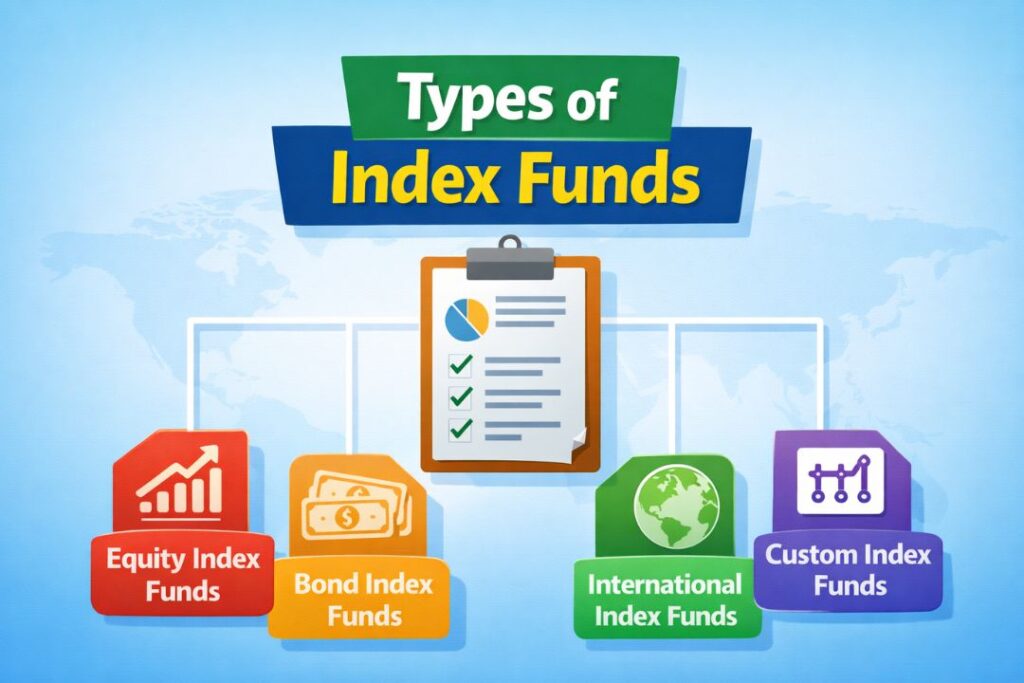
1. Broad Market Passive funds
These track major indices like Nifty 50 or Sensex.
2. Midcap and Smallcap Passive funds
Focus on mid-sized or smaller companies with higher growth potential.
3. Sector-Based Passive funds
Examples include banking, IT, or pharma funds.
4. International Passive funds
Invest in global markets like the S&P 500.
5. ETFs (Exchange Traded Funds)
These are traded on stock exchanges like shares.
Key Features of Index Funds
Low Expense Ratio
Because there’s no active management, fees are very low.
Passive Management
No frequent buying and selling.
Market-Linked Returns
Returns depend entirely on market performance.
Diversification
Your money is spread across multiple companies.
Advantages of Passive funds
Cost Efficiency
Lower fees mean more money stays invested.
Long-Term Wealth Creation
Markets tend to grow over time.
Reduced Risk (Compared to Stocks)
Diversification reduces the impact of a single company’s loss.
Easy to Start
No complex research required.
Disadvantages of Passive funds
No Extra Returns
You won’t outperform the market.
Market Volatility
Short-term ups and downs can affect your investment.
Lack of Control
No fund manager to actively respond to market changes.
Index Funds vs ETFs (Important Difference)
Many people confuse index funds and ETFs.
| Feature | Index Fund | ETF |
|---|---|---|
| Buying Method | Through AMC | Through stock exchange |
| Price | End-of-day NAV | Real-time price |
| Minimum Investment | SIP possible | Need Demat account |
- Both track indices, but ETFs trade like stocks.
Index Fund vs Direct Stock Investing
| Feature | Index Fund | Stocks |
|---|---|---|
| Risk | Lower | Higher |
| Effort | Very low | High |
| Knowledge Required | Basic | Advanced |
| Diversification | Yes | No |
Who Should Invest in Passive funds?
Index funds are perfect for:
- Beginners who are new to investing
- Salaried individuals doing SIP
- Long-term investors (5–15 years)
- People who don’t want daily market stress
Common Mistakes to Avoid
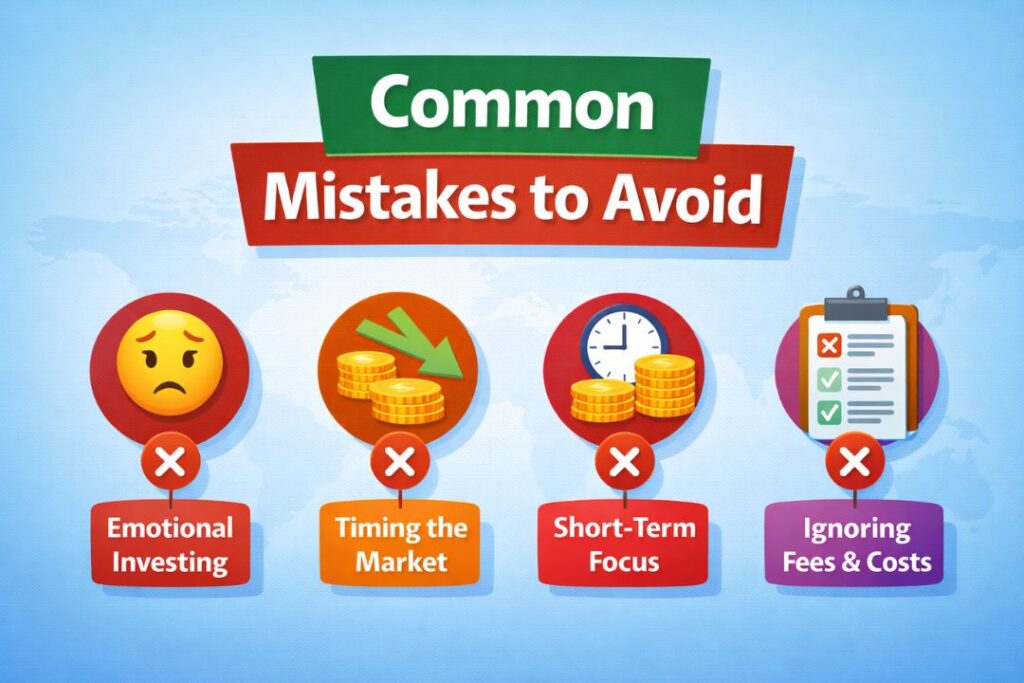
1. Investing for Short Term
Index funds work best over the long term.
2. Panic Selling
Market falls are normal—don’t exit early.
3. Choosing Too Many Funds
Stick to 1–2 good index funds.
4. Ignoring Expense Ratio
Even small fees matter in long-term investing.
How to Invest in Passive funds (Step-by-Step)
- Choose a platform (Zerodha, Groww, etc.)
- Complete your KYC
- Select a good index fund (like Nifty 50 fund)
- Decide SIP or lump sum
- Start investing
SIP vs Lump Sum in Passive funds
SIP (Systematic Investment Plan)
- Invest fixed amount monthly
- Best for beginners
- Reduces risk
Lump Sum
- Invest one-time large amount
- Works well in market dips
For most people, SIP is the safer option.
How Much Return Can You Expect?
Historically, index funds in India have given:
- Around 10%–14% annual returns over long term
But remember:
- Short-term returns can vary
- Long-term patience is key
Taxation on Passive funds (India)
Short-Term Capital Gains (STCG)
- If sold before 1 year → 15% tax
Long-Term Capital Gains (LTCG)
- After 1 year → 10% tax (above ₹1 lakh profit)
Best Strategy for Passive fund Investing
- Start early
- Invest regularly
- Stay invested during market crashes
- Avoid timing the market
Time in the market is more important than timing the market.
How Passive funds Help in Building Long-Term Wealth
One of the biggest advantages of index funds is their ability to create wealth over time without requiring constant effort. Many investors try to “time the market,” buying when prices are low and selling when prices are high. In reality, this is extremely difficult—even for professionals.
Passive funds remove this problem completely.
Instead of trying to predict market movements, you stay invested consistently. Over time, markets tend to grow because businesses grow, economies expand, and innovation continues. By simply staying invested in an Passive fund, you automatically become part of that growth.
Let’s understand this with a simple mindset:
- You don’t need to chase profits
- You don’t need to predict crashes
- You just need to stay invested
This approach may sound simple, but it is incredibly powerful when combined with time.
Power of Compounding in Passive funds
Compounding is the real secret behind long-term investing success.
When you invest in an Passive fund, your returns start generating their own returns. Over time, this creates a snowball effect.
For example:
- Year 1: ₹10,000 becomes ₹11,000
- Year 2: ₹11,000 grows further
- Year 5+: Growth becomes faster
The longer you stay invested, the stronger compounding becomes.
This is why many experts say:
“Start early, even with a small amount.”
Even a small monthly SIP can grow into a large amount if given enough time.
Are Passive funds Safe During Market Crashes?
This is one of the most common concerns among beginners.
The truth is—index funds are not completely risk-free. When the market falls, your investment value will also go down. But here’s the important part:
Market crashes are temporary, but growth is long-term.
Historically, markets have always recovered after downturns. Whether it’s economic slowdowns, global crises, or sudden drops—markets eventually bounce back.
If you panic and sell during a crash, you lock in your losses.
But if you stay invested, you give your money a chance to recover and grow.
Smart investors see market dips as opportunities, not threats.
How to Choose the Right Passive fund
Even though Passive funds are simple, choosing the right one still matters.
Here are a few practical tips:
Check Expense Ratio
Lower is always better. Even a 0.5% difference matters in the long run.
Look at Tracking Error
This shows how closely the fund follows the index. Lower tracking error is good.
Fund Size (AUM)
A larger fund is usually more stable and reliable.
Choose Trusted Fund Houses
Go with well-known and reliable companies.
Final Tip: Keep It Simple
Many beginners make investing complicated by trying too many strategies at once. But when it comes to Passive funds, simplicity is your biggest advantage.
You don’t need:
- Multiple funds
- Constant buying and selling
- Daily market tracking
Instead, focus on:
- Consistency
- Patience
- Long-term thinking
Wealth is not built overnight—it is built over time.
Final Thoughts
Passive funds are one of the easiest and smartest ways to build wealth over time. You don’t need to be an expert, track stocks daily, or take unnecessary risks.
Instead, you simply invest in the growth of the overall economy.
If you stay consistent and patient, Passive funds can help you achieve your financial goals with less stress and more stability.
FAQs
1. Is index fund good for beginners?
Yes, it is one of the best options for beginners.
2. Can I become rich using Passive funds?
Yes, with long-term investing and discipline.
3. Which index fund is best in India?
Nifty 50 and Sensex Passive funds are popular choices.
4. What is the minimum investment?
You can start with ₹100–₹500 via SIP.
5. Is SIP necessary?
Not necessary, but highly recommended.
Disclaimer : This content is for informational purposes only and not financial advice. Investments are subject to market risks. Please consult a financial advisor before investing.
