

Choosing the right investment strategy is one of the most important decisions for any investor. Two of the most popular approaches in the stock market are value investing and growth investing. While both strategies aim to generate returns, they follow very different philosophies and methods.
When it comes to investing in the stock market, one of the most common questions investors face is whether to choose value vs growth stocks. Both strategies have their own advantages, risks, and long-term potential. Some investors prefer growth stocks because they offer the possibility of higher returns as companies expand rapidly. Others focus on value stocks, which are often considered undervalued and may provide steady returns over time.
Understanding the difference between these two investment approaches is important before building a portfolio. Your choice often depends on factors such as your risk tolerance, financial goals, and investment time horizon. In this article, we’ll explore what value vs growth stocks are, how they differ, and which strategy might be the better fit for your investment goals.
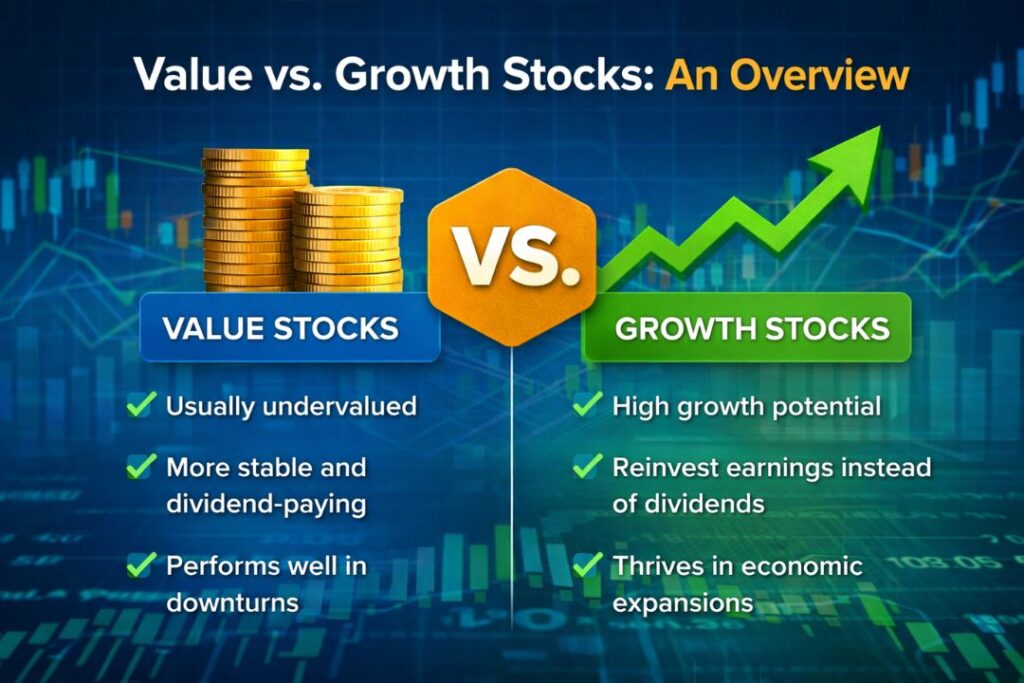
Value vs Growth Stocks: An Overview
Growth stocks are those of companies that are considered to have the potential to surpass the overall market over time because of their future potential. Value stocks are categorized as companies that are currently trading below what they are really worth and will thus provide a superior return. They have some key differences such as risk levels, instability, and dividend payments. So, which category is better?
The comparative historical performance of these two sub-sectors produces some surprising results. Important factors include an investors’ time horizon and risk tolerance.
Key Points
- Growth stocks have the potential to outperform the market due to expected future growth and are often found in sectors like tech.
- Value stocks are typically undervalued due to factors like market perception and are usually more stable, offering dividends.
- Historically, value stocks have outperformed growth stocks over the long term, though recent decades have seen growth stocks excel.
- An investor’s decision between growth and value stocks should consider their risk tolerance, investment goals, and time horizon.
- Market conditions influence performance, with value stocks often excelling during economic downturns and growth stocks thriving in expansions.
Understanding Value Stocks
Value stocks are usually larger, more well-established companies that trade below the price that analysts feel the stock is worth, depending on the financial ratio or benchmark used as a comparison. For example, the book value of a company’s stock may be $25 a share based on the number of shares outstanding divided by the company’s capitalization. Hence, if it trades for $20 a share at the moment, then many analysts would consider this to be a good value play.
Stocks can become undervalued for several reasons. In some cases, public perception will push the price down, such as if a prominent figure in the company is caught in a personal scandal or the company does something unethical. But if the company’s financials are still relatively solid, then value-seekers may view this as an ideal entry point, because they figure that the public will soon forget about whatever happened and the price will rise to where it should be.
Value stocks usually trade at a discount compared to P/E, book value, or cash flow proportions. Occasionally, stocks fall into both value and growth categories. These stocks are viewed as undervalued yet also hold potential for growth. Morningstar classifieds all of the equities and equity funds that it ranks into either a growth, value, or blended category.
Exploring Growth Stocks
Analysts consider growth stocks to have the potential to surpass either the overall markets or a specific subsegment of them for a period of time. These stocks can be found in small-, mid-, and large-cap sectors and can only retain this status until analysts feel that they have attained their potential.
Growth companies are expected to expand due to promising products or superior management compared to rivals.
Make sure you choose the right investment strategy and stocks that align with your objectives and investment goals.
Key differences between value vs growth stocks
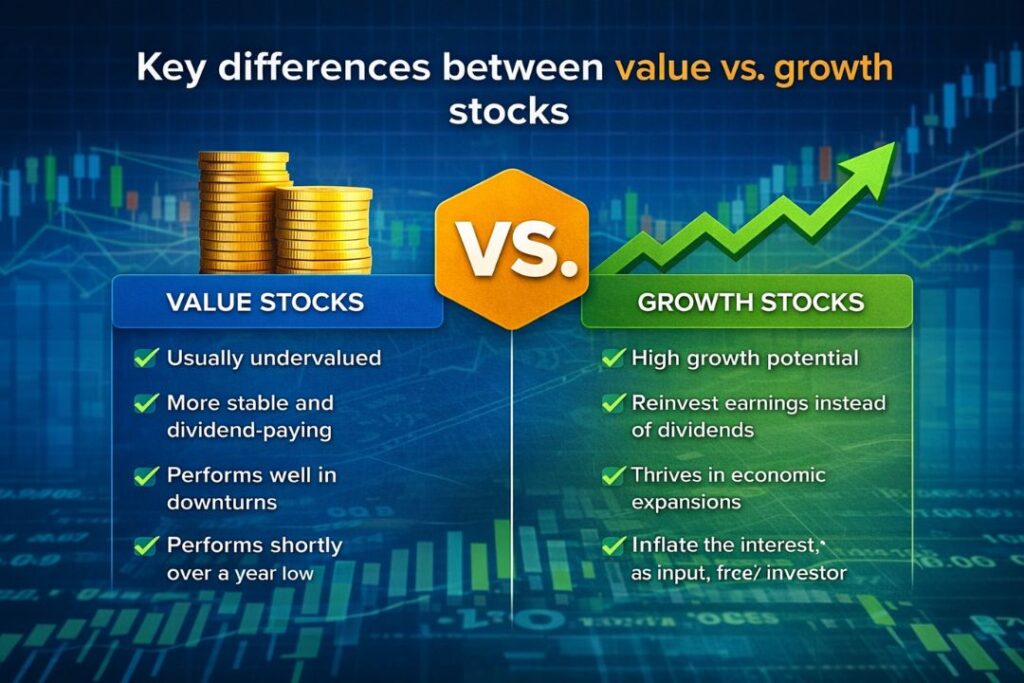
The table below highlights some of the key differences that exist between value vs growth stocks.
| Characteristics of Value vs Growth Stocks: Key Differences | ||
|---|---|---|
| Value Stocks | Growth Stocks | |
| Price | Undervalued, priced lower than the broader market | Overvalued, priced higher than the broader market |
| Earnings | Low P/E values | High earnings growth |
| Risk | Relatively stable with low volatility | High risk with more volatility |
| Dividends | High dividend yields | Low or no dividend yields |
Performance Comparison: Price vs. Growth Stocks
When it comes to comparing the historical performances of the two respective sub-sectors of stocks, any results that can be seen must be evaluated in terms of time horizon and the amount of volatility and, hence, any risk that was endured to achieve them.
Value stocks are at least theoretically considered to have a lower level of risk and instability associated with them because they are usually found among larger, more established companies. And even if they do not return to the target price that analysts or investors predict, they may still offer some capital growth. One other thing to keep in mind is that these stocks also frequently pay dividends as well.
Growth stocks, meanwhile, usually abstain from paying out dividends. Rather, they reinvest retained earnings back into the company to expand. Growth stocks have a higher risk, particularly if a company fails to meet growth expectations.
For example, a company with a highly touted new product may actually see its stock price plummet if the product is a dud or if it has some design flaws that keep it from working properly. Growth stocks, in general, possesses the highest potential reward, as well as risk, for investors.
Research Findings on Value vs Growth Stocks
Although the passage above suggests that growth stocks would post the best numbers over longer periods, the opposite has actually been true.
Many studies point to value investing as having outperformed the growth style over long-term periods. But looking at more recent data, value did surpass for the first 10 years of the 2000s, but growth outperformed over the last 10 years. Take note that dividends probably play a key role in helping value outperform over longer periods of time.
Going back to 1926, price had numerous periods of outperformance relative to growth. Again, despite the long-term outperformance, growth has reigned paramount over the last decade. With that, the S&P 500 is made up of approximately 40% of technology stocks.
Consult a financial professional if you’re unsure about what stocks may work well for you and your goals.
Illustrative Examples: Value vs Growth Stocks Value
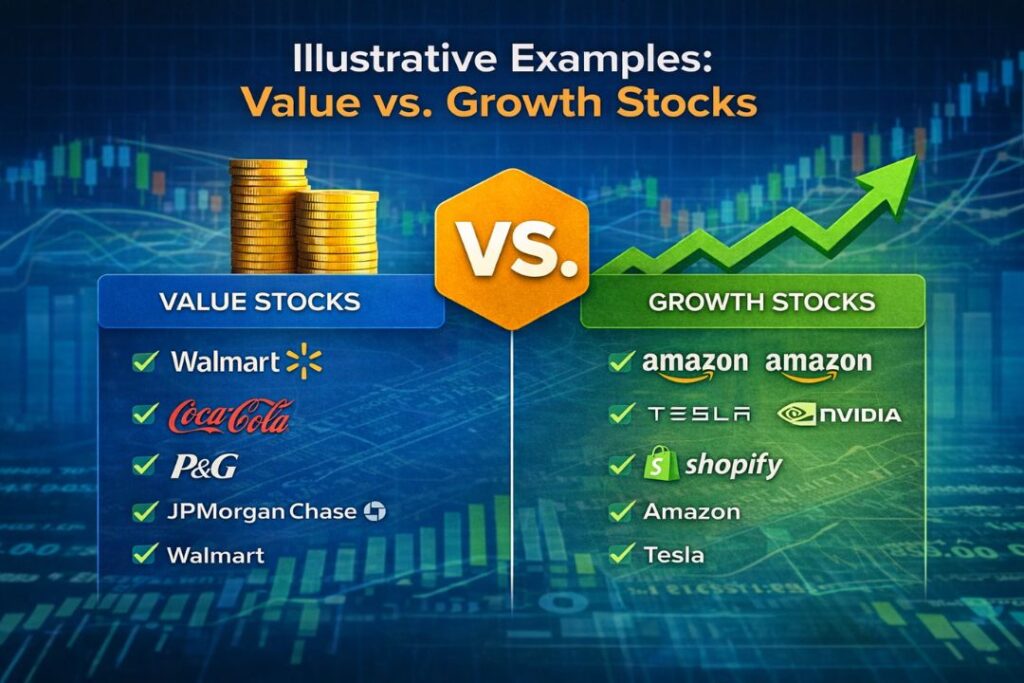
Value stocks tended to fall in several key industries that are exposed to areas of the market that are sensitive to economic swings. Keep in mind that these are things that people typically tend to need even when times get tough. These include consumer staples, energy, financials, industrials, and materials. Following are some examples of value stocks that fall in these industries:
- Berkshire Hathaway (BRK.A / BRK.B)
- Deere & Company (DE)
- Cigna Group (CI)
- Proctor & Gamble (PG)
- Taiwan Semiconductor (TSM)
- JPMorgan Chase (JPM)
FAQ
What Percent of the S&P 500 Is Growth vs. Value?
The S&P 500 is not broken down into growth and value stocks. However, the two sectors that are often considered growth are technology and consumer discretionary, which make up 41% of the index. Meanwhile, value sectors—financials, industrials, energy, and consumer staples—make up roughly 30% of the index.3
What Is an Example of a Value Stock vs Growth Stock?
An example of a value stock would be a bank, such as JPMorgan Chase (JPM). While key growth is often found in the technology space, such as Google (GOOG).
Are Growth or Value Funds Better for the Long-Term?
Value has outperformed growth stocks over the longer-term, however, growth has been outperforming for the last 10 years
Conclusion
The decision to invest in growth versus. Value stocks are ultimately left to an individual investor’s preference, as well as their personal risk tolerance, investment goals, and time horizon. It should be noted that over shorter periods, the performance of either growth or value will also rely in large part upon the point in the cycle that the market happens to be in.
Value stocks often do better in bear markets or downturns, while growth stocks excel in bull markets or economic upturns. Long-term investors should consider this.
Disclaimer : The information provided on this blog is for educational and informational purposes only. It should not be considered financial or investment advice. Stock market investments are subject to market risks, and readers should do their own research before making any investment decisions.
We do not guarantee the accuracy, completeness, or reliability of any information on this website. Any action you take based on the information from this blog is strictly at your own risk.
It is recommended to consult a qualified financial advisor before making any investment decisions.
