

Introduction :
Since the beginning of the year 2026, a big question has been in discussion among investors what should be done if the market crashes? Should we panic and sell our investments or should we look at this decline as an opportunity?
History is witness that every few years, due to some reason or the other, market crash is seen. Sometimes economic recession, sometimes war, sometimes rapid changes in interest rates and sometimes banking crisis the reasons may be different, but market decline definitely tests the investors.
The fear of a market Downturn is natural. When the portfolio value drops by 20–30% in a matter of weeks, the mental pressure increases. But this is where the real test of wisdom and discipline lies.
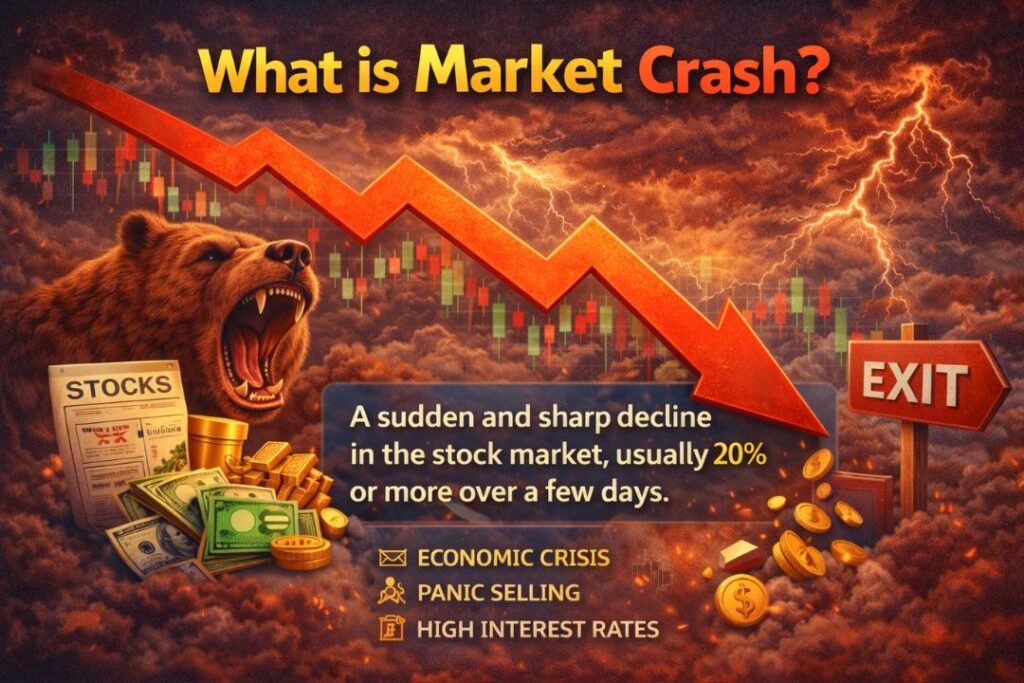
What is Market Crash?
A market crash is when the stock market experiences a sudden and sharp drop, typically of 20% or more. This decline can happen over a few days or weeks.
Main causes of a market Downturn:
- Economic recession
- Banking crisis
- War or geopolitical tensions
- Sharp increase in interest rates
- Investor panic
When a market Downturn occurs, investor confidence weakens and widespread selling begins.
Why is there talk of a market Downturn in 2026?
Some of the signs we’re seeing globally in 2026 are:
- High global debt levels
- Slow economic growth in some countries
- High valuations in the tech sector
- Uncertainty about interest rates
For these reasons, many analysts are discussing the possibility of a market Downturn. However, it is important to remember that it is almost impossible to accurately predict a market crash.
Is every fall a market Downturn?
No.
- A 5–10% decline: A normal correction
- A 10–20% decline: A major decline
- More than 20%: A Downturn
Investors often mistake a normal decline for a market Downturn and make hasty decisions.
Real Example
Example 1: The Financial Crisis of 2008
The 2008 market crash rocked global markets. Many investors panicked and sold their shares. But those who remained patient saw a spectacular recovery over the next 5–7 years.
Example 2: The 2020 COVID Crash
A market Downturn occurred in March 2020. The market fell by approximately 35%. But by the end of the same year the market had reached new heights.
Investors who panicked and exited were unable to take advantage of the recovery.
Should one exit in a market Downturn?
This depends on your investment goals and time horizon.
If you’re a long-term investor:
- Exiting during a market crash is often detrimental.
- Continuing SIP during the downturn can be beneficial.
If your goal is 1–2 years:
- It may be better to keep the risk low.
Is it right to invest in a market Downturn?
Many experienced investors consider market crashes as opportunities.
Why?
- Good stocks are available at low prices.
- The potential for long-term returns increases.
But blind buying without research can also be a mistake.
Strategy: What to do for 2026?
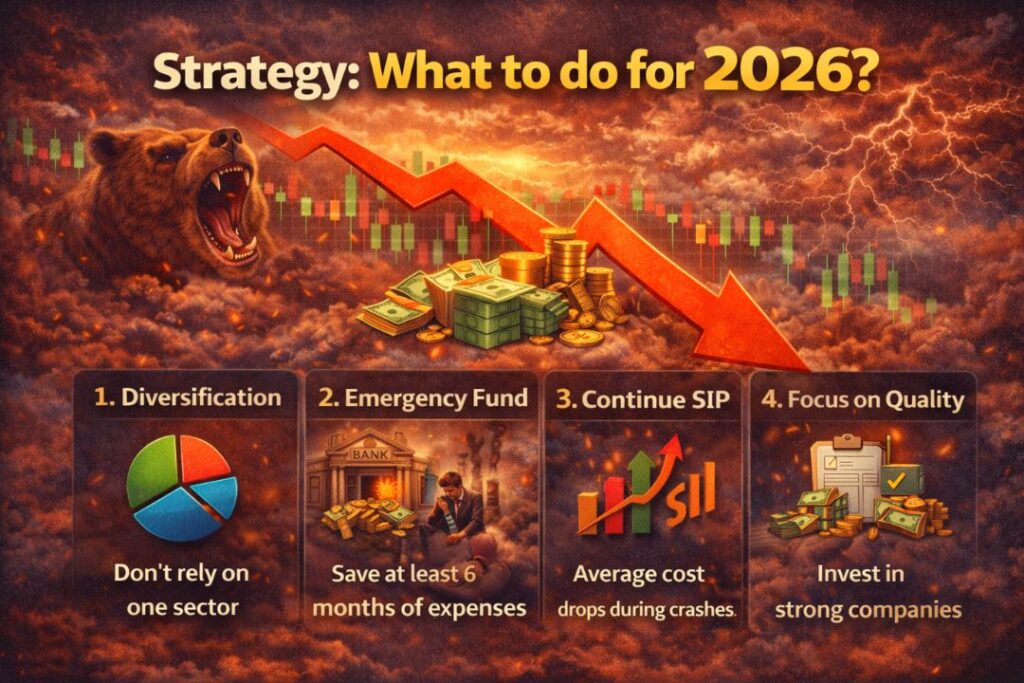
1.Maintain Diversification
Don’t invest in just one sector.
2.Keep an Emergency Fund
Set aside at least 6 months’ worth of expenses.
3.Continue SIPs
Average costs are lower during market crashes.
4.Focus on quality
Choose companies with strong balance sheets.
Psychological Aspects
During a market Downturn , emotions can cloud decisions:
- Fear
- Greed
- Rumors
Successful investors control their emotions.
Risk Management Plan
- 60% Equity
- 30% Debt
- 10% Gold
This balance can cushion the blow during a market Downturn.
Is Market Downturn an Opportunity?
Yes, but only for those who:
- Have a long-term perspective
- Are patient
- Are disciplined
What is the biggest mistake made during a market crash?
The biggest mistake investors make during a market Downturn is taking decisions in panic.
When a portfolio falls by 20–30%, the mind immediately thinks of stop loss. But often people sell when the market is near its bottom.
Real-life example:
Amit sold his ₹8 lakh investment at ₹5.5 lakh during the 2020 downturn.
After 6 months the same portfolio reached ₹9 lakh.
Exiting hastily during a market crash can wipe out long-term earnings.
The Power of a Cash Position in a Market Downturn
A prudent investor always keeps 10–20% of his or her assets in cash or liquid funds.
Why?
- Market crashes offer good companies at bargain prices.
- Cash is essential to seize the opportunity.
If all the money is already invested, it becomes difficult to seize the opportunity.
Sector Rotation Strategy 2026
Not all sectors fall equally in every market Downturn.
Defensive Sectors:
- FMCG
- Pharma
- Utilities
Cyclical Sectors:
- Real Estate
- Auto
- Metals
Defensive sectors tend to fall less during market crashes.
If a market Downturn occurs in 2026, sector balancing may be prudent.
Long-Term vs. Short-Term Investors
Short-Term Investor:
- More losses in a market Downturn
- Timing risk
- More emotional pressure
Long-Term Investor:
- Can see declines as opportunities
- Can take advantage of compounding
Market crashes are temporary, but long-term growth can be permanent.
The Importance of Dollar Cost Averaging
Dollar Cost Averaging (SIP) is a highly effective strategy during a market Downturn.
Example:
Ravi invests ₹10,000 every month.
When the market falls, he gets more units.
When the market recovers, lower average costs lead to higher profits.
Stopping SIP during a market crash is often a wrong move.
Understanding Valuation is Important
Not every downturn is an opportunity.
If the valuation of a company is very high even after the market Downturn and its earnings are declining, then one should be cautious.
The right opportunity is where:
- The company’s business is strong
- Debt is low
- Future prospects are clear
Impact of the Global Market Crash

Markets today are interconnected.
If there is a market crash in America or Europe, India may also be affected.
But sometimes emerging markets like India recover quickly.
Therefore, international diversification can also help reduce risk.
What to do for Retirement Investors?
If you’re nearing retirement:
- Keep equity exposure low
- 40–50% in debt
- 10% in gold
A completely equity-based portfolio can be risky during a market crash.
Does Market Crash Create Wealth of the Future?
History shows:
- The market grew exponentially in the 10 years after 2008.
- Record highs in the 2 years after 2020.
Market crashes cause temporary pain, but can yield long-term benefits for those who remain patient.
Advanced Strategic Model for 2026
If a market crash occurs in 2026, this strategy can be adopted:
Step 1: Avoid Panic
Don’t make decisions as soon as the market falls.
Step 2: Review your portfolio
Identify weak companies.
Step 3: Add Quality
Gradually add strong companies.
Step 4: Cash Management
Don’t invest all your money at once.
Buy in 3–4 portions.
Emotional Control Formula
Successful investors follow three rules during market crashes:
- Stay away from the news
- Don’t check your portfolio repeatedly
- Remember your long-term goal
Emotional stability is real power.
Final Thought
Market crashes may seem scary, but they are a natural part of investing.
If you:
- Have built a diversified portfolio
- Have an emergency fund
- Have continued SIPs
- Have selected quality stocks
Then a market Downturn could be an opportunity for you, not a threat.
Remember
The market goes up over time, but occasional declines are part of its journey.
FAQs
Q1: Should I withdraw all my money during a market crash?
No, unless you need the money immediately.
Q2: How long does a market crash last?
This can range from a few months to 1–2 years.
Q3: Should SIP be stopped?
No, continuing with SIP is often a better strategy.
Q4: Is it possible to predict a market crash?
Accurate prediction is almost impossible.
Q5: Is Gold Safe in a Market Crash?
Gold often provides stability, but not guarantees.
Q6: Is it right to take out a loan and invest during a market crash?
No.Borrowing and investing during a market crash can be very risky. If the decline continues for a long time, the losses may increase further.
Q7: Which investors suffer the most losses in a market crash?
Investors who invest without research, just by looking at the trend or invest all their money in a single sector, may suffer huge losses in a market crash.
Q8: Does the market always recover after a market crash?
History shows that the market has recovered in the long run, but it may take time. Patience and the right strategy are essential.
Disclaimer : This article is for educational purposes only. This is not investment advice of any kind. The market is subject to risk. Please consult your financial advisor before investing. Past performance does not guarantee future results.
Stay connected for more such information https://stockhubnews.com
