
Introduction :
The year 2026 brings both opportunity and uncertainty for investors. Changes in the global economy, technological revolutions, fluctuations in interest rates, energy transitions, and geopolitical tensions all these factors are impacting the markets. In such an environment, simply thinking of earning higher returns can be risky. It is wise to organize your investments in such a way that if one area weakens, the other can balance it. This thinking is the core of Portfolio Diversification Strategy.
Simply put, Portfolio Diversification Strategy means dividing your capital across different asset classes, sectors and geographical areas to reduce risk and maintain long-term stability. This strategy not only secures the investment but also opens the way for balanced growth.
In this comprehensive blog, we will delve deeper into the Portfolio Diversification Strategy in the context of 2026 with examples, practical models, risk management, rebalancing, common mistakes, and final strategic tips.
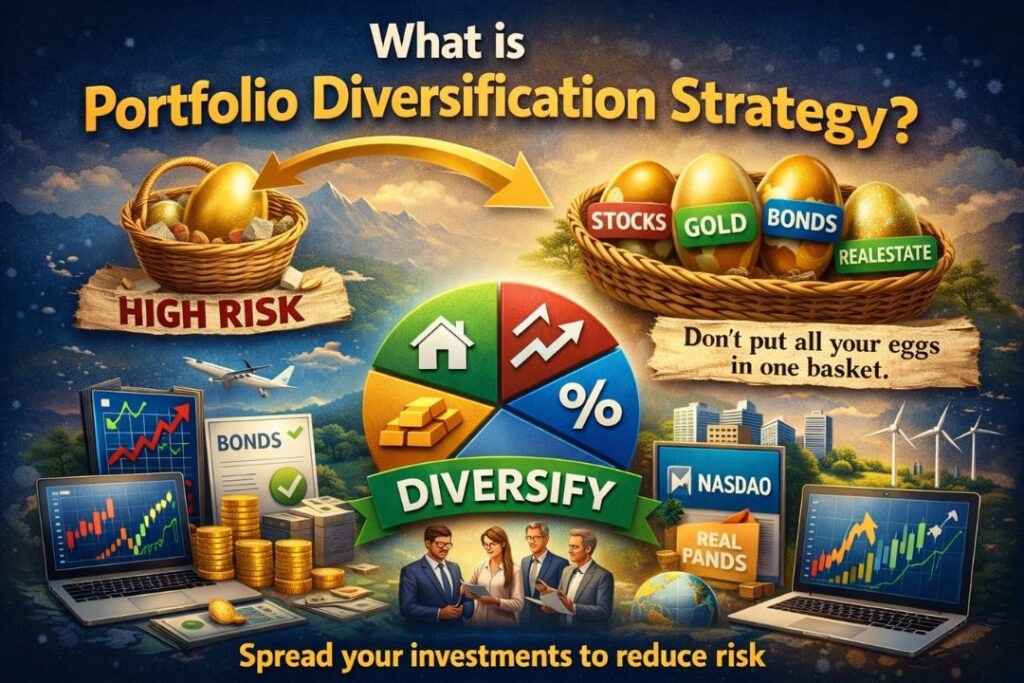
What is Portfolio Diversification Strategy?
Portfolio Diversification Strategy is an investment approach in which you do not invest your entire investment in just one stock, one sector or one asset, but distribute it across different options.
A simple example
Let’s say you have ₹10 lakh.
- If you invest all your money in just one tech company and that company goes into decline, your entire investment will be affected.
- But if you invest ₹4 lakh in equity, ₹3 lakh in debt, ₹1 lakh in gold, ₹1 lakh in international funds and ₹1 lakh in liquid funds, the risk reduces significantly.
This balance is the basis of Portfolio Diversification Strategy.
Why is diversification more important in 2026?
Economic conditions in 2026 are offering mixed signals:
- Moderate global growth
- Potential stability in interest rates
- Expansion of the technology and AI sectors
- Investment in energy and infrastructure
- Efforts to control inflation
Markets can show both ups and downs during these times. If your investments are diversified, the impact of a sudden drop will be less.
Major asset classes and their balance
Equity (Shares)
Equity is considered the asset class with the highest long-term returns, but it also has high volatility.
Potentially Strong Sectors in 2026:
- Banking and Financial Services
- Infrastructure
- Renewable Energy
- Defense Sector
- Artificial Intelligence
Example:
Rahul (age 28) invests ₹15,000 per month in SIPs. He invested 70% in equity funds, 20% in debt funds and 10% in gold. This balanced portfolio diversification strategy gives him both growth and protection in the long term.
Debt and Bonds
Debt investments offer stability.
These include:
- Government bonds
- Corporate bonds
- Debt mutual funds
If the equity market falls, debt investments often remain stable.
Gold
Gold provides protection during times of economic crisis and inflation.
A 5–10% gold allocation is considered balanced.
International Investment
Relying solely on India is not the right strategy.
International investing:
- Provides dollar exposure
- Gains stakes in global companies
- Risk is divided geographically
Portfolio Diversification Strategy by Age
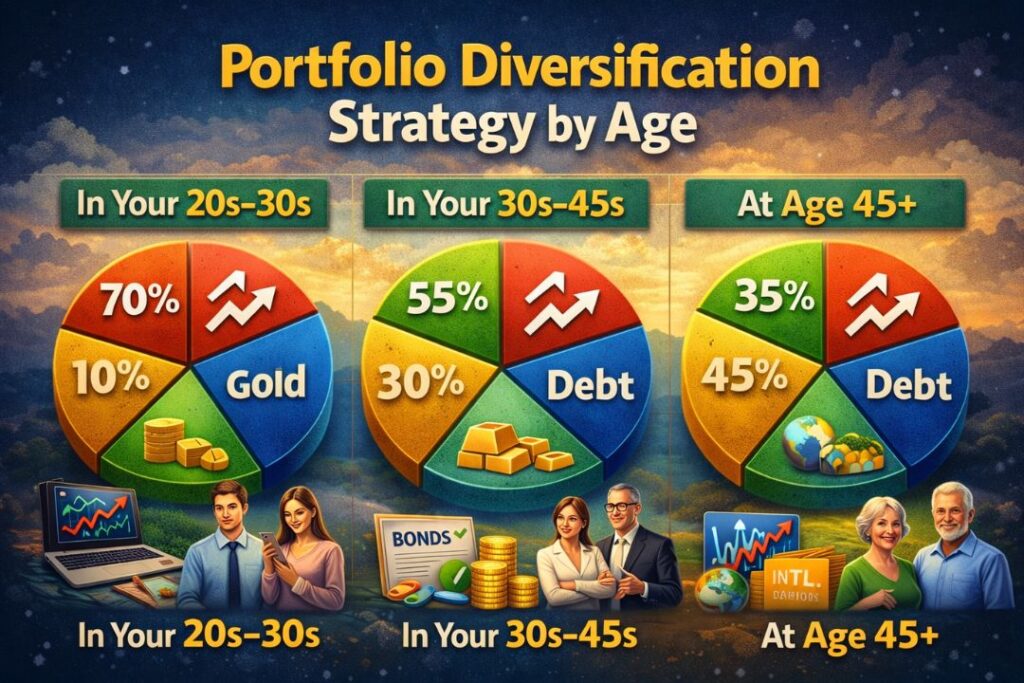
20–30 years
- 70% equity
- 20% debt
- 10% gold
30–45 years
- 55% equity
- 30% debt
- 10% gold
- 5% international
Above 45 years
- 35% equity
- 45% debt
- 10% gold
- 10% international
Real-Life Example
Example 1: The COVID Era
When the stock market crashed in 2020, investors with gold and debt investments saw their losses minimized. This was the strength of the Portfolio Diversification Strategy.
Example 2: Tech Sector Crash
If an investor had invested only in tech stocks in 2022, they would have suffered a massive decline. But if his portfolio also included banking and FMCG, the losses would have been limited.
The Importance of Rebalancing
Let’s say your target was 60% equity. The market rose sharply and equity rose to 75%.
Now the risk has increased.
Solution: Sell some equity and invest in debt.
It is wise to rebalance every 6–12 months.
Common Mistakes
Investing in only one sector
Relying on social media tips
Investing without a goal
Over-diversification
Not conducting regular reviews
Sample Model Portfolio for 2026
Moderate Risk Investor
- 55% Equity
- 25% Debt
- 10% Gold
- 5% International
- 5% Liquid
This portfolio diversification strategy can provide balanced risk and stable returns.
Psychological Discipline
Investing isn’t just about mathematics, it’s also about psychology.
- Panic selling during downturns
- Greedy during upturns
- Constantly changing portfolios
An investor following a portfolio diversification strategy avoids emotional decisions.
The benefits of compounding over the long term
If ₹5 lakh is invested for 20 years at a 12% annual return, it could grow to over ₹48 lakh.
This is not possible without proper diversification.
Macroeconomic Trends and Portfolio Diversification Strategy in 2026
Focusing solely on individual stocks or funds isn’t enough when investing in 2026. Global economic indicators also play an important role. Interest rates, inflation, currency exchange rates, crude oil prices, and government policies all affect your portfolio.
If interest rates fall, equities and real estate could benefit.
If inflation rises, gold and commodities may perform better.
Therefore, a prudent investor takes these macro trends into account when creating a portfolio diversification strategy in 2026. For example, if the global economy is slowing, defensive sectors such as FMCG and pharma may be given more weight.
The Importance of Multi-Asset Investing
Multi-asset investing is becoming increasingly popular in 2026. This means combining equity, debt, and gold within a single fund or strategy.
Example:
Seema (age 35) invests ₹20,000 every month. Instead of buying 3 different funds, he chose a Multi-Asset Allocation Fund which has 60% equity, 30% debt and 10% gold.
This approach simplifies the portfolio diversification strategy, especially for investors who are short on time.
Small-Cap, Mid-Cap, and Large-Cap Balance
Diversification isn’t limited to asset classes. Balance is also important within equity.
- Large Cap: Stable and low risk
- Mid Cap: Moderate risk, high potential growth
- Small Cap: Higher risk, higher potential returns
A balanced example for 2026:
- 50% Large Cap
- 30% Mid Cap
- 20% Small Cap
If the entire investment is solely in small caps, significant losses could occur during a market downturn. Therefore, market cap based segmentation is also necessary under Portfolio Diversification Strategy.
Passive vs. Active Strategy
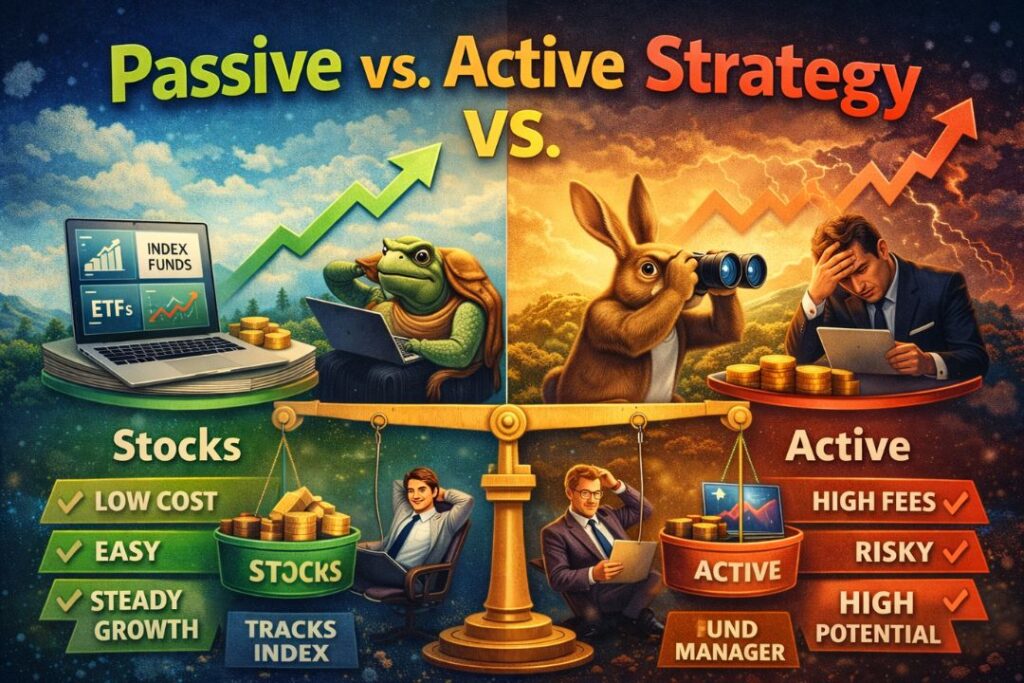
Index funds and ETFs are becoming increasingly popular these days. Passive investing offers low expenses and stable tracking.
Active fund managers try to beat the market, but their fees are higher.
A balanced strategy in 2026 might be:
- 60% Passive Funds
- 40% Active Funds
This mix makes the portfolio diversification strategy cost-effective and flexible.
Understanding Risk-Adjusted Returns
Simply looking at higher returns isn’t enough. You should also consider the risk associated with those returns.
Example:
- Fund A: 15% return, high volatility
- Fund B: 12% return, stable performance
Fund B often proves to be a better long-term option because of the lower risk.
The objective of Portfolio Diversification Strategy is “Smart Returns”, not “Highest Returns”.
Inflation Shield Planning
Inflation can reduce the real value of your investments. If inflation is 6% and your return is 7%, the real growth is only 1%.
Considering inflation in 2026:
- Equity
- Real Estate
- Gold
Balanced use of these is essential.
This is also an important part of Portfolio Diversification Strategy.
Behavioral Finance and Diversification
Investors often make decisions based more on emotion than calculation.
- Overbuying in a rally
- Selling in a downturn
- Everyone is buying mentality
A diversified portfolio reduces emotional stress because the risk is already divided.
Example:
If you only invest in tech stocks and they fall, panic will be high. But if your portfolio is balanced, peace of mind is maintained.
Retirement Planning and Portfolio Diversification Strategy
Diversification becomes increasingly important as we approach retirement.
For a 50-year-old investor:
- 40% equity
- 45% debt
- 10% gold
- 5% liquid
This structure provides both income and stability.
SWP (Systematic Withdrawal Plan) can be used for monthly income after retirement. A diversified portfolio makes SWP sustainable in the long run.
Tax Efficiency and Diversification
Tax planning should also be part of a portfolio diversification strategy.
- ELSS funds offer tax savings.
- Long-term capital gains are taxed at a lower rate.
- Debt funds have a different tax structure.
Tax savings increase real returns.
The Advanced Model for 2026
If an experienced investor wants to build a balanced but growth-oriented portfolio, this model may be useful:
- 50% Indian equities
- 15% international equities
- 20% debt
- 10% gold
- 5% liquid
This advanced portfolio diversification strategy covers both global and domestic opportunities.
Conclusion (Extended Thought)
Success in 2026 won’t come simply from picking the right stocks. Success will be achieved through balanced thinking, regular review and discipline.
Diversification doesn’t make you rich instantly, but it does protect you from becoming poor because of bad decisions.
Remember, investing is a marathon, not a sprint.
Portfolio Diversification Strategy is the safety net that keeps you stable through all the ups and downs of the market.
FAQs
Q1: How often should the Portfolio Diversification Strategy be changed?
Answer: Review every 6–12 months, but don’t make frequent changes.
Q2: Is diversification possible with mutual funds alone?
Yes, it is possible with multi-asset or index funds.
Q3: Is gold necessary?
5–10% gold provides security in times of crisis.
Q4: Is international investment safe?
In the long run, yes, but keep it to a limited percentage.
Q5: Can small investors diversify?
Yes, easily through SIP.
Disclaimer : This article is written for educational and general information purposes only. The information provided herein does not constitute investment advice. Before investing, evaluate your financial situation, risk profile and goals or consult a certified financial advisor. The market is subject to risk, and past performance is not a guarantee of future performance.
Stay connected for more such information https://stockhubnews.com
