
Introduction :
These days, whenever we watch the news or read the newspaper, we hear one word repeatedly – GDP. Sometimes it is said that India’s GDP increased by 7%, and sometimes it is said that GDP growth rate decreased. In such a situation, a question arises in the minds of common people what is GDP and how does it affect our lives?
If you invest, do business or just want to understand the economic condition of the country, then it is very important to know what is GDP. It is the most important indicator of the economic strength and development of any country.
In this article, we will explain in detail:
What is GDP?
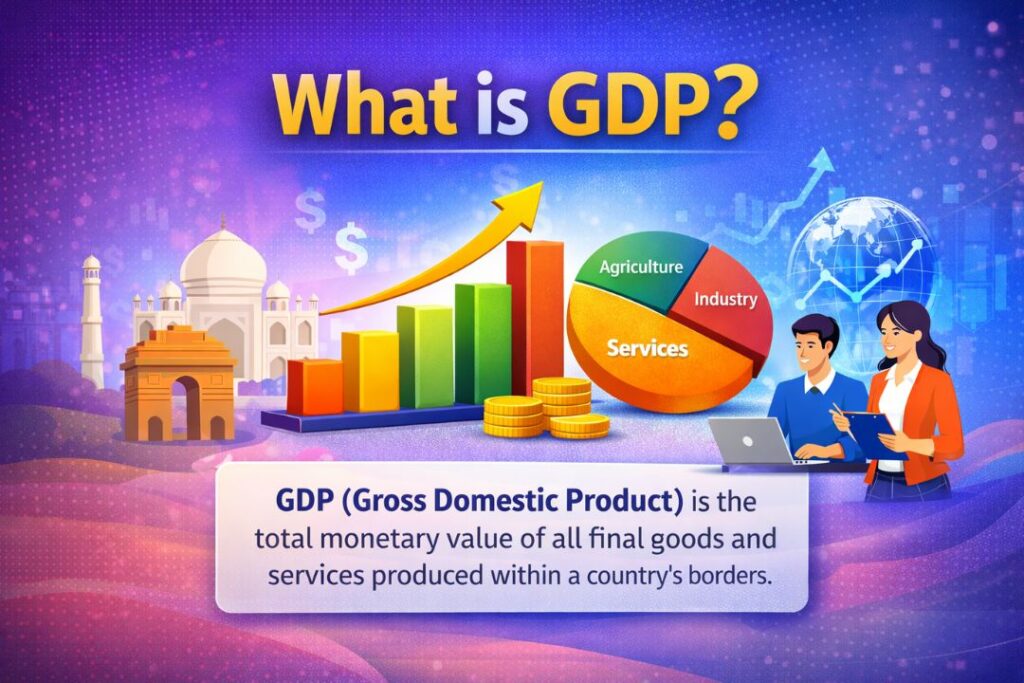
The full name of GDP is Gross Domestic Product.
To put it simply, what is GDP?
The total market value of all final goods and services produced within a country’s borders over a period of time (usually one year) is called GDP.
It is important to note that GDP only includes Final Goods, not raw materials.
What is the meaning of Final Goods?
Let’s say:
- A farmer grows wheat.
- A miller makes flour from that wheat.
- A bakery makes bread from that flour.
If we add up the costs of all three, we’ll double-count.
Therefore, only the price of the final product (bread) is added to GDP.
A Real-Life Example
Suppose a small town has:
- Agricultural production of ₹20 lakh
- Manufacturing of ₹30 lakh
- Services of ₹25 lakh
Total production = ₹75 lakh
This would be the town’s GDP.
Now this process happens at the all India level.
Who measures GDP in India?
GDP in India is calculated by the National Statistical Office (NSO).
This organization releases GDP figures every quarter and annually.
Three ways to measure GDP in India
If you want to understand what is GDP and how it is measured in India, there are three main ways:
1.Production Method
This adds up the production of three main sectors:
Agriculture
Industry
Services
Example:
- Agriculture = ₹30 lakh crore
- Industry = ₹45 lakh crore
- Services = ₹100 lakh crore
Total GDP = ₹175 lakh crore
The service sector contributes the largest share of India’s GDP, especially IT and banking.
2.Income Method
This method adds up the total income earned in the country:
- Salaries
- Profits
- Rent
- Interest
If the total income in a country in a year is ₹170 lakh crore, that would be considered GDP.
3.Expenditure Method
The most popular method.
GDP = C + I + G + (X − M)
Where:
- C = Consumption (people’s spending)
- I = Investment (companies’ investment)
- G = Government Spending
- X = Exports
- M = Imports
Real Example (in the context of India)
- People buy cars, mobile phones, and clothes – Consumption
- Companies build new factories – Investment
- The government builds metros and highways – Government Spending
- India sells IT services to the United States – Export
- India imports oil – Import
The total value of all these constitutes GDP.
Types of GDP
Nominal GDP
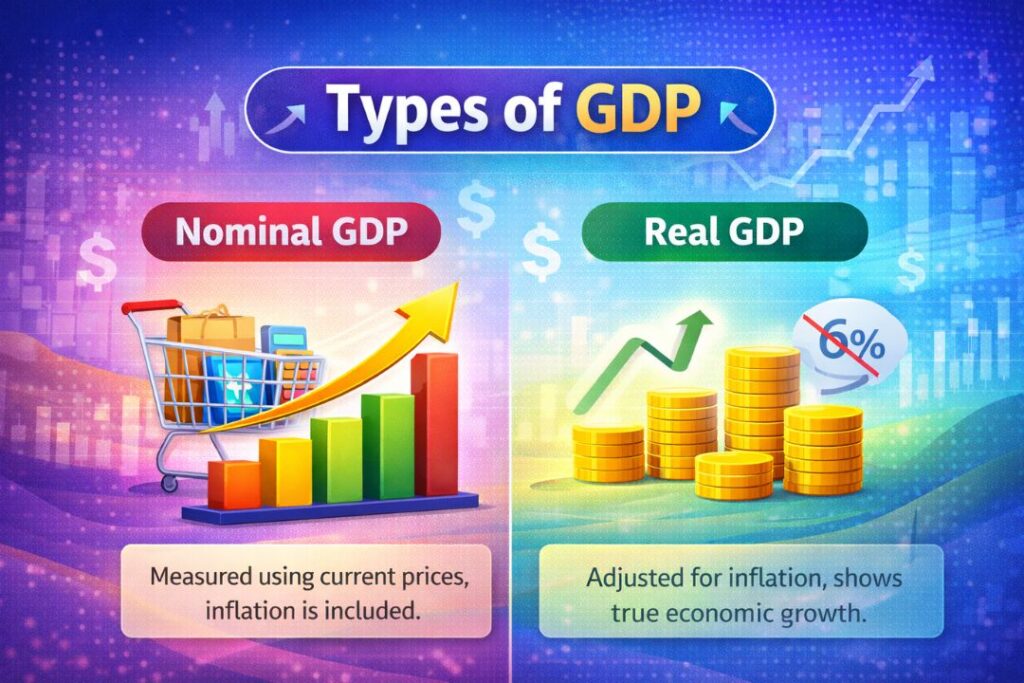
Measured at current prices. This includes inflation.
Real GDP
Reflects real growth after removing inflation.
Example:
If GDP grows by 9% and inflation is 5%, real growth will be about 4%.
What is GDP Growth Rate?
GDP growth rate tells how much percentage GDP increased this year compared to last year.
If GDP was ₹150 lakh crore in 2024 and increased to ₹165 lakh crore in 2025, the growth is about 10%.
Benefits of GDP Growth
When GDP grows:
- Employment opportunities increase
- Foreign investment comes in
- Businesses expand
- Tax collection increases
Reasons for GDP Decline
- Economic Recession
- Global Crisis
- War
- Pandemics (like COVID-19)
- Decrease in Investment
Does increasing GDP mean everyone is rich?
No.
GDP shows total production, but it doesn’t tell us whether the money is distributed equally.
Therefore, economists also look at:
- Per Capita Income
- Unemployment Rate
- Poverty Rate
- Inflation
What is Per Capita GDP?
Total GDP ÷ Total Population = Per Capita Income
If the country’s GDP is ₹200 lakh crore and the population is 1 billion, then the per capita income would be ₹2 lakh.
India’s GDP and Global Comparison
India is one of the world’s fastest-growing large economies.
India’s GDP is growing due to:
- Digital economy
- Startup culture
- Young population
- Strong domestic demand
The Relationship Between GDP and the Stock Market
When GDP increases:
- Companies’ earnings increase
- The stock market rises
- Investor confidence increases
When GDP decreases, the stock market may see a decline.
The Impact of GDP on the Common Man
If you work, run a business, or invest GDP definitely affects you.
GDP will increase – job opportunities will increase
GDP will decrease – economic pressure will increase
What is GDP – Understand it in depth (Advanced Explanation)
GDP and Sector-Wise Contribution
When we understand what is GDP, it’s also important to understand how much different sectors contribute to a country’s GDP.
India’s economy is divided into three main parts:
1.Primary Sector
- Agriculture
- Fisheries
- Mining
In India, agriculture once had a significant contribution, but now the percentage has declined. Still it is very important for employment.
2.Secondary Sector
- Manufacturing
- Factory Production
- Construction
Example:
If an automobile company produces 100,000 vehicles, its total sales are added to GDP.
3.Tertiary Sector
- Banking
- IT
- Telecom
- Education
- Healthcare
Today, the service sector contributes the most to India’s GDP.
What is GDP Deflator?
When we ask what is GDP, we must also understand how changes in prices are measured.
GDP Deflator is an index that shows how much impact inflation has had on GDP.
Formula:
GDP Deflator = (Nominal GDP ÷ Real GDP) × 100
If Nominal GDP is high and Real GDP is low, it means inflation is high.
Importance of Base Year
GDP is calculated based on a Base Year.
In India, the base year is changed from time to time to include new economic activities.
By changing the base year:
- New companies are included
- The impact of new technology is visible
- Economic data becomes more accurate
GDP and the Digital Economy
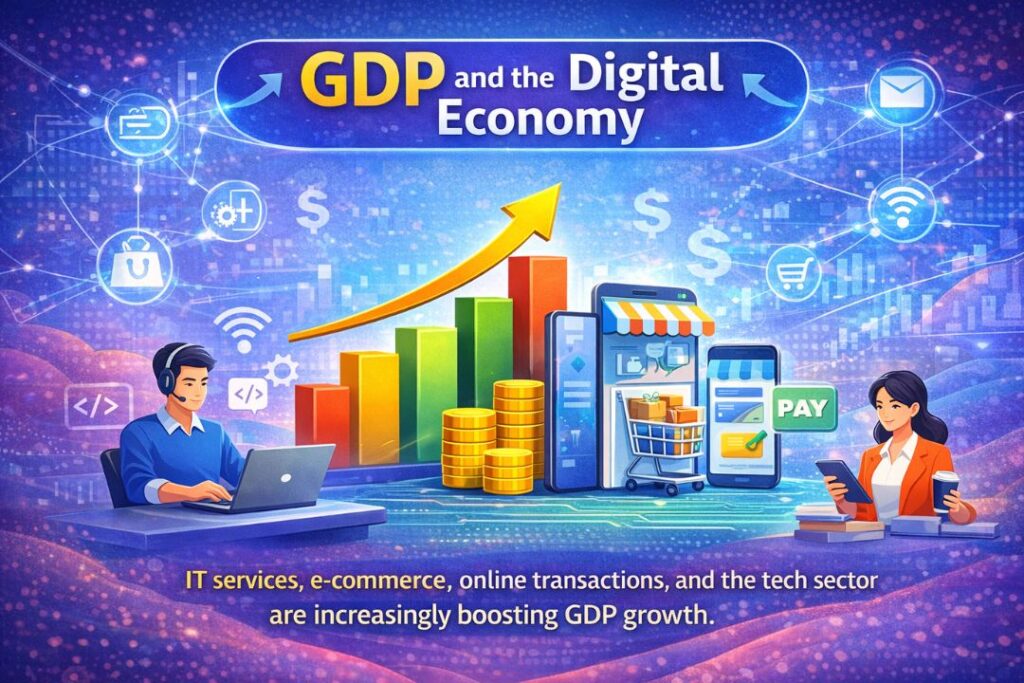
Today, following the Digital India campaign, the digital sector has grown rapidly.
- UPI transactions
- Online shopping
- Startup companies
- Fintech services
All of these have a direct impact on GDP.
Example:
If people shop more online, consumption increases and GDP rises.
GDP and Government Policies
The government takes several steps to increase GDP:
- Tax changes
- Infrastructure investment
- Promotion of startups
- Make in India scheme
When the government builds roads, railways, and airports, it:
- Employment increases
- Production increases
- GDP improves
GDP and Foreign Investment (FDI)
Foreign Direct Investment (FDI) also plays an important role in increasing GDP.
If a foreign company opens a factory in India:
- Employment is created
- Production increases
- Exports may increase
This directly increases GDP.
GDP and Recession
When GDP growth remains negative for two consecutive quarters, it is called an economic recession.
During a recession:
- Companies reduce production
- Job cuts occur
- Investment decreases
During COVID-19, many countries, including India, saw their GDP decline.
Limitations of GDP
Many people ask, if GDP is so important, does it show the whole picture?
No. GDP has some limitations:
- It does not reflect the unequal distribution of income
- It does not calculate environmental damage
- Does not include household work
- Does not include black money
Therefore, a country’s prosperity cannot be assessed based on GDP alone.
What is Green GDP?
Green GDP is a modern concept.
It measures real economic growth minus environmental damage.
If a factory pollutes, that production will be added to the normal GDP, but the environmental cost will be subtracted in Green GDP.
Relationship between GDP and Per Capita Income
If a country’s total GDP is large but its population is also very large, per capita income may be low.
Therefore, it is not enough to just know what is GDP , but it is also important to see what is the per capita income.
How can India’s GDP grow in the future?
- By strengthening the manufacturing sector
- By increasing exports
- By promoting the digital and technology sectors
- By focusing on skill development
- By investing in infrastructure
If these areas improve, India’s GDP can grow rapidly.
GDP and the Common Citizen
If GDP increases:
- Job opportunities increase
- Salaries may rise
- Businesses expand
If GDP decreases:
- Economic pressure increases
- Investment decreases
- Unemployment may increase
Therefore, every citizen should understand what is GDP and how it affects their lives.
Final Conclusion
Now you have a deeper understanding of what is GDP, how it is measured, and its impact on our lives.
GDP is not just a figure, but it reflects the economic strength, production capacity and direction of development of the country.
If production increases -income increases – expenditure increases – GDP increases.
This determines the progress of the country.
FAQ
1.What is GDP and what is its full name?
What is GDP – The full name of GDP is Gross Domestic Product. It is the total market value of all final goods and services produced in a country during a given period of time. GDP is the main way to measure the economic condition of a country.
2.Who measures GDP in India?
GDP in India is calculated by the National Statistical Office (NSO). This organization releases GDP figures every quarter and annually.
3.How is GDP measured?
GDP is measured in three main ways:
- Production Method
- Income Method
- Expenditure Method (C + I + G + (X − M))
These three methods measure a country’s total economic activity.
4.What is the difference between Nominal GDP and Real GDP?
Nominal GDP is based on current prices and includes inflation.
Real GDP shows real economic growth after removing inflation.
Therefore, Real GDP is considered more important to understand real development.
5.What is GDP Growth Rate?
GDP Growth Rate tells how much percentage the country’s GDP increased or decreased this year compared to the previous year. It reflects the pace of economic development.
6.What impact does increasing GDP have on the common man?
When GDP increases:
- Employment opportunities increase
- Wages may rise
- Trade and investment increase
When GDP decreases:
- Unemployment may increase
- Economic activity may slow down
7.Does a higher GDP mean a country is richer?
Not necessary. What is GDP? It simply tells the total production. It does not tell whether the wealth is distributed equally among all people or not.
Therefore, per capita income, poverty rate and unemployment rate are also seen.
Disclaimer :This article is written for educational and general information purposes only. The information provided herein is based on various public sources and economic theories.
This article is not intended to be any kind of investment, financial, or legal advice. Please consult your financial advisor or expert before making any investment or financial decision.
The figures given in the article may change over time. The website will not be responsible for any financial loss.
Stay connected for more such information https://stockhubnews.com
