
Introduction
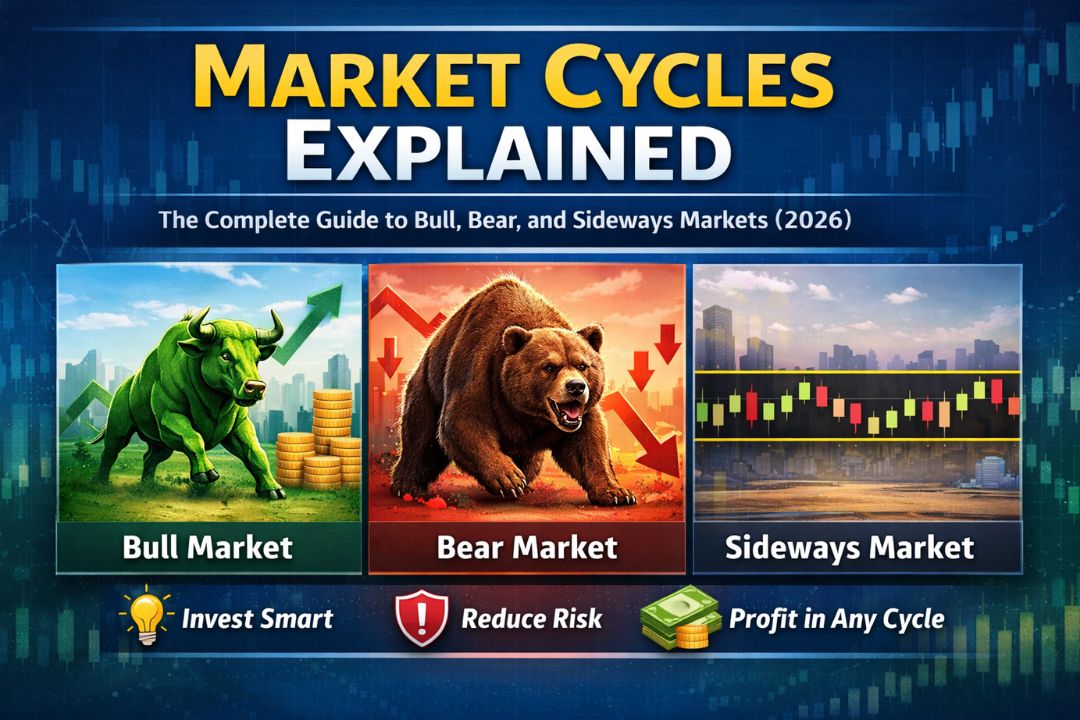
Financial markets never moves in a straight line. Prices rise, fall, consolidated, and repeat patterns over time. Understanding these patterns is necessary for any serious investor. In this detailed guide, we will break down market cycles explained in simple yet professional terms so beginners and intermediate investors can make smart decisions.
Whether you invest in stocks, indices, or ETFs, knowing how cycles work helps you minimize risk and improve long-term returns.
What Are Market Cycles Explained?
Before diving deeper, let’s define the concept clearly.
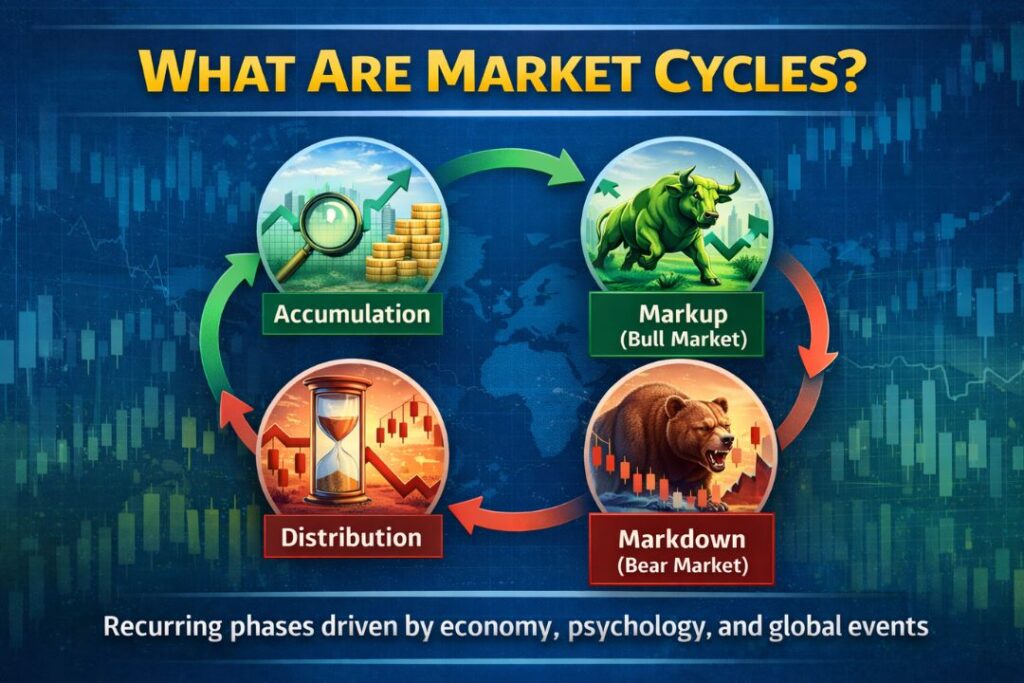
Market cycles refer to the natural fluctuations in financial markets drove by economic growth, investor psychology, liquidity, and global events. When we talk about market cycles explained, we are referring to the repeating phases that markets go through over time.
Every full cycle typically includes four major phases:
- Accumulation Phase
- Markup Phase (Bull Market)
- Distribution Phase
- Markdown Phase (Bear Market)
These stages repeat, though their duration and intensity vary.
Accumulation Phase
This phase begins after a extended decline. Sentiment is still negative, and most retail investors are cautious. However, experienced investors and institutions begin quietly purchasing quality assets.
Key Characteristics:
- Low trading volume
- stabilizing prices
- Negative news dominance
- Attractive valuations
At this stage, smart money positions itself initially. Understanding market cycles explained allows investors to identify when pessimism may actually present opportunity.
Markup Phase (Bull Market)
This is the most hopeful phase of the cycle. Prices begin making higher highs and higher lows. Economic data improves, corporate earnings grow, and investor confidence increases.
Characteristics:
- Strong upward trend
- Rising trading volumes
- Media optimism
- Increase in retail participation
During this stage, understanding market cycles explained stops investors from becoming overconfident. While profits grow, risks also increase if appraisals become excessive.
Distribution Phase
After a strong bull run, the market begins losing momentum. Prices may still appear strong, but instability increases. Institutional investors started selling gradually.
Characteristics:
- Sideways movement
- High volatility
- Strong but slowing economic data.
- Mixed sentiment
This phase is tricky because the overall mood may still appear positive. A clear understanding of market cycles explained helps investors identify warning signs early rather than reacting after a major decline begins.
Markdown Phase (Bear Market)
The markdown phase marks a sustained downward trend. Fear dominates the market and many investors exit at a loss.
Characteristics:
- Lower highs and lower lows
- panic selling
- Negative headlines
- economic slowdown
Historically, every bear market has ultimately led to recovery. That is why learning market cycles explained is vital for long-term investors who want to stay rational during volatility.
What Is a Sideways Market?
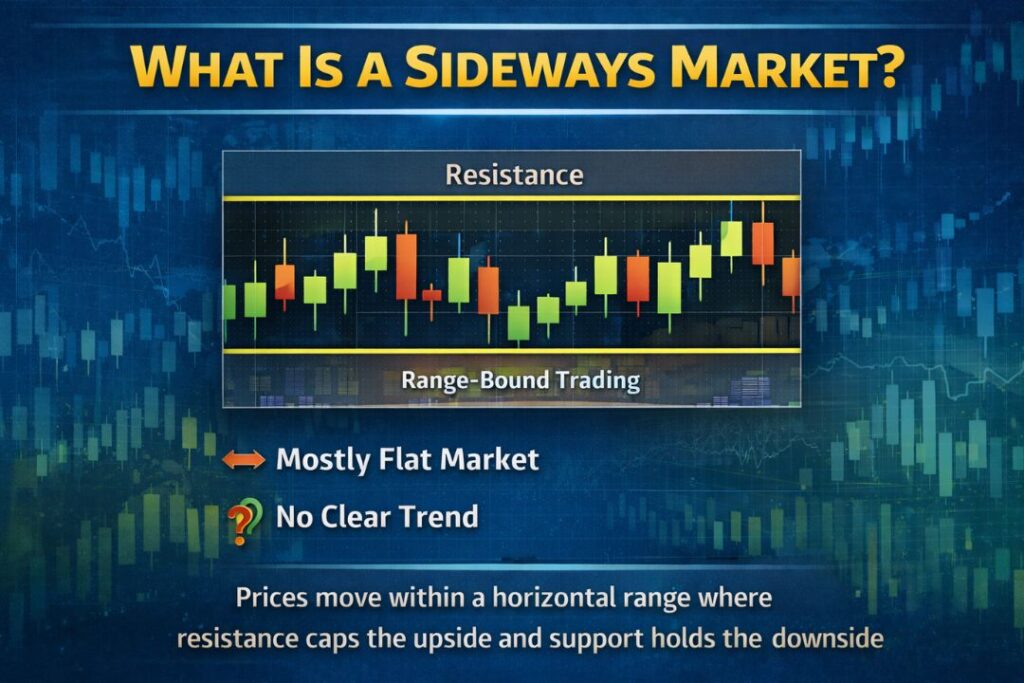
Not all markets trend strongly up or down. Occasionally prices move within a range for weeks or months.
Characteristics:
- Low momentum
- Range-bound movement
- Frequently breakouts and false signals
In sideways markets, traders may use range strategies, while long-term investors frequently continue systematic investing.
The psychology behind market cycles.
Markets are as much driven by emotion as by economics. The emotional stages typically following this pattern:
- Optimism
- Excitement
- Euphoria
- Anxiety
- Fear
- Panic
- Despair
Understanding investor psychology is a key part of market cycles explained because emotional extremes frequently signal turning points.
Role of Economic Factors
Market cycles are impacted by:
- Interest rates
- Inflation
- Corporate earnings
- Global events
- liquidity conditions
In India, investors frequently track policy announcements from the Reserve Bank of India and monitor index performance on the National Stock Exchange of India to gauge broader economic direction.
Macro trends strongly impact cycle transitions.
How to Recognize the Current Market Phase
To apply market cycles explained practically, following this checklist:
- Analysis index trends (higher highs or lower lows?)
- Watch trading volume patterns
- Track economic indicators
- Monitoring corporate earnings growth
- Assess investor sentiment
Combining technical and fundamental analysis improves precision.
Investment Strategy for Every Phase
During Accumulation:
- Focus on quality stocks
- Invest gradually
- Avoid excessive leverage
During Markup:
- Ride the trend
- Use trailing stop-loss
- Avoid chasing hype
During Distribution:
- Gradually reduce exposure
- Diversify assets
- Protect profits
During Markdown:
- Avoid panic selling
- Continue SIP if fundamentals stay strong
- Looking for long-term opportunities
A disciplined strategy built around market cycles explained helps investors stay consistent rather than emotional.
Common Errors Investors Make
- Buying near market tops
- Selling near market bottoms
- Follow social media tips blindly
- Ignoring risk management
- overtrading in volatile markets
Education reduces these mistakes considerably.
Why market cycles matter in 2026 and beyond
Global economies are impacted by technology shifts, AI adoption, geopolitical risks, and inflation cycles. These forces will continue shape financial markets.
By understanding market cycles described, investors can:
- Avoid emotional decisions
- Improve entry timing
- Build wealth systematically
- Reduce long-term risk
Markets may change, but cycles stay constant.
Risk Management Principles
No matter the phase, always:
- Maintain an emergency fund
- Diversify investments
- Avoid excessive debt
- Allocate assets properly
- Invest with a long-term vision
Even the best understanding of market cycles explained must be combined with regimented risk control.
Market Cycles Advanced Technical Signals
While understanding the fundamental structure of market movements is essential, investors who want deeper clarity must combine macro knowledge with technical confirmation. When discussing market cycles explained, technical indicators help confirm which phase the market is presently in.
Moving Averages
Moving averages smooth price data and show trend direction.
- 50-day moving average – short to medium trend
- 200-day moving average – longer-term trend
When price remains above the 200-day average, markets are generally in a bullish phase. When it drops below consistently, it may signal a bearish transition.
Relative Strength Index (RSI)
RSI measures momentum.
- Above 70 – Overbought
- Below 30 – Oversold
During late markup stages, RSI often remains overbought for extended periods. In markdown stages, it remains weak. These patterns reinforce the concept of market cycles explained with real chart evidence.
Volume Analysis
Volume confirms conviction.
- Rising price + increasing volume = strong trend
- Falling price + increasing volume = strong selling pressure
Institutions leave footprints via volume before price reverses dramatically.
sector rotation and market cycles
Not all sectors perform evenly in every phase. Understanding sector rotation improves timing and portfolio assignment.
Early Bull Phase
- Infrastructure
- Capital goods
Mid Bull Phase
- Technology
- Consumer discretionary
Late Bull Phase
- Defense sectors like FMCG and healthcare
Bear Market Phase
- Gold
- Utilities
- defensive assets
Sector rotation is a powerful practical application of market cycles explained, as money flows shift before the broader market responds.
How Global Markets Impact Domestic Cycles
Today’s markets are interconnected. A recession in the United States or Europe frequently impacts emerging markets like India.
Key global drivers include:
- us federal reserve rate decisions
- Crude oil prices
- Dollar Strength
- Geopolitical tensions
Indian investors frequently monitor global indices alongside domestic benchmarks listed on the National Stock Exchange of India.
Global liquidity cycles frequently trigger transitions between accumulation and markdown phases worldwide.
Long-term wealth creation through cycles
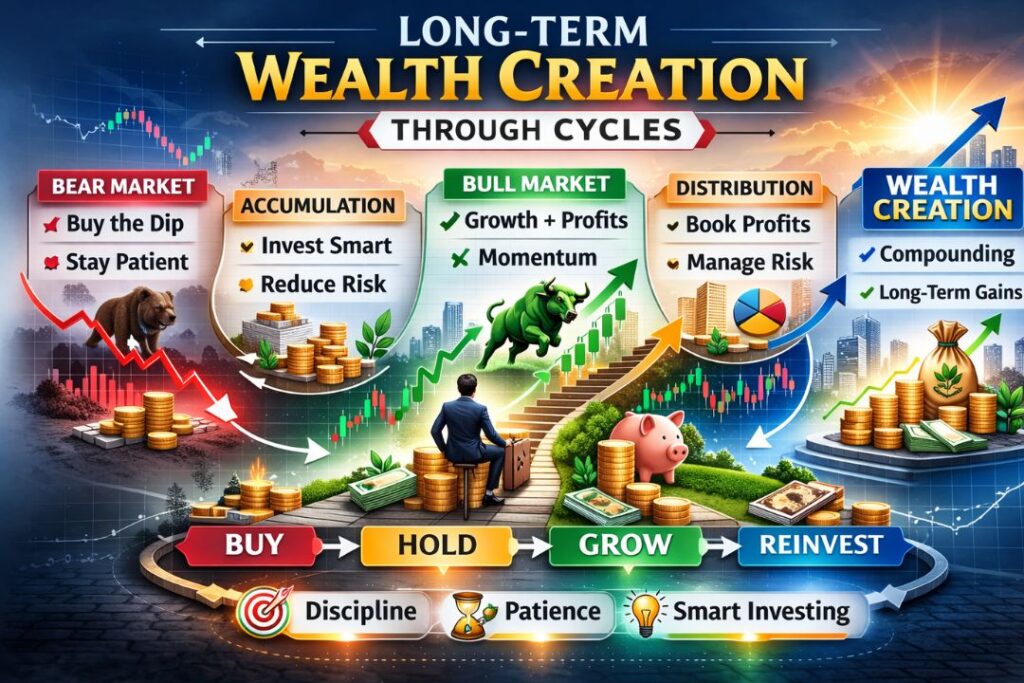
Investors who study history realize that wealth is created not by predicting daily moves but by surviving full cycles.
For example:
- Investors who stayed invested during market crashes have historically benefited during recovery rallies.
- Those who exited during panic frequently missed strong rebounds.
This is why long-term discipline combined with knowledge of market cycles understood becomes a competitive advantage.
Role of Institutional Investors
Institutional investors such as mutual funds, hedge funds, and pension funds significantly impact market direction.
During Accumulation:
They quietly build positions.
During Distribution:
They slowly reduce exposure while retail investors buy aggressively.
Retail investors who understand market cycles explained try to align with institutional behavior rather than react emotionally.
Asset Allocation Based on Market Stage
Smart investors adjust allocation rather than fully exiting markets.
Aggressive Allocation
- Higher equity exposure
- Growth stocks
- Small and mid-cap focus
Balanced Allocation(Late Bull/Distribution)
- Mix of equity and debt
- Defensive stocks
- Partial profit booking
Conservative Allocation
- Higher debt allocation
- Gold exposure
- systematic investing approach
Asset allocation reduces volatility impact and improves long-term sustainability.
Dividend investing across market cycles
Dividend-paying companies behave differently in each stage.
- In bull markets, growth shares outperform.
- In bear markets, dividend stocks provide stability and earnings.
Investors seeking steady returns frequently rotate into dividend stocks during uncertain conditions. This strategic move reflects a mature understanding of market cycles explained.
Market Timing versus Time in the Market
Many investors attempt perfect entrance and exit timing. Nevertheless, timing the market consistently is extremely difficult.
Instead of pursuing perfection:
- Focus on gradual investing
- Use SIP strategies
- Maintain diversification
Understanding market cycles explained improves awareness but should not encourage reckless timing efforts.
Behavioral finance and decision making
Human behavior plays a massive role in investing results.
Common biases include:
- recency bias
- Confirmation bias (looking for information that supports existing beliefs)
- Loss aversion(fear of losses more than desire for gains)
Recognizing these biases enhances the application of market cycles explained in real-life investing.
Technology and AI Effect on Modern Market Cycles
Modern markets react faster because of:
- Algorithmic trading
- High-frequency trading
- AI-driven analysis
- Instant global news flow
While momentum has increased, the fundamental structure of market cycles explained remains unchanged. Human psyche still drives long-term movements.
Practical checklist before investing
Before entering into any trade or investment
- Which phase is the wider market in?
- Is the sector aligned with the present cycle?
- Are valuations reasonable?
- What is the risk reward ratio?
- Do I have a stop-loss plan?
This structured thinking reduces emotional mistakes.
Final Thoughts on Market Cycles
Financial markets reward patience, discipline and education. Short-term noise frequently distracts investors, but long-term cycles remain consistent.
The purpose of learning market cycles explained is not to predict accurate tops and bottoms but to improve probability, reduce risk, and stay aligned with macro trends.
Over decade, markets have always moved through cycles of optimism and fear. Those who understand the rhythm survive recessions and benefit from recoveries.
The true edge in investment comes from:
- emotional control
- Strategic allocation
- Continuous learning
- Long-term perspective
When you combine these principles with a deep understanding of market cycles, you move from reacting to markets to strategically navigating them.
Frequently Asked Questions (FAQs)
1.What are market cycles in the stock market?
Market cycles refer to the recurring stages that financial markets go through over time, including accumulation, markup (bull market), distribution, and markdown (bear market). Understanding market cycles explained helps investors recognize whether the market is rising, falling, or consolidating.
2.How long does a market cycle generally last?
There is no definite duration for a market cycle. It can last from a few months to several years, depending on economical conditions, interest rates, global events, and investor sentiment.
3.What is the difference between a bull market and a bear market?
A bull market is characterized by rising prices, strong investor confidence, and economical growth.
A bear market involves falling prices, fear-driven selling, and economic recession.
4.How can beginners recognize the current market phase?
Beginners can analyze:
- Index trends(higher highs or lower lows)
- Moving averages (50 day and 200 day)
- Trading Volume
- Economic Indicators
- Policies updates from the Reserve Bank of India
These factors assist in understanding where the market stands within the cycle.
5.Is it possible to predict market cycles correctly?
No one can predict market cycles with full accuracy. However, studying historic patterns, economic data, and technical signals improves probability and decision-making.
6.Should investors stop investment during a bear market?
Not necessarily. Long-term investors frequently continue systematic investments during bear markets because lower prices can provide better long-term opportunities when recovery begins.
7.Why is understanding market cycles important for long-term investment?
Understanding market cycles interpreted allows investors to:
- Avoid emotional decisions
- Manage risk better
- Improve entry timing
- Build wealth consistently
Knowledge of cycles helps investors stay disciplined rather than reacting to short-term market noise.
Disclaimer:
This article is for informational and educational purposes only.
It does not constitute financial, investment, or trading advice.
Market investments are subject to risk, and past performance does not guarantee future results.
Please consult a certified financial advisor before making any investment decisions.
