
Introduction
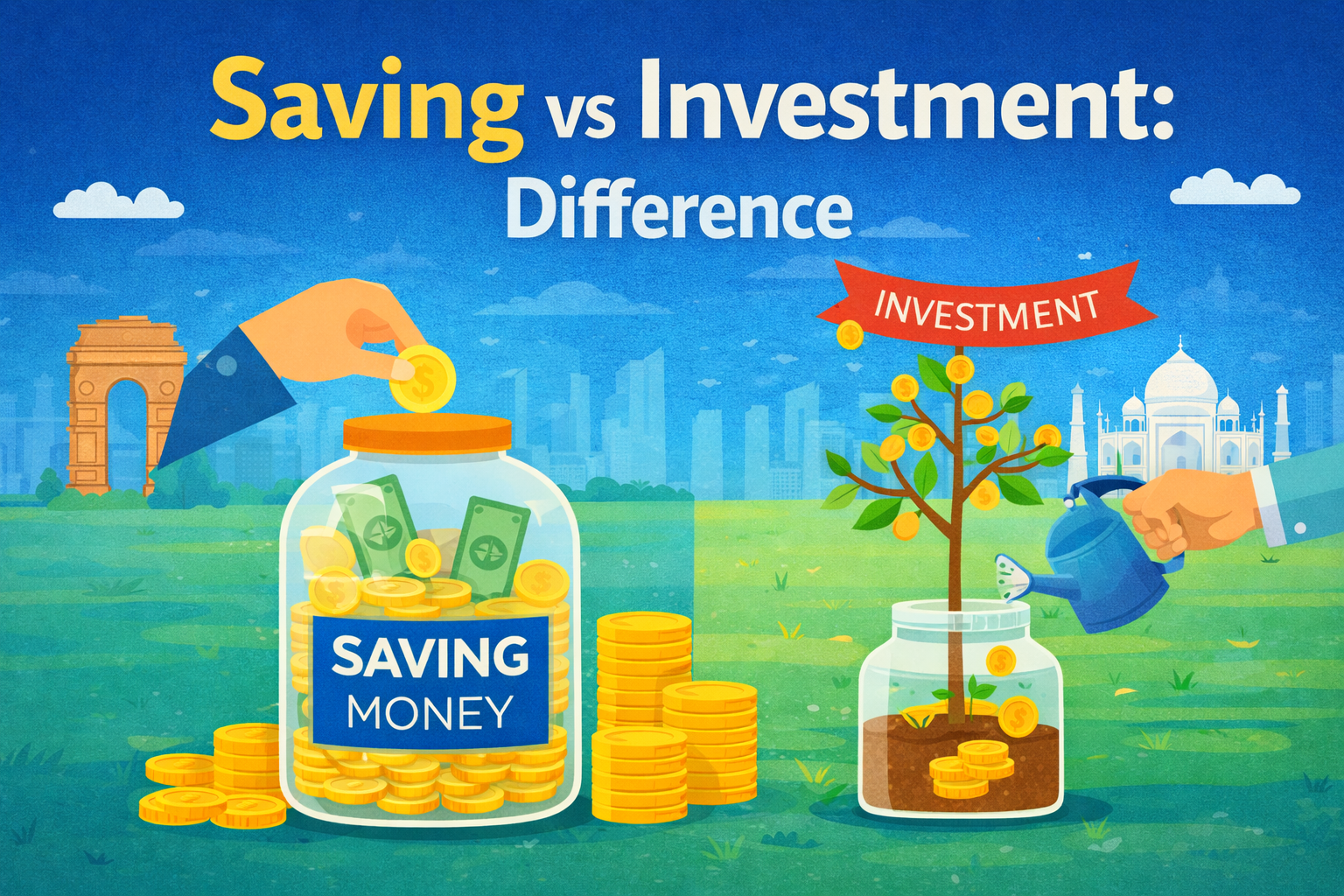
In today’s era, everyone wants to earn money, but very few people know how to manage that money properly. If you want to strengthen your financial position, then you have to understand the Saving vs Investment Difference in depth.
Often people consider saving and investment to be the same, but in financial science both are completely different and serve different purposes. Savings give you immediate security, while investing helps you turn your future dreams into reality.
In this comprehensive guide, our main focus is to uncover every aspect of the Saving vs Investment difference so that you can make the right financial decisions in 2025. We will not only explain the fundamental differences between the two but also provide you with the right investment strategy that will help you beat inflation and create wealth.
Let’s start your financial journey through this 7-point guide and learn how understanding the Saving vs Investment Difference can make a big and positive difference in your life.
Saving vs Investment Difference and the Right Way to Achieve Financial Freedom
In today’s era, everyone wants to earn money, but very few people know how to manage that money properly. If you want to strengthen your financial position, then you have to understand the Saving vs Investment Difference in depth. Often people consider saving and investment to be the same, but in financial science these two are completely different. In this blog, we will discuss in detail what is better for your future.

What is saving?
Saving means that part of your current income which you keep aside for future use. This is usually done to meet short-term goals or emergency needs. The primary goal of saving is capital preservation, not capital appreciation.
Key features of Saving:
- low risk:In this, your principal amount is usually safe, like in a bank account.
- Liquidity:You can withdraw your money instantly (like from an ATM) whenever you want.
- Diminishing returns:The interest earned is very low (usually 3-4% per annum).
Savings gives you peace of mind, knowing you have a safety net for unpredictable expenses like medical bills, car repairs, or job loss. This peace of mind is an important part of the Saving vs Investment Difference, as investing doesn’t offer this immediate security. It is best to keep it in a separate bank account so that it does not get mixed up with everyday expenses.
What is Investment?
Investment means investing your money in assets that can increase its value over time and earn you returns. The main goal of investing is wealth creation and growing your money faster than the inflation rate.
Key features of Investment:
Potential for Returns:The returns are much higher than savings, as there is risk involved.
Risks:There is a risk of market volatility; You may even lose some money.
Compounding:In investing, you get the tremendous benefit of ‘interest on interest’ or ‘return on return’, which Albert Einstein called the eighth wonder of the world.
Investing puts your money to work for you. Over the long term, this makes your money grow exponentially, allowing you to achieve your larger financial goals like retirement or buying a home.
Saving vs Investment Difference: Key Differences
Understanding the Saving vs Investment Difference is the most important step in your financial journey. Here is a table explaining the main differences:
| आधार | बचत (Saving) | निवेश (Investment) |
|---|---|---|
| मुख्य उद्देश्य | अल्पकालिक लक्ष्य और आपातकाल | दीर्घकालिक वेल्थ क्रिएशन |
| जोखिम | ना के बराबर (Low Risk) | मध्यम से उच्च (Higher Risk) |
| संभावित रिटर्न | बहुत कम (आमतौर पर 3-4%) | अधिक (10-15% या ज्यादा संभव) |
| तरलता (Liquidity) | बहुत अधिक (तुरंत उपलब्ध) | निवेश के प्रकार पर निर्भर (कुछ में लॉक-इन होता है) |
| महंगाई (Inflation) | महंगाई को मात नहीं दे पाती | महंगाई को मात देने की क्षमता रखती है |
| कंपाउंडिंग | बहुत कम प्रभाव | जबरदस्त प्रभाव (समय के साथ बढ़ता है) |
This difference between savings and investment shows that they are not substitutes for each other, but complementary. A balanced mix of both makes a strong financial plan.
7 Big Benefits of Saving and Investing
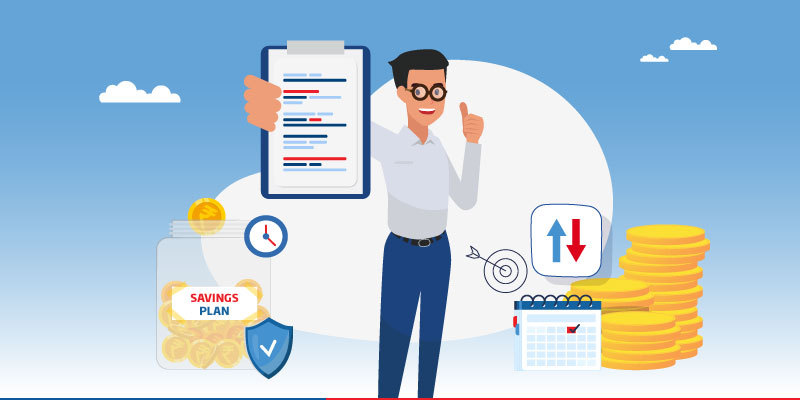
Both have their own importance. Here are 7 key benefits to ensure your financial security and prosperity:
1.Financial Safety Net:
The biggest advantage of saving is that it protects you from unexpected financial shocks. A good emergency fund, equivalent to 3 to 6 months of essential expenses, gives you peace of mind during a job loss or health crisis and protects you from expensive personal loans or credit card debt.
2.Beating Inflation:
Money kept in savings loses its purchasing power over time. If the interest on FD is 7% and inflation is 6%, your actual return is only 1%. Investments, especially in equities (stock markets), have historically delivered returns well above the inflation rate over the long term.
3.Leveraging Compounding:
This is the most powerful weapon of investment. You not only earn returns on your original investment, but also on your returns. The sooner you start investing, the more time compounding will have to work its magic.
4.Achieving Long-Term Goals:
Savings may be capable of meeting your smaller goals, like a 3-month vacation, but investing is essential for bigger goals like retirement or children’s education. The main Saving vs Investment difference here is that investment gives you the strength to fight inflation. Options like equity mutual funds can offer returns of 10-15% or more, which helps build the large corpus required for these goals, which is not possible through savings alone.
5.Avoiding Debt:
A strong emergency fund protects you from taking on high-interest debt during tough times.
6.Tax Efficiency:
Many investment options, such as Public Provident Fund (PPF), Equity-Linked Savings Schemes (ELSS), and National Pension Scheme (NPS), offer tax breaks, allowing you to legally save your income and grow your wealth more efficiently.
7.Source of Passive Income:
Certain investments, such as dividend-paying stocks or real estate, can provide you with an additional source of regular income, increasing your financial independence.
How does inflation eat away your money?
Inflation is a silent killer that quietly erodes the value of your money. The average inflation rate in India usually ranges between 4% and 7%.
Imagine, today a cup of tea costs ₹20. If the inflation rate is 6%, the same tea will cost ₹21.20 next year.
Now, if you have kept ₹1000 in your savings account, on which you get 4% interest. After one year, you will have ₹1040.
But, due to inflation rate of 6%, the goods which you could buy for ₹1000 today, you will need ₹1060 next year to buy them.
This means you have ₹20 less – your money is actually giving negative returns instead of growing.
This is why simply saving is not enough. You should invest your money in instruments that give returns higher than the inflation rate. Asset classes such as equities and real estate have historically proven to be a good hedge against inflation.
The right strategy for you: Striking a balance
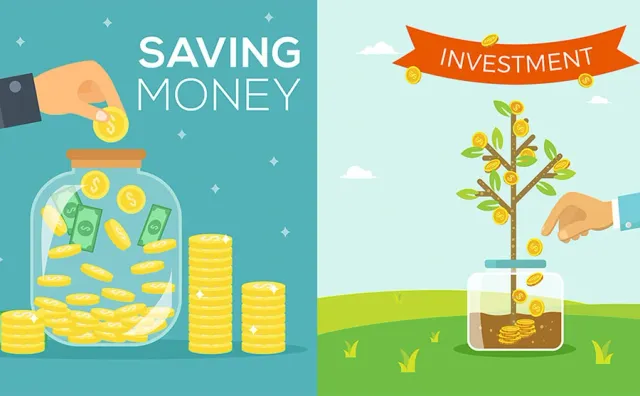
Correct financial planning is not just about choosing between saving or investing, but about striking a balance.
1.Create an emergency fund
Put the first part of your income into your emergency fund. The goal should be to accumulate an amount equivalent to 3 to 6 months of essential expenses (like rent, food, EMI, school fees). Keep this money in safe and liquid instruments, such as savings account, sweep-in FD or liquid mutual funds. This is your financial security blanket.
2.Start long-term investing
Once you have an emergency fund, start investing your remaining income (at least 20% of your monthly income) for long-term goals. Here your focus should be on wealth creation.
An Ideal Mix:
- Low-risk goals (0-3 years): FDs, RDs, debt mutual funds.
- Moderate-risk goals (3-10 years): Hybrid funds, balanced funds, ULIPs.
- High-risk/long-term goals (10+ years): Equity mutual funds (through SIP), direct share buying, NPS, PPF.
Discipline and regularity are the keys to success. Even if you start with a small amount, it is important to invest regularly.
Best Investment Options for 2025
There are many excellent options available in the Indian market for wealth creation in 2025. You can choose based on your risk appetite and goals.
Low Risk Options
These options prioritize security and stability.
- Public Provident Fund (PPF): This is a government-backed scheme that offers guaranteed returns and tremendous tax benefits (EEE – Exempt, Exempt, Exempt). It is great for long-term, secure growth with a 15-year lock-in.
- Bank Fixed Deposit (FD): FDs offer a fixed interest rate for a fixed tenure. These are safe and suitable for those looking for fixed returns, although returns often lag behind inflation.
- National Savings Certificate (NSC): This is also a government scheme which has a lock-in of 5 years and offers tax benefits under Section 80C.
Medium Risk Options
These strike a balance between security and development.
- Hybrid Mutual Funds: These funds invest in both equity and debt instruments, thereby reducing risk while maintaining growth potential.
- Real Estate: A traditional investment option in India. It can provide good returns over the long term and hedge against inflation, but it is less liquid (it may be difficult to sell).
High Risk Options
These options offer the potential for higher returns but are subject to market fluctuations.
- Equity Mutual Funds: These are the easiest way for small investors to participate in the growth of the stock market. Professional fund managers invest your money in shares of various companies. You can start with just ₹100 through SIP (Systematic Investment Plan).
- Direct Equity/Stocks:In this you directly buy shares of listed companies. It has the highest return potential but requires extensive research, market knowledge, and a high risk appetite.
To start investing, you can open an account on online platforms like Groww or Zerodha. For more information about investing, you can also use external resources like Investopedia.
Conclusion
Understanding the Saving vs Investment Difference is the first and most important step towards Financial Freedom. Savings give you immediate security, while investing helps you turn your future dreams into reality.
By depending solely on savings, you will lag behind in the race of inflation. This is an important Saving vs Investment Difference which is often overlooked by people. At the same time, just investing without any safety net can be risky. Take a disciplined and balanced approach: create an emergency fund, and then make regular long-term investments.
Get started today. Time is the biggest companion of investment. The sooner you start, the greater the magic of compounding.
Note: This blog post is for informational purposes only. Before taking any financial decision, it is always advisable to consult your financial advisor.
(FAQs) – Saving vs Investment Difference
Here are answers to savings and investment Difference questions that people often search on Google:
Q1: What is the main Saving vs Investment Difference?
The most basicSaving vs Investment Difference is that saving keeps your money safe (like a bank account), while investing makes your money grow (like a mutual fund). Savings have low risk and low returns, whereas investing has some risk but offers high returns.
Q2: Why is it important to understand the difference between saving and investment to become rich?
If you don’t understand the Saving vs Investment Difference, you will keep all your money in a savings account where inflation will slowly erode it. To become rich, you need to invest your money so that it can grow through ‘compounding’. This is the main Saving vs Investment Difference that exists between a rich and a common man.
Q3:Can we save and invest at the same time?
yes of course! A good financial plan is one that balances the Saving vs Investment Difference. You should keep a part of your income for emergency fund (Saving) and the other part should be invested for future goals (Investment).
Q4:What role does the Saving vs Investment Difference play in the case of inflation?
Inflation reduces the value of your money. Savings typically lag behind inflation, while investments have the potential to beat inflation. Therefore, to avoid inflation, it is important to move towards investment by knowing the Saving vs Investment Difference.
Q5: Is it difficult for beginners to know the difference between Saving and Investment?
No, it’s very simple. Just remember to do ‘Saving’ for short term and ‘Investment’ for long term (more than 5 years). Once you master this Saving vs Investment Difference, your path to financial freedom becomes easier.
Disclaimer : This article, Saving versus Investment: Difference and 5 Big Benefits, is published for educational and informational purposes only. The information provided herein does not constitute financial, investment, tax, or legal advice.
Saving and investing options may vary based on an individual’s financial goals, income level, risk tolerance, and market conditions. Readers are advised to conduct their own research or consult with a certified financial advisor before making any financial or investment decisions.
The author and the website are not responsible for any financial losses, risks, or consequences arising from the use of the information presented in this article. Market-related investments are subject to market risks, and past performance is not indicative of future returns.
By reading this article, you agree that any action taken based upon the content is at your own discretion and responsibility.
