

Introduction
In the vast world of financial markets, traders follow different strategies depending on their goals, time availability, risk hunger, and personality. Some traders purchase and sell within minutes. Others held positions for days. And then there are those who aim to capture major price trends over weeks or even months these traders practice positional trading.
Positional trading is one of the most balanced and tactical forms of trading. It combines the analytical depth of long-term investing with the strategic precision of shorter-term trading. For busy professionals, swing traders looking to level up, or investors seeking higher returns than passive investing, Trend-Based Trading offers a mighty middle ground.
This full guide will help you understand:
- What is positional trading?
- How it works
- Key strategies and indicators
- Risk management techniques
- Advantages and disadvantages
- Different between intraday, swing, and Trend-Based Trading
- Real-world examples
- Psychological discipline is required
- How to Build a Trend-Based Trading Plan
Let’s dive deep.

What is Positional Trading?
Positional trading is a trading strategy where a trader holds a financial asset (stock, commodity, cryptocurrency, crypto, etc.) for a longer period typically from several weeks to several months to capture major price trends.
Unlike intraday traders who close positions the same day, positional traders hold through minor fluctuations and focus on the wider trend.
Simple Definition:
Trend-Based Trading is trend-based trading where positions are held long enough to capture significant price moves.
Best Timeframe for Trend-Based Trading
Typical holding period includes:
- 2 weeks
- 1 month
- 3 months
- Sometimes 6–12 months
Commonly used charts:
- Daily chart
- Weekly Chart
- Monthly chart
Lower timeframes like 15-minute or hourly charts are seldom used for primary decisions.
How Trend-Based Trading Works
Positional trading works on the principal that:
Big money is made in big moves.
Markets move in trends:
- Uptrend
- Downtrend
- Sideways
A positional trader identifies the beginning of a strong trend and enters early. The goal is to remain in the trend until it shows signs of reversal.
Basic Process:
- Identify Strong Stock
- Confirm trend direction
- Enter at breakout or pullback
- Place stop loss below key level.
- Hold Patiently
- exit near resistance
Difference between intraday, swing & positional trading
| Feature | Intraday Trading | Swing Trading | Positional Trading |
|---|---|---|---|
| Holding Time | Minutes to hours | 2–10 days | Weeks to months |
| Stress Level | Very High | Moderate | Low |
| Time Required | Full Day | 1–2 hours | 30–60 mins daily |
| Brokerage Cost | High | Medium | Low |
| Profit Size | Small per trade | Medium | Large trend capture |
| Risk | High | Medium | Controlled |
Trend-Based Trading fits those who cannot watch markets all day.
Types of Positional Trading
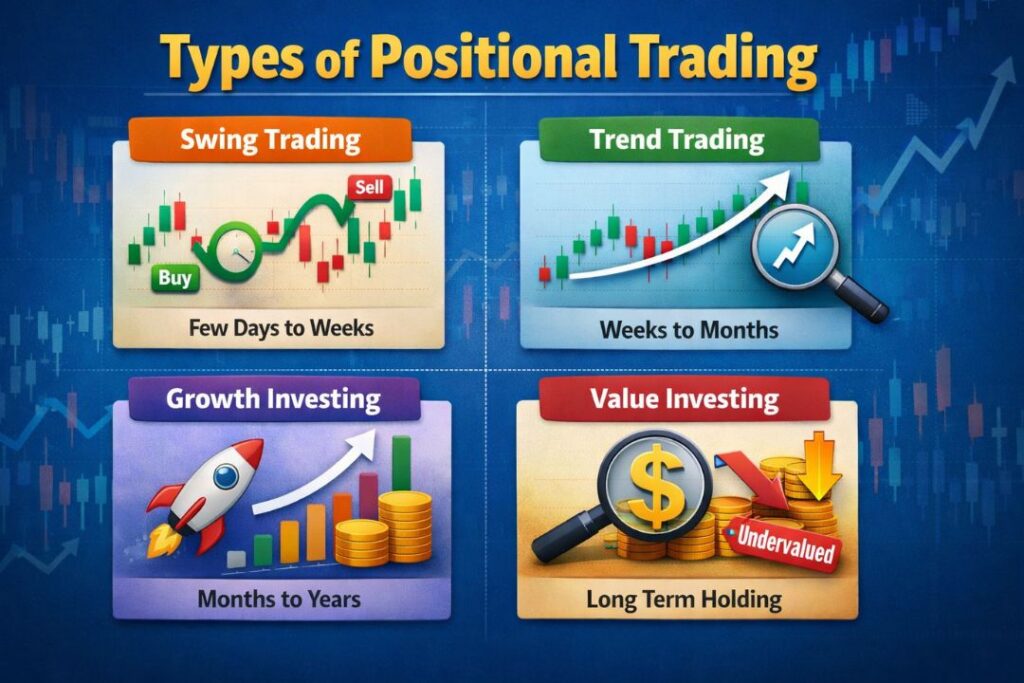
1.Trend Following Strategy
Traders enter when a strong uptrend or downtrend starts and ride the trend.
Indicators used:
- Moving Averages
- ADX
- MACD
2.Breakout Trading
Entry when price breaks major resistance or support.
Example:
If a stock consolidates for 6 months and breaks above resistance with higher volume, positional traders enter.
3.Pullback Strategy
Purchasing during temporary corrections in an uptrend.
Example:
Stock in strong uptrend falls to 50-day moving average — nice entry zone.
4.fundamental Trend-Based Trading
Combined financial results, earnings growth, and industry trends with technical setup.
Best indicators for Trend-Based Trading
1.moving averages
Used to confirm trend.
Golden Cross:
50 DMA crossing above 200 DMA→ Bullish
Death Cross:
Bearish
2.MACD
Helps identify moment shifts.
3.RSI(Relative Strength Index)
Best used for pullbacks:
RSI near 40 in uptrend → Buying opportunity
RSI near 60 in downtrend → Selling opportunity
4.Volume Analysis
Breakouts must occur with strong volume.
5.Support & Resistance
Entry near support.
Exit near resistance.
risk management in positional trading
Risk management distinguishes successful traders from gamblers.
1.Stop-Loss Rule
Always put stop-loss below major support.
Example:
Entry at ₹1000
Support at ₹950
Stop-loss at ₹940
2.Risk Per Trade
Never risk more than 1-2% of total capital per trade.
3.Position Sizing
Capital allocation based on stop loss distance
4.Trailing Stop-Loss
Move stop-loss upward as the price rises.
Benefits of Trend-Based Trading
- Less Stress
- Lower Brokerage
- Bigger Profit Potential
- More Time for Analysis
- Avoid Market Noise
- Works well in trending markets
Disadvantages of Trend-Based Trading
- Requires Patience
- Capital Blocked for Long Term
- Overnight Risk
- Trend Reversal Risk
- Requires Discipline
Trend-Based Trading Psychology
Emotional discipline is key.
Common Mistakes:
- Booking profit too early
- Fear during corrections
- Overleveraging
- Ignoring stop-loss
Golden Rule:
Let profits run. Cut losses early.
Patience is the greatest weapon of positional traders.
Example of Trend-Based Trading (Illustration)
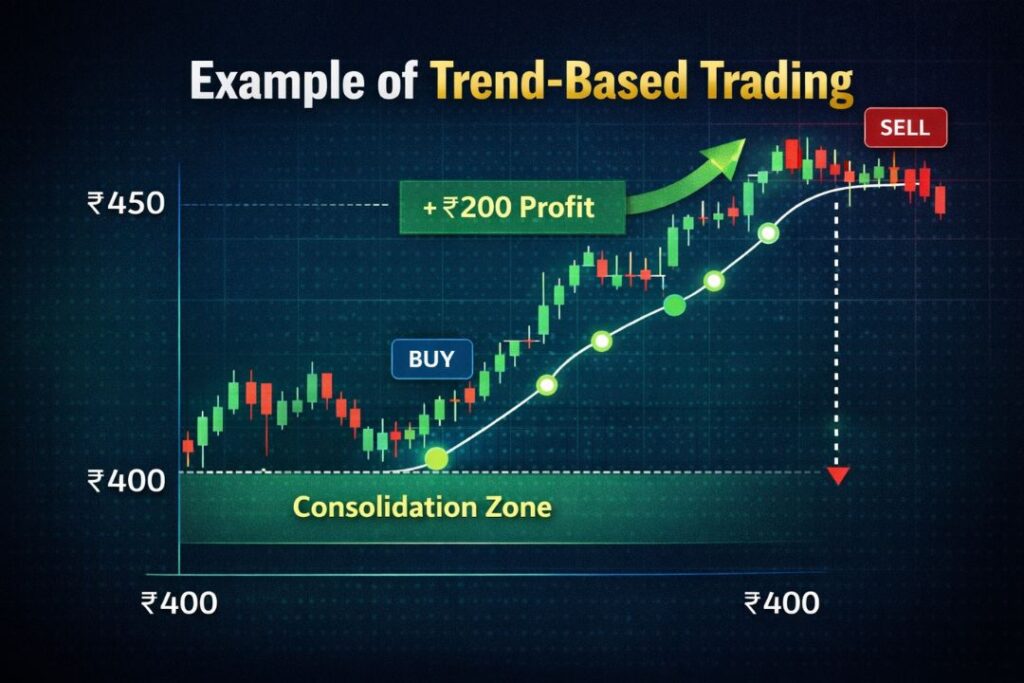
Assume a stock trades between ₹500–₹550 for 4 months.
Breakout above Rs 550 with high volume.
Entry: ₹560
Stop-loss: ₹520
Target: ₹700–₹800
Holding period: 2–4 months
This is classic positional trade.
Positional Trading vs. Long-Term Investment
| Feature | Positional Trading | Investing |
|---|---|---|
| Based On | Technical + Trend | Fundamentals |
| Holding Period | Months | Years |
| Entry Timing | Important | Less Important |
| Stop-Loss | Strict | Rarely Used |
| Objective | Capture trend | Wealth Creation |
Appropriate Markets for Positional Trading
- Stock Market
- Commodity Market
- Forex Market
- Cryptocurrency
- Index Trading
Works best in trendy environments.
Best Time frame for Indian Traders
Daily chart is most powerful for positional trading.
Weekly chart confirms main trend
Avoid 5-minute or 15-minute noise.
How to Choose Stocks for Positional Trading
Look for:
- Strong Earnings Growth
- Sector Leader
- High Volume Breakout
- Institutional Buying
- Clean Chart Structure
- Strong Relative Strength
Avoid:
- Penny stocks
- Low volume stocks
- News-based speculation
Capital Required
You can begin Trend-Based Trading with:
- ₹20,000 (small stocks)
- Rs 1,00,000 (better flexibility)
- ₹5,00,000+
Leverage must be used carefully.
Step-by-Step Positional Trading Plan
- Select 10–15 strong stocks
- Study daily chart
- Mark support & resistance
- Wait for breakout or pullback
- Enter with proper stop-loss
- Risk only 1–2%
- Trail stop-loss
- Exit on trend reversal
Consistency beats aggression.
Common Myths Regarding Trend-Based Trading
- You need huge capital
- It is the same as investing
- It guarantees profit
- Only experts can do it
Truth:
With discipline and knowledge, everyone can learn.
Who should do Trend-Based Trading?
- Working Professionals
- Part-time Traders
- Long-term Investors want better entry
- Low-stress traders
- People with patience
Not suitable for:
- Impulsive traders
- High adrenaline intraday traders
Advanced concepts in Trend-Based Trading
Sector Rotation
Investment in sectors showing momentum
Relative Strength
Compare stock versus index performance.
Moving Average Ribbon
Multiple moving averages confirmed trend strength.
Risk-Reward Ratio
Minimum 1:2 ratio is recommended.
Real-World Case Study (Example Structure)
A strong stock in IT sector:
Consolidation: 3 months
Breakout: With volume
Uptrend: 40% rally in 5 months
Positional traders captured entire move.
Intraday traders missed big trend.
Taxation in Trend-Based Trading (India)
Holding Period:
Less than 1 year – Short Term Capital Gains (STCG)
More than 1 year – Long Term Capital Gains (LTCG)
Plan accordingly.
Final checklist before taking trade
- Is the trend strong?
- Is breakout confirmed?
- Is the volume high?
- Is risk-reward favorable?
- Is stop-loss defined?
- Is position size correct?
If yes – Enter confidently.
Conclusion
Trend-Based Trading is one of the most powerful trading strategies for those who wants:
Big profits
Less screen time
controlled risk
Structured approach
It sits perfect between short-term trading and long-term investing.
Success in positional trading does not come from forecasting the market every day. It comes from:
- Following trend
- Managing risk
- Staying patient
- Being disciplined
Remember:
The market rewards patience more than pace.
If you master positional trading, you can transform your financial journey with confidence and continuity.
FAQs
1.What is positional trading?
This is a strategy where traders hold stocks for weeks or months to capture bigger price trends.
2.How long is a positional trade?
Typically 2 weeks to 6 months, depending on the trend.
3.Is it better than intraday trading?
It depends. Positional trading is less stressful and demands less screen time.
4.Is stop-loss important?
Yes. Stop-loss is compulsory to control risk.
5.Can beginners do it?
Yes. It is often easier than intraday trading if appropriate risk management is used.
6.Is stop-loss necessary in positional trading?
Absolutely yes. Stop-loss protects your capital and prevents major losses. Every trade must have a predefined exit level.
7.Do I need large capital for positional trading?
No. You can start with smaller capital like ₹20,000-₹50,000, but better flexibility comes with higher capital. Appropriate risk management is more important than capital size.
Disclaimer :
This material is for educational purposes only and not financial advice. Trading involves risk. Please do your own research and consult a financial advisor before investment. The author is not liable for any financial losses.
Stay connected for more such information https://stockhubnews.com
