
Introduction
In an emerging economy like India, government policies are not merely administrative decisions; they are the heartbeat that determines the country’s economic direction. The policy-making process becomes even more important amid changing global conditions, technological revolution, population structure and investment climate.
In this context, Policy Pulse is an approach through which we deeply analyse government policies, monetary decisions, budget reforms and regulatory changes. This article will explain to you how Policy Pulse impacts India’s economic structure, business environment, investment opportunities and the lives of common citizens.
What is Policy Pulse and why is it important?
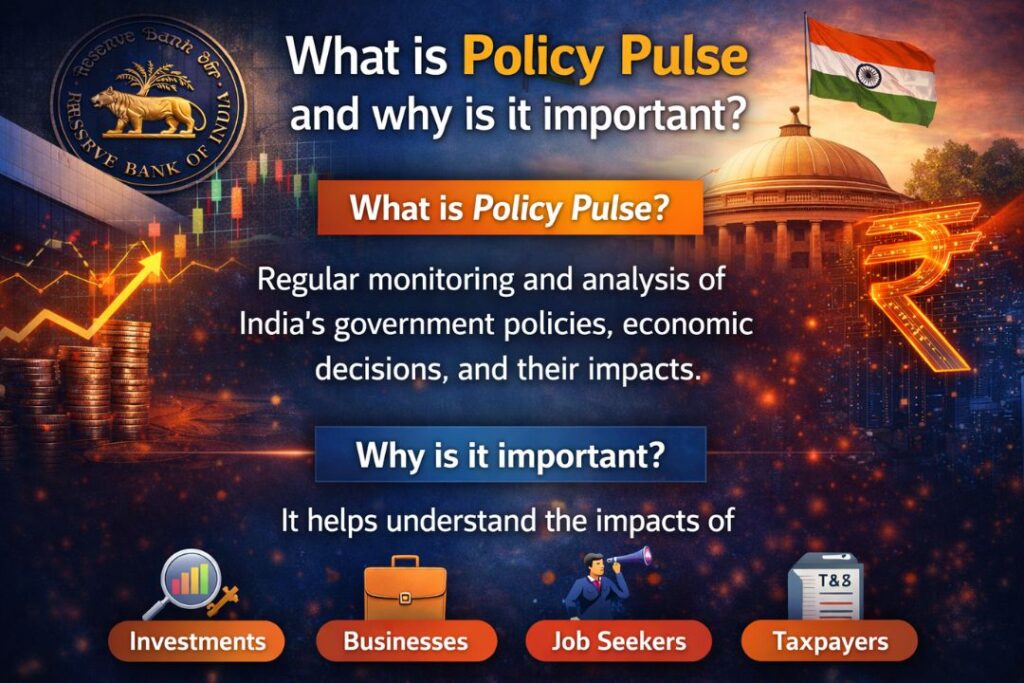
In simple words, Policy Pulse means regular monitoring of government policies, their analysis and understanding their impact.
When the government changes tax rates, when the central bank increases or decreases interest rates, or when new digital policies are implemented it has a direct impact on the country’s economy.
Why is it necessary?
- For investors
- For businesses
- For students and job seekers
- For taxpayers
- For startup founders
Just reading the news isn’t enough these days. It is more important to understand the economic thinking behind it and its long-term impact. This is what Policy Pulse does.
Monetary Policy and the Indian Economy
The monetary policy of India is conducted by the Reserve Bank of India.
Key instruments of monetary policy:
- Cash Reserve Ratio (CRR)
- Statutory Liquidity Ratio (SLR)
When the RBI increases the repo rate, borrowing becomes more expensive for banks. As a result:
- Home loan EMIs increase
- Business loans become more expensive
- Liquidity in the market decreases
- Inflation is controlled
If we regularly track these changes through Policy Pulse, investment decisions can be made more intelligently.
2026 Perspective
India’s monetary policy is adopting a balanced approach due to global inflationary pressures and fluctuations in energy prices.
Budget and Tax Reforms: Blueprint for Economic Direction
The Union Budget of every year clarifies the economic priorities of India. The budget presented by Finance Minister Nirmala Sitharaman is not just a statement of income and expenditure, but it is also a strategy for development.
Key components of the budget:
- Changes in income tax slabs
- Capital expenditure
- Infrastructure investment
- Rural development schemes
- Startup incentives
When the government reduces tax rates, consumption increases.
When capital expenditure is increased, employment is created.
It is important to understand the sector-wise impact after the budget through Policy Pulse.
Digital Economy and New Policies
India’s digital revolution is being led by the Digital India initiative, which began during Narendra Modi’s tenure.
Key areas of digital policy:
- UPI expansion
- Digital payment security
- Data protection law
- Artificial intelligence policy
- Cybersecurity
With the expansion of digital infrastructure:
- Fintech companies are growing rapidly
- The e-commerce sector has strengthened
- MSMEs have found new markets
Policy Pulse is becoming an important tool for understanding the economic impact of digital policies.
India’s Policy in the Global Context
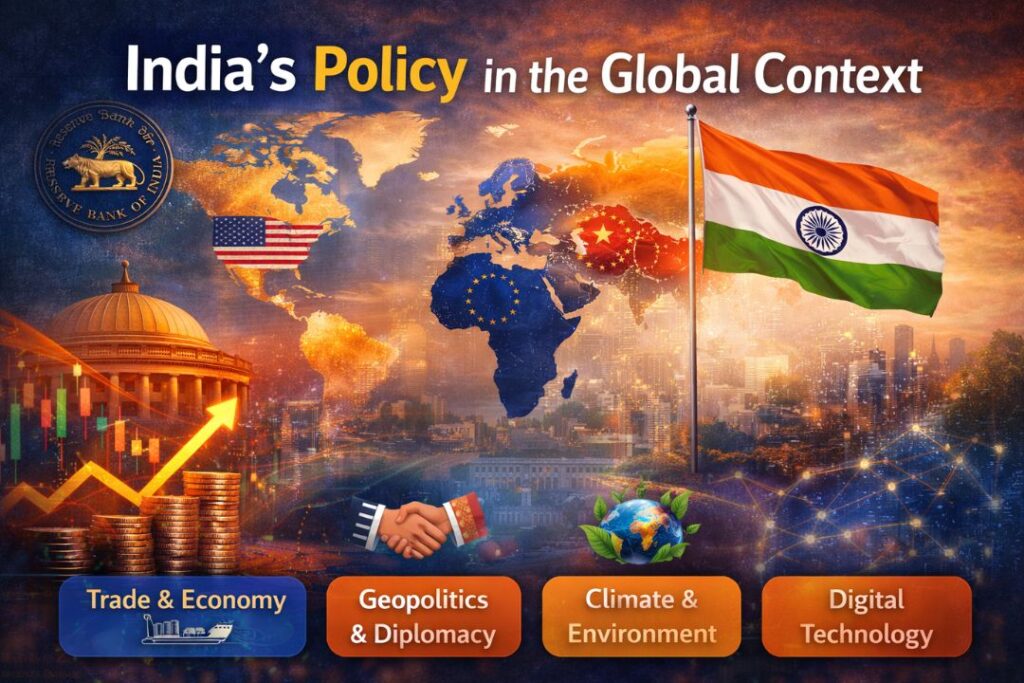
India’s policies are no longer limited to domestic needs. Reports from international institutions such as the International Monetary Fund and the World Bank also influence policymaking.
Global factors:
- Oil prices
- Strengthening dollar
- Geopolitical tensions
- Risk of global recession
Foreign investment in India may be affected when the US raises interest rates.
Therefore, Policy Pulse’s global analysis is equally important.
Policy Impact on Businesses
Government policies directly affect the business environment.
Examples:
- GST simplification → Ease of compliance
- Production-Linked Incentives (PLI) Growth in manufacturing
- Labor law reforms Changes in employment structure
Regularly reading Policy Pulse provides businesses with the following benefits:
- Planning for the future
- Determining tax strategies
- Selecting investment expansion timing
- Managing risk
Strategic Importance for Investors
The stock market is extremely sensitive to policy changes.
If:
- Interest rates fall – Banking and real estate sectors strengthen
- Capital expenditure increases – Infrastructure stocks rise
- Digital policy strengthens – Tech sector benefits
Therefore, long-term investors should pay attention to Policy Pulse’s analysis.
Impact on the Common Citizen
The impact of government policies is not limited to corporations.
Impact on daily life:
- LPG subsidies
- Electricity rates
- Education loans
- Agricultural support prices
- Health insurance plans
If citizens understand Policy Pulse, they can:
- Make better financial decisions
- Plan taxes
- Take advantage of government schemes
Key Policy Trends in 2026
- Green Energy Investment
- Semiconductor Manufacturing
- Digital Currency Use
- Rural Infrastructure
- Startup Innovation
The government is playing an active role in all these areas.
Policy Pulse can be a medium to identify these emerging trends.
How to do policy analysis?
To adopt an effective Policy Pulse approach:
Step 1: Read official sources
- RBI reports
- Budget documents
- NITI Aayog reports
Step 2: Understand sector-wise impacts
Step 3: Compare short-term and long-term outcomes
Step 4: Add global context
Risks and Challenges
Policymaking is not always simple.
Key Challenges:
- Political Pressures
- Global Instability
- Fiscal Deficit
- Inflation
If policy is not balanced, economic instability may arise.
That’s why Policy Pulse’s unbiased and data-driven analysis is crucial.
The Future
India is on its way to becoming a $5 trillion economy.
Achieving this goal requires:
- Stable monetary policy
- Balanced fiscal policy
- Strong digital infrastructure
- Global competitiveness
Policy Pulse is a tool for understanding future economic direction.
Data-driven policy analysis: The real key to understanding
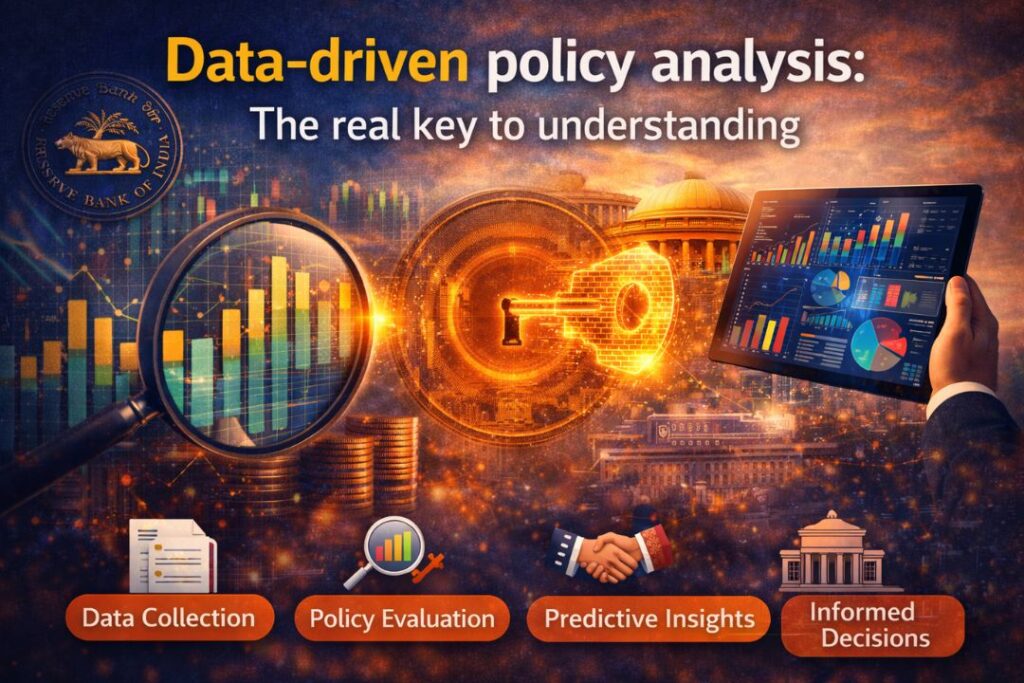
In today’s times, relying only on announcements is not enough. data to understand the real impact of any policy,It is necessary to analyze economic indicators and behavioral consequences. This is where a structured Policy Pulse approach becomes most effective.
The Role of Economic Indicators
Some key indicators are crucial for measuring the impact of policies:
- GDP Growth Rate
- Inflation Rate (CPI/WPI)
- Unemployment Rate
- Index of Industrial Production
- Fiscal Deficit
If the government increases capital expenditure, growth in the infrastructure and construction sectors may be visible within a few months. Similarly, if the central bank keeps interest rates consistently high, consumer demand may slow.
The correct approach to policy analysis is to distinguish between short-term fluctuations and long-term structural changes.
Understanding Sector-Specific Impacts
Not every policy has the same impact on all sectors. For example:
- Green energy incentives – Benefits solar and renewable companies
- Defense budget increase – Strengthens the defense manufacturing sector
- MSME relief package – Cash flow support for small businesses
If we only read the headlines, we don’t get the full picture. But when we study sector-wise impact in depth, investment and business decisions become more strategic.
The Aspect of Social and Regional Inequality
The impact of policies should also be considered at the social level.
- Are rural areas getting more benefits?
- Is the tax burden on the urban middle class increasing?
- Are women entrepreneurs getting encouragement from the new schemes?
When policy making is balanced, development becomes inclusive. Otherwise, inequality risks increasing.
Therefore, policy analysis should be done not only from the economic perspective but also on the basis of social impact.
Transparency and Accountability
Transparency is essential in any democratic system.
- Are the policy goals clear?
- Is there a deadline?
- Are progress reports public?
When policies are data-driven and transparent, the confidence of investors and citizens increases.
A mature analysis framework ensures that we focus on results, not just announcements.
Long-term vision versus immediate benefits
Many times, governments make short-term, popular decisions that may not have as positive long-term impact.
The right approach is to look at:
- Will this policy still be profitable in five years?
- Will this increase productivity?
- Will this strengthen India in global competition?
The real success of the policy lies in its sustainability and structural reforms.
Conclusion
India’s economy is constantly undergoing changes. Government policies, monetary decisions, budget reforms and digital initiatives together determine the economic direction of the country. It is not enough to understand all these changes superficially; It is more important to understand the strategy behind these, the long-term impact and the potential risks.
As a conscious citizen, investor or businessman, we should keep a regular track of policy changes. The right information and analysis helps us make better financial decisions, reduce risks and identify opportunities.
After all, the economic strength of any country depends on the clarity, transparency and stability of its policies. Only when we make informed decisions about policy changes can we move forward towards economic progress, individually and collectively.
FAQ
1.What is Policy Pulse and why is it important for the common people?
Policy Pulse is an analytical approach to understand the impact of government policies, budget announcements, and monetary decisions. It helps in understanding not just the news but its economic and social impact. Common citizens can take better financial and tax related decisions through this.
2.What impact do government policies have on the stock market?
Government policies directly affect the stock market. For example, if interest rates fall, the banking and real estate sectors may benefit. If infrastructure spending increases, construction and steel companies could see a boost. Therefore, policy updates are very important for investors.
3.What is the difference between monetary policy and fiscal policy?
Monetary policy is conducted by the Reserve Bank of India, which includes decisions such as interest rates and cash controls.
Fiscal policy is made by the government, which includes tax rates, government spending, and budget management. Together, they keep the economy balanced.
4.What impact do the budget announcements have on the common taxpayer?
There may be changes in income tax slabs, subsidies, and government schemes in the budget. If tax rates decrease, people’s disposable income increases. If government spending increases, employment and business opportunities may increase.
5.How are digital policies transforming India’s economy?
Digital payments, data protection laws and startup incentive schemes are making India’s economy more transparent and faster. Digital infrastructure is providing new opportunities to small businesses and fintech companies, thereby boosting economic activity.
6.What key indicators should be considered when conducting policy analysis?
While doing policy analysis, attention should be paid to indicators like GDP growth rate, inflation, unemployment rate, fiscal deficit and industrial production. These indicators show how the policy is actually impacting the economy.
Disclaimer : This article has been prepared for educational and informational purposes only. The information presented herein is based on public sources and general economic analysis.
This material does not constitute investment, tax, legal or financial advice of any kind. Please consult your certified financial advisor, tax expert or related professional before making any investment or financial decision.
The views expressed in the article may change with time, circumstances and policy changes. Neither the author nor the publisher will be responsible for any financial loss, investment decisions, or economic consequences.
