
When we talk about the economy, most people imagine big companies, offices, factories, stock markets, and government regulations. But there’s another side of the economy that quietly runs in the background one that doesn’t show up clearly in official statistics. This is called the informal economy.
You’ve seen it everywhere: street vendors selling snacks, freelancers working without contracts, small repair shops, domestic workers, or even someone earning cash by doing odd jobs. These are all part of the informal economy.
In this blog, we’ll break everything down in a simple and relatable way what the informal economy is, how it works, why it exists, its pros and cons, and why it matters more than you think.
What is the Informal Economy?
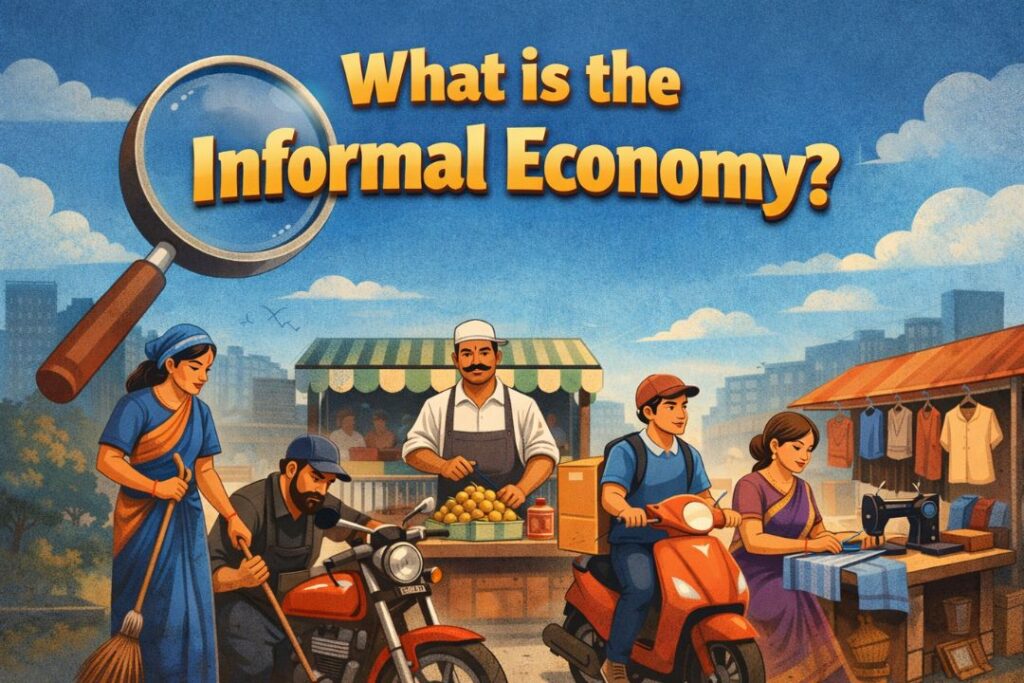
The informal economy refers to all economic activities that are not regulated, taxed, or officially recorded by the government.
In simple words, it’s the kind of work where:
- There is no formal contract
- No fixed salary structure
- No job security
- Often no taxes involved
For example:
- A roadside chai seller
- A freelance graphic designer working without registration
- A housemaid paid in cash
- A small vendor selling clothes without a license
These people are working, earning, and contributing to the economy but they are not officially recognized in the formal system.
Why Does the Informal Economy Exist?
The informal economy isn’t just random it exists for real reasons. Let’s understand why.
1. Lack of Formal Job Opportunities
In many countries, especially developing ones, there aren’t enough formal jobs for everyone. So people create their own work.
2. Easy Entry
Starting a formal business requires paperwork, licenses, and investment. Informal work, on the other hand, is easy to start.
Example:
If someone wants to sell food on the street, they can start the same day without much setup.
3. Survival Needs
For many people, informal work is not a choice it’s a necessity. They need to earn daily to survive.
4. Avoiding Regulations and Taxes
Some people choose informal work to avoid taxes or strict government rules.
5. Low Skill Requirements
Many informal jobs don’t require formal education or specialized training.
Types of Informal Work
The informal economy is very diverse. It includes many types of work:
1. Street Vendors
People selling food, fruits, clothes, or accessories on roadsides.
2. Domestic Workers
Housemaids, cooks, drivers, babysitters.
3. Daily Wage Laborers
Construction workers, helpers, loaders.
4. Small Shop Owners
Local shops that may not be officially registered.
5. Freelancers and Gig Workers
Designers, writers, photographers working without contracts.
6. Home-Based Workers
People making products from home like handicrafts, food items, or tailoring.
Key Features of the Informal Economy
Here are some common characteristics:
- No formal registration
- No written contracts
- Payments mostly in cash
- Irregular income
- No job security
- No employee benefits (like insurance or pension)
- Small-scale operations
Real-Life Examples
To understand better, let’s look at some everyday examples:
- A person selling pani puri at a roadside stall
- A mechanic fixing bikes in a small roadside garage
- A woman stitching clothes at home
- A delivery person working independently without a formal company
All these are part of the informal economy.
Advantages of the Informal Economy
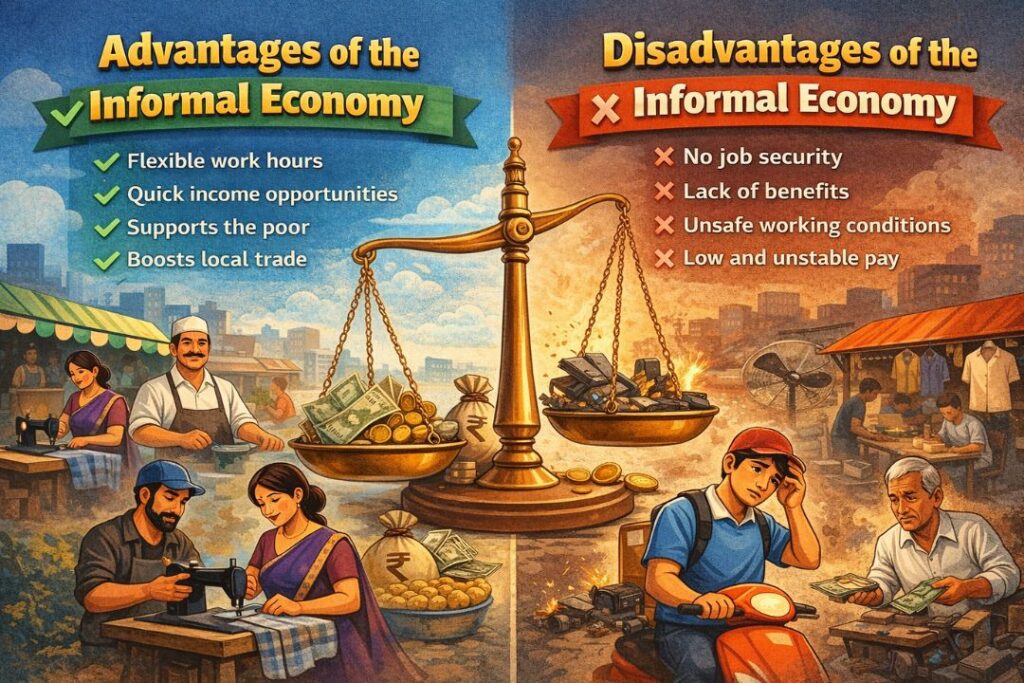
Even though it’s not officially structured, the Unofficial economy has many benefits.
1. Provides Employment
It creates jobs for millions of people who might otherwise be unemployed.
2. Easy to Start
No heavy investment or paperwork is required.
3. Flexible Work
People can work according to their own time and availability.
4. Supports Local Communities
It helps meet daily needs at affordable prices.
5. Encourages Entrepreneurship
People can start small businesses without fear of failure.
Disadvantages of the Informal Economy
While it has benefits, there are also serious downsides.
1. No Job Security
Workers can lose their job anytime without notice.
2. Low and Unstable Income
Earnings are unpredictable and often very low.
3. No Legal Protection
Workers are not protected by labor laws.
4. No Social Benefits
No health insurance, pension, or paid leave.
5. Risk of Exploitation
Employers may take advantage of workers.
6. Unsafe Working Conditions
Many informal jobs lack safety measures.
Informal Economy vs Formal Economy
Let’s compare both:
| Feature | Informal Economy | Formal Economy |
|---|---|---|
| Registration | Not registered | Registered |
| Taxes | Usually not paid | Paid regularly |
| Job Security | No | Yes |
| Contracts | No written contracts | Legal contracts |
| Benefits | None | Insurance, pension, leave |
| Income | Unstable | Stable |
Role of Unofficial economy in Developing Countries
In countries like India, the informal economy plays a huge role.
- A large percentage of people work in informal jobs
- It supports rural and urban livelihoods
- It acts as a safety net during unemployment
In fact, without the informal sector, many economies would struggle to function.
Impact on the Government
The informal economy also affects governments in different ways.
Positive Impact:
- Reduces unemployment
- Keeps economic activity running
Negative Impact:
- Loss of tax revenue
- Difficult to regulate
- Hard to measure economic growth accurately
COVID-19 and the Informal Economy
The pandemic showed how vulnerable informal workers are.
- Many lost their income instantly
- No savings or support systems
- Migrant workers faced major hardships
This highlighted the need for better protection and policies.
Challenges Faced by Informal Workers
Informal workers deal with many daily struggles:
- Income uncertainty
- Lack of financial access (loans, banking)
- No healthcare support
- No retirement plans
- Limited growth opportunities
How Can the Informal Economy Be Improved?
Instead of eliminating it, governments try to improve and support it.
1. Formalization
Encouraging businesses to register officially.
2. Skill Development
Providing training to improve productivity.
3. Access to Finance
Helping workers get loans and banking services.
4. Social Security
Providing insurance, pensions, and healthcare.
5. Simplifying Rules
Making it easier to register and run small businesses.
Digital Revolution and Unofficial economy
Technology is slowly changing the informal sector.
- Digital payments (like UPI)
- Online marketplaces
- Social media selling
- Gig economy platforms
These tools are helping informal workers grow and reach more customers.
Is Informal Economy Good or Bad?
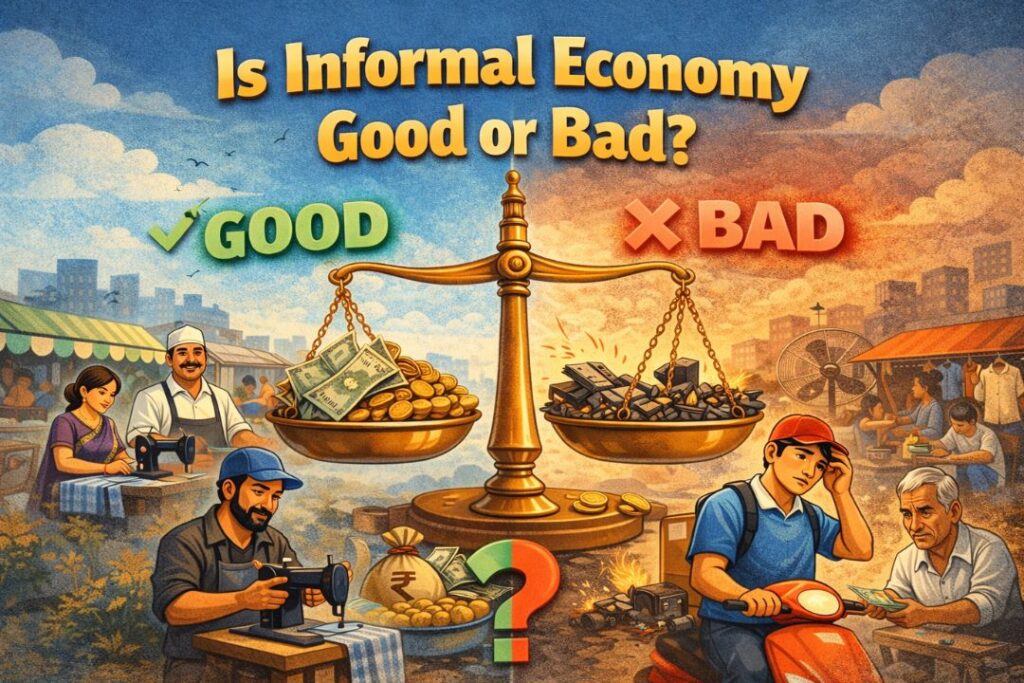
The answer is not simple.
It’s both necessary and problematic.
- It helps people survive and earn
- But it also lacks protection and stability
So, instead of removing it, the goal should be to make it safer and more organized.
The Future of Unofficial economy
The informal economy is not going away anytime soon.
But its future may include:
- More digital integration
- Better government support
- Gradual formalization
- Improved working conditions
Final Thoughts
The informal economy is like the unseen backbone of everyday life. It may not always be visible in official reports, but it plays a massive role in keeping society running.
From the tea vendor on your street to the freelancer working from home, these individuals are contributing to the economy in meaningful ways.
Understanding the informal economy helps us appreciate the efforts of millions of people who work hard every day without recognition, security, or benefits.
Instead of ignoring it, we should focus on supporting and improving it so that everyone gets a fair chance to grow, earn, and live with dignity.
FAQs on Informal Economy
1. What is the informal economy in simple terms?
The informal economy includes jobs and businesses that are not officially registered with the government. These activities usually don’t follow formal rules like paying taxes, having contracts, or providing employee benefits.
2. What are some common examples of informal work?
Some everyday examples include street vendors, housemaids, construction laborers, small roadside shop owners, freelancers without contracts, and home-based workers like tailors or food makers.
3. Why do people work in the informal economy?
Most people work in the informal sector because it’s easy to enter, requires little investment, and provides immediate income. In many cases, people don’t have access to formal job opportunities, so this becomes their main source of livelihood.
4. Is the informal economy legal?
It depends. Some informal activities are legal but unregistered, while others may operate without proper permissions. The main issue is that these activities are not officially monitored or regulated.
5. What are the biggest problems faced by informal workers?
Informal workers often deal with unstable income, no job security, lack of healthcare or insurance, unsafe working conditions, and no legal protection if something goes wrong.
6. Can informal businesses become formal?
Yes, they can. With proper registration, licenses, and compliance with government rules, informal businesses can transition into the formal economy. Governments often encourage this by simplifying processes and offering support.
Disclaimer : This article is for informational purposes only. The content is based on general knowledge and does not constitute professional, legal, or financial advice. Readers are advised to do their own research or consult a qualified expert before making any decisions.
