
Introduction :
Inflation is one of the most important economic issues that affects households, businesses, and governments. In simple terms, inflation means a general increase in prices of goods and services over time. When inflation rises, the purchasing power of money decreases, which means people can buy fewer goods with the same amount of money.
For a large developing economy like India, controlling inflation is essential for maintaining economic stability and protecting consumers from rising living costs. If inflation increases rapidly, it can reduce savings, affect business planning, and create financial uncertainty.
In India, inflation management is mainly handled by the central bank, the Reserve Bank of India, along with economic policies implemented by the government. Through a combination of monetary and fiscal policies, India attempts to maintain price stability while supporting economic growth.
This article explains India’s inflation control policy in India, the tools used by policymakers, and the overall impact on the Indian economy.
What is Inflation?
Inflation refers to the increase in the overall price level of goods and services in an economy during a specific period of time. When inflation rises, the cost of living also increases because people need to spend more money to purchase everyday goods such as food, fuel, housing, and transportation.
Inflation is usually measured using the Consumer Price Index (CPI). CPI tracks the price changes of a group of commonly used goods and services consumed by households.
India follows an inflation targeting system, which means policymakers aim to maintain inflation within a specific range.
India’s Inflation Target
- Target inflation rate: 4%
- Acceptable range: 2% to 6%
If inflation goes above or below this range, the central bank may take corrective actions to stabilize the economy.
Major Causes of Inflation in India
Understanding the causes of inflation is important for designing effective policies to control it.
1. Demand-Pull Inflation
Demand-pull inflation occurs when the demand for goods and services increases faster than supply. This often happens during periods of strong economic growth when people have higher income and spending increases.
Businesses may increase prices because more people are willing to buy products.
2. Cost-Push Inflation
Cost-push inflation occurs when the cost of production increases. When companies face higher costs for raw materials, wages, or transportation, they often pass those costs on to consumers by increasing prices.
Important factors include:
- Rising crude oil prices
- Increased transportation costs
- Higher wages
- Supply shortages
3. Food Inflation
Food prices play a major role in India’s inflation because food products form a large part of household spending.
Factors influencing food inflation include:
- Weak monsoon
- Crop damage
- Supply chain disruptions
- Storage limitations
4. Imported Inflation
India imports many commodities such as crude oil and electronic products. If global prices increase or the Indian rupee weakens against the US dollar, the cost of imports rises. This leads to higher domestic prices.
Role of Monetary Policy in Inflation Control
Monetary policy refers to the actions taken by the central bank to control the supply of money and interest rates in the economy.
The Reserve Bank of India uses several tools to manage inflation.
Repo Rate
The repo rate is the interest rate at which commercial banks borrow money from the central bank.
When inflation rises, the central bank may increase the repo rate. This makes borrowing more expensive, which reduces spending and investment. As a result, demand decreases and inflation slows down.
Reverse Repo Rate
The reverse repo rate is the interest rate at which banks deposit money with the central bank.
When this rate increases, banks prefer to deposit funds with the central bank instead of lending them to businesses and consumers. This reduces the amount of money circulating in the economy.
Cash Reserve Ratio (CRR)
CRR is the percentage of bank deposits that must be kept with the central bank.
If CRR increases, banks have less money available for lending. This reduces liquidity and helps control inflation.
Open Market Operations
Open market operations involve buying or selling government securities in the financial market.
When the central bank sells government securities, money is withdrawn from the economy. This helps reduce inflationary pressure.
Fiscal Policy and Inflation Control
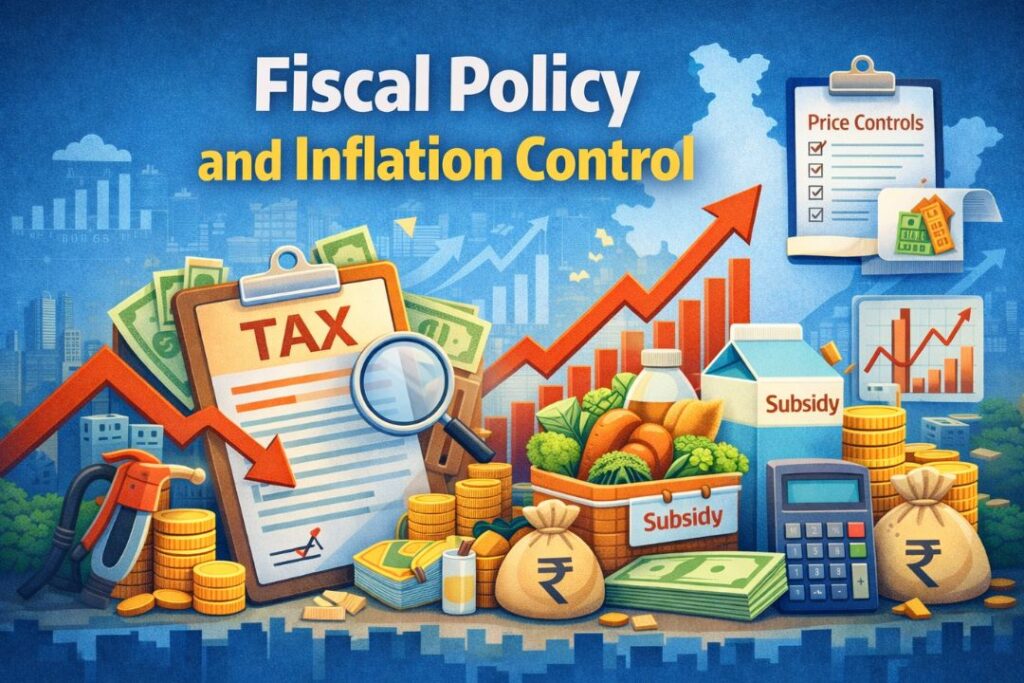
Fiscal policy refers to government decisions regarding taxation and public spending.
The government can influence inflation through fiscal measures.
Government Spending
If government spending increases significantly, demand in the economy may rise and create inflationary pressure.
To control inflation, the government may reduce unnecessary expenditure.
Taxation Policies
Increasing certain taxes can reduce consumer spending and lower demand in the economy. Lower demand helps stabilize prices.
Subsidies and Price Support
The government often provides subsidies for essential goods such as food and fuel to protect consumers from price increases.
These subsidies help reduce the burden of inflation on households.
Inflation Targeting Framework
India adopted a formal inflation targeting framework in 2016.
Under this system, interest rate decisions are taken by the Monetary Policy Committee (MPC).
The committee includes six members who evaluate economic conditions and determine the appropriate policy interest rate.
The main objectives include:
- Maintaining price stability
- Supporting economic growth
- Ensuring financial stability
Challenges in Controlling Inflation
Despite strong policies, inflation control remains challenging in India.
Agricultural Dependence
India’s agriculture sector depends heavily on monsoon rainfall. Poor rainfall can reduce crop production and increase food prices.
Global Economic Shocks
Global events such as wars, energy crises, and supply chain disruptions can cause sudden increases in commodity prices.
Currency Fluctuations
If the Indian rupee weakens, imports become more expensive, which can increase inflation.
Supply Chain Issues
Poor logistics, transportation bottlenecks, and storage problems can increase the cost of goods and contribute to inflation.
Impact of Inflation on the Economy
Inflation affects different groups in different ways.
Consumers
High inflation reduces purchasing power and increases the cost of living.
Businesses
Companies may face higher production costs and reduced profitability.
Investors
Investors often move their money into assets like stocks, real estate, or gold to protect against inflation.
Economic Growth
Moderate inflation can support growth, but extremely high inflation can create instability.
Government Measures to Manage Inflation
The Indian government uses several strategies to stabilize prices.
These include:
- Increasing food supply through buffer stocks
- Reducing import duties on essential goods
- Monitoring commodity prices
- Supporting agricultural production
These measures help prevent sudden price increases in essential goods.
Future Outlook
India continues to improve its inflation management system through policy reforms and economic development.
Key improvements include:
- Strengthening monetary policy framework
- Expanding infrastructure and supply chains
- Improving agricultural productivity
- Enhancing digital financial systems
With these improvements, India aims to maintain stable inflation and sustainable economic growth.
How Inflation Affects Everyday Life in India
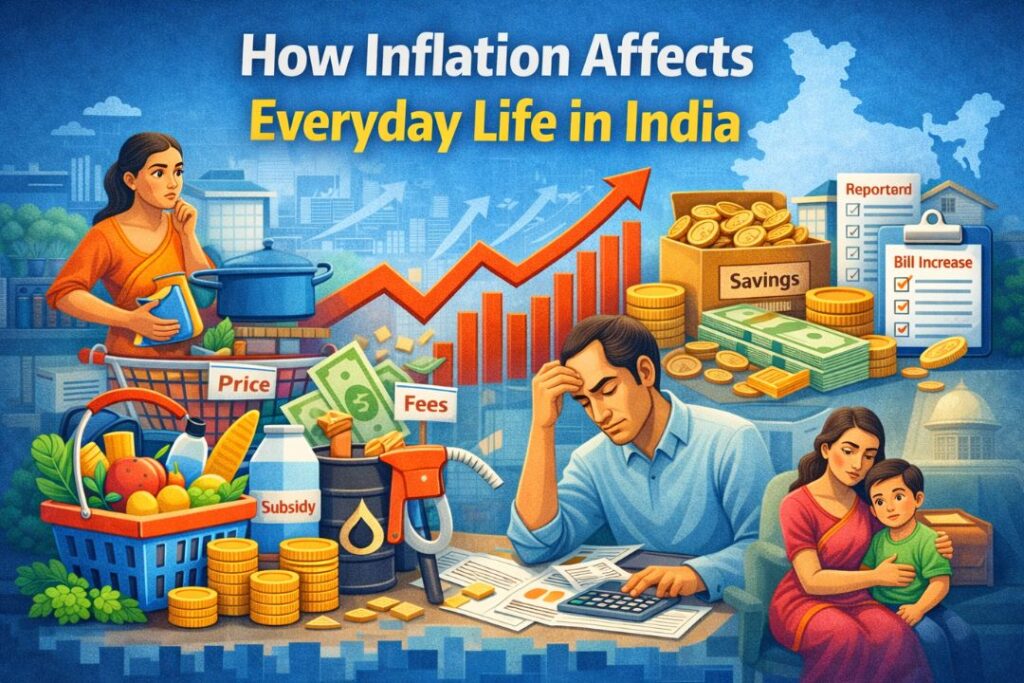
Inflation is not just an economic concept discussed by policymakers and economists; it directly affects the everyday life of millions of people across India. From the price of vegetables in local markets to fuel costs and housing expenses, inflation influences how families manage their budgets and make financial decisions.
For an average household, even a small increase in inflation can significantly impact monthly expenses. For example, if the price of essential goods like cooking oil, vegetables, milk, and fuel rises, families must spend more money on daily necessities. This reduces the amount of money available for savings, education, healthcare, or leisure activities.
In India, food inflation plays a particularly important role because a large portion of household income is spent on food items. When food prices increase due to factors such as poor monsoon, supply shortages, or rising transportation costs, it puts additional financial pressure on households. This is why managing food supply and agricultural production is an important part of inflation control policy in India.
Fuel prices are another major factor affecting inflation. India imports a large amount of crude oil, and changes in global oil prices can quickly affect domestic fuel prices. When petrol and diesel prices increase, transportation costs also rise. This increase in transportation costs eventually leads to higher prices for goods and services across the economy.
Inflation also affects businesses and industries. When production costs increase, companies may need to raise the prices of their products to maintain profitability. For example, if raw materials become more expensive or wages increase, businesses may pass these costs on to consumers. This creates a chain reaction where prices rise across multiple sectors of the economy.
Small businesses are particularly vulnerable to inflation because they often operate with limited financial resources. Rising costs of electricity, transportation, and raw materials can reduce their profit margins. As a result, some businesses may reduce production, delay expansion plans, or increase prices for their products.
At the same time, inflation can influence investment decisions. Investors often look for ways to protect their money from losing value due to rising prices. In India, many investors choose to invest in assets such as stocks, real estate, and gold during periods of higher inflation. These assets are considered potential hedges against inflation because their value may increase over time.
For policymakers, the challenge is to maintain a balance between economic growth and price stability. Very low inflation may indicate weak demand in the economy, while very high inflation can reduce purchasing power and create uncertainty. Therefore, maintaining moderate inflation is considered healthy for economic growth.
The Indian government and the central bank continuously monitor economic indicators to assess inflation trends. They analyze factors such as food supply, fuel prices, global commodity markets, and domestic demand. Based on these factors, policymakers adjust interest rates, manage liquidity, and implement fiscal measures to stabilize prices.
Another important aspect of inflation control is improving supply chains and infrastructure. Efficient transportation systems, better storage facilities, and improved agricultural productivity can help reduce supply shortages and stabilize prices. Over the years, India has invested significantly in infrastructure development to improve the movement of goods across the country.
Digital technology is also playing a role in improving market efficiency. Online marketplaces, digital payment systems, and improved data monitoring help authorities track price movements and respond quickly to supply disruptions.
In the long run, controlling inflation requires a combination of sound economic policies, strong institutions, and continuous monitoring of market conditions. As India’s economy continues to grow and integrate with global markets, inflation management will remain a key priority for policymakers.
Ultimately, stable inflation helps create a healthy economic environment where businesses can grow, consumers can plan their spending, and investors can make long-term financial decisions with confidence. For a developing country like India, maintaining price stability is essential for achieving sustainable and inclusive economic growth.
Conclusion
Inflation control is essential for maintaining economic stability and protecting consumers from rising living costs. India uses a combination of monetary policy tools and fiscal measures to control inflation.
The coordination between the government and the central bank has strengthened inflation management in recent years. Although challenges such as food price volatility and global economic shocks remain, India’s policy framework continues to evolve to ensure long-term price stability.
Final Thoughts
Inflation management is one of the most important responsibilities of economic policymakers. Stable prices help households plan their expenses, businesses make investment decisions, and investors manage their portfolios.
India’s inflation control policies aim to strike a balance between economic growth and price stability. As the economy grows, effective policy coordination will remain essential for maintaining sustainable development.
FAQ
What is inflation control policy in India?
Inflation control policy in India refers to the economic strategies used by governments and central banks to maintain stable prices in the economy.
Who manages inflation in India?
Inflation in India is primarily managed by the Reserve Bank of India through monetary policy decisions.
What is the ideal inflation rate in India?
India targets an inflation rate of around 4%, with an acceptable range between 2% and 6%.
Why is inflation important for the economy?
Moderate inflation supports economic growth, while very high inflation can reduce purchasing power and create economic instability.
Disclaimer : This article is intended for informational and educational purposes only. Economic policies and inflation trends may change depending on government decisions and global market conditions. Readers should conduct independent research or consult financial professionals before making financial or investment decisions.
