

Introduction
Equity mutual funds are one of the most popular investment choices for investors who want to build wealth over the long term. These funds invest primarily in shares of companies listed on the stock exchange, making them growth-oriented and suitable for investors with a higher risk appetite.
In India, equity mutual fund have gained huge popularity due to rising financial awareness, easy SIP options, and the potential to beat inflation over time. However, many investors still invest without completely understanding how equity mutual funds work, their types, risks, and the right strategy to follow.
This blog provides a complete guide to equity mutual fund, covering meaning, types, advantages, risks, taxation, SIP vs lump sum, and smart investment strategies.

What is an equity mutual fund?
An equity mutual fund is a type of mutual fund that investments at least 65% of its total assets in equity shares of companies. The main aim of these funds is capital appreciation over the long term.
When you invest in an equity mutual fund, your money is pooled with money from other investors and invested in a diverse portfolio of stocks by a professional fund manager.
How Equity Mutual Funds Work
- Investors invest money into the fund.
- The fund manager assigns money to selected stocks.
- Fund performance depends on stock market movements.
- Returns are reflected in the fund’s NAV (Net Asset Value)
Your returns increase when the value of underlying stocks increases and decrease when markets fall.
Types of Equity Mutual Funds
Large-Cap Equity Funds
These funds invest in large, well-established companies with steady earnings.
They offer comparatively lower risk compared to other equity funds.
Suitable for : Conservative equity investors
Mid-Cap Equity Funds
These funds invest in mid-sized companies with high growth potential.
They are more volatile but can provide higher returns.
Suitable for : Moderate to aggressive investors.
Small-Cap Equity Funds
These invest in smaller companies with very high growth potential and high risk.
Returns can be extraordinary, but volatility is high.
Suitable for: Aggressive investors with long time horizon.
Flexi-Cap Funds
These funds can invest freely across large-cap, middle-cap, and small-cap stocks.
Fund managers adjust allocation based upon market conditions.
ELSS(Tax Saving Equity Funds)
ELSS funds invest in equities and offer tax advantages under Section 80C.
They have a lockdown period of 3 years.
Sectoral/Thematic Funds
These funds concentrate on a specific sector like IT, banking, pharma, or themes like infrastructure.
High risk – high reward
Advantages of Equity Mutual Funds

High Return Potential
Over the long term, equity mutual funds have the potential to generate higher returns compared to conventional investments like FD or RD.
professional fund management
Seasoned fund managers make investment decisions based on research and market analysis.
Diversification
Your money is spread across multiple companies and sectors, minimizing overall risk.
SIP Convenience
You can start investing with small quantities through SIPs, making it affordable for salaried individuals.
Inflation Beating Returns
Equity mutual funds help protect buying power by beating inflation over time.
Risks of Equity Mutual Funds
Market Risk
Returns depend on stock market performance, which can be unstable in the short term.
No Guaranteed Returns
Unlike fixed deposits, equities mutual funds do not offer guaranteed returns.
Short-Term Losses
If markets decline, the NAV of equity funds can decline.
Sectoral Risk
Sector-specific funds may underperformance if that sector faces challenges.
Equity Mutual Funds vs Other Investments
Fixed Deposit vs Equity Mutual Fund
- Higher returns potential than FD
- Higher risk than FD
- Better for long-term goals
Equity Mutual Fund vs Direct Stocks
- Lower risk due to diversity
- Professionally managed
- Suitable for beginners
SIP vs lump sum in equity mutual funds
SIP Investment
- Invest a fixed amount monthly
- Reduces market timing risk
- Ideal for salaried investors
Lump Sum Investment
- One-time large investment
- Suitable when market appraisals are attractive
- Requires market understanding
Who should invest in equity mutual funds?
- Young investors
- Salaried professionals
- Long-term wealth creators
- Investors planning retirement
- Investors are comfortable with market ups and downs
Time horizon for equity mutual funds
Equity mutual funds work best when invest for:
- 5 years or more
- Ideally for 10+ years for best results
Longer time horizon reduces risk and enhances returns.
Taxation of equity mutual funds (India)
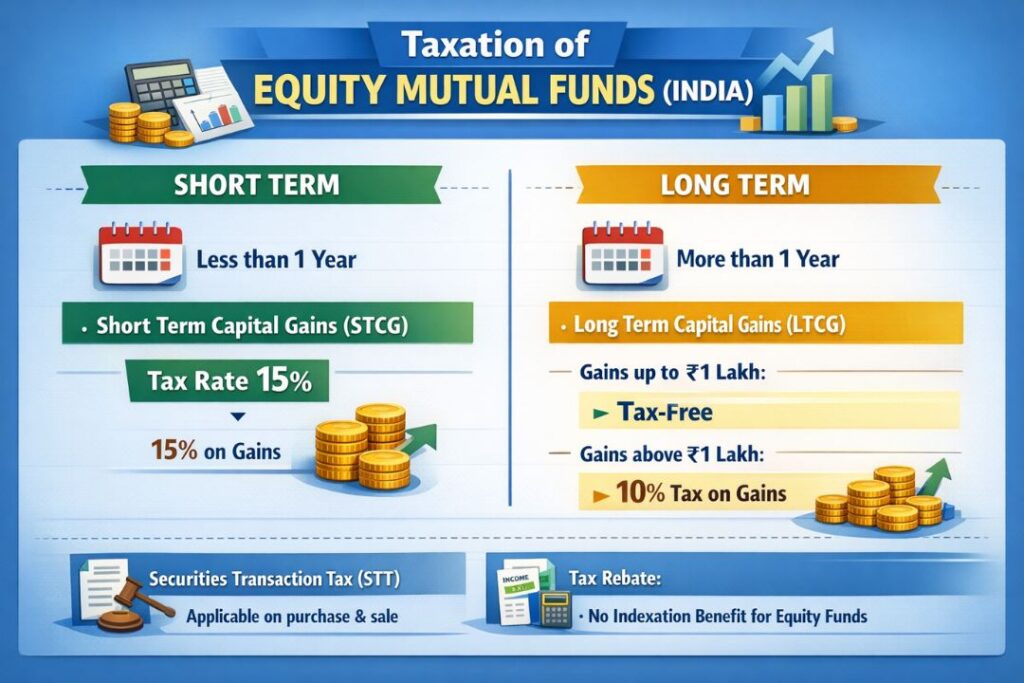
Short Term Capital Gains(STCG)
- Holding Period
- Tax: 15%
Long Term Capital Gains(LTCG)
- Holding period :More than 1 year
- Tax: 10% on gains above Rs 1 lakh per year
How to Select the Right Equity Mutual Fund
- Check fund category
- Analyze past performance (not just returns)
- Compare expense ratio
- Understanding fund manager track record
- Match funds with your risk profile.
Common Errors Investors Make
- Investing without target clarity
- Chasing past returns
- Exiting during market falls
- Investing without diversity
- Expecting short-term profits
Smart strategy for equity mutual fund investors
- Start SIP early
- Increase SIP with income increase
- Stay invested during market instability
- Review portfolio annually
- Avoid emotional decisions
Equity Mutual Funds and Long-Term Wealth Formation
Many investors have created considerable wealth by staying invested in equity mutual funds over decades. Compounding plays a powerful role when investments are permitted to grow over time.
Consistency and patient matter more than timing the market.
Conclusion
Equity mutual funds are one of the best tools for long-term wealth creation when used properly. They offer high return potential, professional management, and diversity, making them suitable for most investors.
However, they come with market risks, and investors must invest with a clear goal, long-term mentality, and disciplined strategy. When combined with SIPs and patience, equity mutual funds can help achieve major financial goals like retirement, children’s education, and financial freedom.
FAQs
Q1. Are equity mutual fund safe?
Equity mutual fund carry market risk, but long-term investing reduces risk significantly.
Q2. How much should I invest in equities mutual funds?
This depends on your income, goals, and risk appetite. SIPs can start as low as Rs.500.
Q3. Can beginners invest in equities mutual funds?
Yes, they are ideal for starters who want market exposure with professional management
Q4. How long should I remain invested in equity mutual funds?
Investors should ideally remain invested for at least 5–10 years to benefit from compounding and to reduce the impact of market volatility.
Q5. Is SIP better than lump amount for equity mutual funds?
For most investors, SIP is better as it reduces market timing risk and promotes disciplined, long-term investing. Lump amount investments are suitable when markets are undervalued.
Disclaimer : This article is for informational purposes only and does not constitute financial or investing advice. Mutual fund investments are subjected to market risks. Please read all scheme-related documents carefully and consult a qualified financial advisor before investment.
