
Introduction
In an increasingly interconnected world, economic sanctions have become one of the most powerful non-military tools used by governments and international institutions to influence global behavior. Instead of using armed force, countries apply Economic Sanctions to press nations, organizations, or individuals to change policies, stop illegal activities, or comply with international law.
From restrictions on oil exports to freezing foreign assets and blocking access to global financial systems, economic Restrictions play a central role in geopolitics. In 2026, they remain a predominant instrument in conflicts involving nuclear programs, territorial disputes, and human rights violations.
This comprehensive guide explains what Economic Restrictions are, how they work, their types, real-world examples, their impact on global markets, and whether they truly achieve their goals.
What are Economic Restrictions?
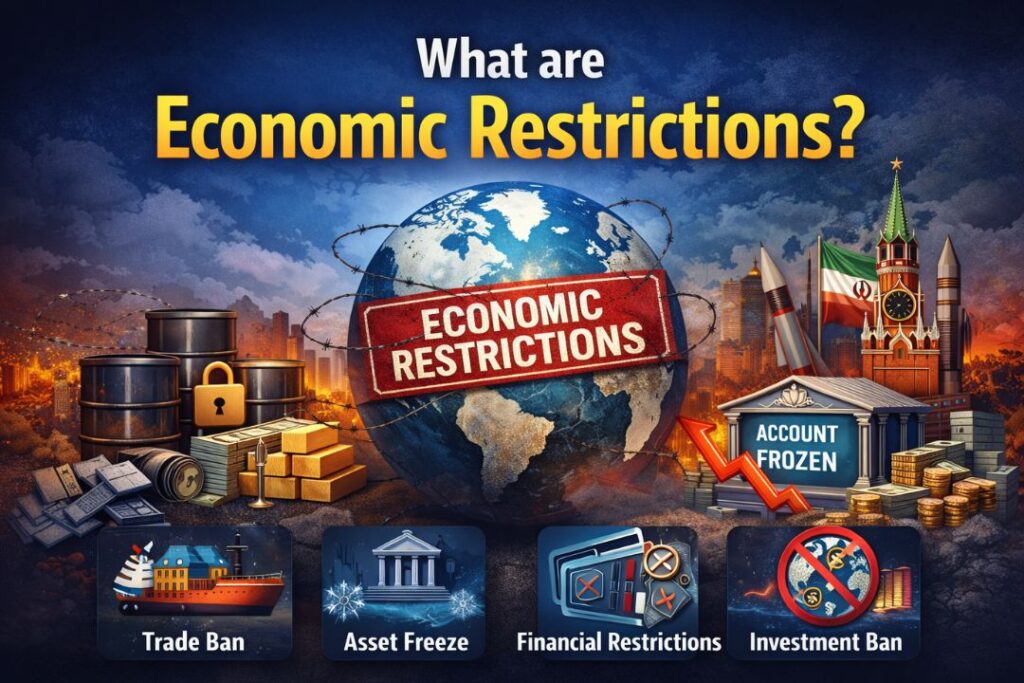
Economic Sanctions are financial or trade penalties imposed by one country or a group of nations against another nation, entity, or individual. These measures aim to restrict economic activity and create pressure without engaging in military conflict.
Sanctions may be imposed by:
- United Nations
- European Union
- United States of America
The primary objectives of economic Restrictions include:
- Preventing Nuclear Proliferation
- Combating terrorism financing
- Protecting human rights
- Pressuring regime changes
- Response to territorial aggression
Unlike trade disputes, economic Restrictions are usually politically motivated and tied to international law or diplomatic conflicts.
Why do countries use economic sanctions?
Governments prefer Economic Restrictions over military interference for several reasons:
- Lower direct human cost
- Reduced military spending
- International Legitimacy
- Flexible pressure
Economic Restrictions can be tightened, expanded, or lifted depending on the political reaction of the targeted country. This flexibility makes them an attractive foreign policy instrument.
Types of Economic Sanctions
Trade Sanctions
Trade-based Economic Sanctions restrict imports or exports between nations.
Examples include:
- export ban on military equipment
- Import restrictions on oil and natural gas
- Complete trade embargoes
Trade sanctions directly impact supply chains and frequently increase global commodity prices.
Financial Sanctions
Financial economic Restrictions target a country’s ability to access global financial systems.
These include:
- Freezing foreign assets
- Blocking banking transactions
- Removing access to SWIFT
- Prohibiting investments
Financial sanctions are frequently more powerful than trade sanctions because modern economies depend heavily on international banking systems.
Targeted or Smart Sanctions
Modern Economic Sanctions increasingly focus on specific individuals or companies rather than entire populations.
These may include:
- Travel bans
- Asset freeze for political leaders
- Sanctions against defense companies
- Technical export restrictions
Smart sanctions aim to minimize harm to ordinary citizens while pressing decision-makers.
Sectoral Sanctions
Sectoral Economic Sanctions prohibit specific industries such as:
- Energy
- Banking
- Technology
- Defense
By targeting critical sectors, governments attempt to weaken strategic industries without closing down the entire economy.
Real-World Examples of Economic Sanctions
Russia
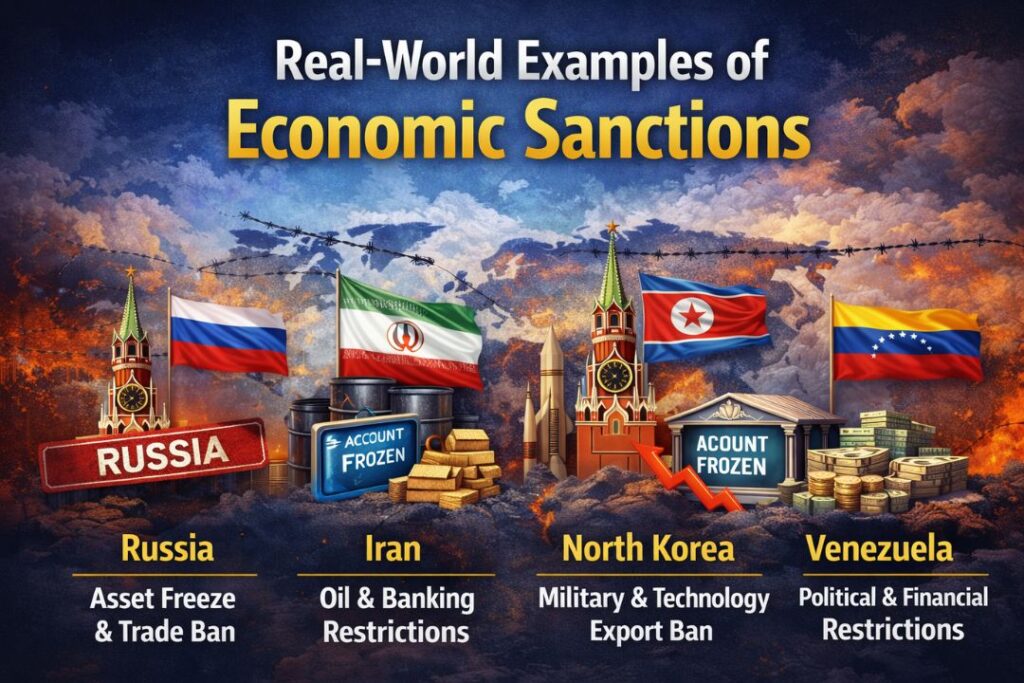
After the 2022 invasion of Ukraine, major economies impose sweeping economic Restrictions on Russia. These included freezing central bank reserves, banning technology exports, and limiting energy trade.
The sanctions led to currency instability, inflation spikes, and changes in global energy markets.
Iran
Iran has faced long-term economic sanctions relating to its nuclear program. Restrictions targeting oil exports and international banking access.
These measures significantly reduced government revenue and caused inflation, but political outcomes remained debated.
North Korea
North Korea has been under Economic Restrictions for decades because of missile and nuclear testing. This includes trade bans, asset freezes, and shipping restrictions.
Despite heavy economic Restrictions, the regime continues its arms program, raising questions about long-term effectiveness.
Economic Effect of Economic Restrictions
The effect of Economic Restrictions can be analyzed at three levels:
Impact on Target Country
- currency depreciation
- Rising inflation
- Reduced GDP growth
- Capital flight
- Supply Shortages
Economic sanctions frequently shrink foreign investment and restrict technology imports.
Impact on Global Markets
Economic Restrictions do not only affect the target country. They can:
- Increase in oil and gas prices
- Disrupt global supply chains
- stock market volatility
- Strengthen safe-haven assets
Organizations like the International Financial Fund and World Bank monitor global spillover effects.
Impact on Ordinary Citizens
While governments design Economic Sanctions to pressure political leaders, civilians frequently experience:
- Higher food prices
- Medicine Shortages
- Unemployment
- Reduced purchasing power
This humanitarian concern is one of the biggest critiques of Economic Restrictions.
Are economic Restrictions effective?
Research shows mixed results.
When Economic Sanctions Work
- When multiple countries co
- When financial systems are globally intertwined
- When sanctions targeted elite decision-makers
- When goals are clear and limited
When Economic Sanctions Fail
- When target countries find alternative trading partners
- When national political support remains strong
- When sanctions last too long without diplomatic involvement
Effectiveness depends on enforcement, global participation, and economic reliance.
Economic Restrictions and emerging economies
Countries like India may not always be targeted directly, but they feel indirect impacts.
For example:
- Oil import costs may rise
- currency markets become volatile
- Inflation pressure increases
Emerging markets must balance diplomatic relations while protecting economic stability.
Financial Sanctions in the Digital Era
In 2026, Economic Sanctions increasingly include:
- Technology export bans
- Semiconductor restrictions
- AI software limitations
- Cybersecurity controls
Digital sanctions may slow innovation and create long-term technological gaps.
The Future of Economic Sanctions
Looking forward, Economic Sanctions are likely to:
- Becoming more targeted and data-driven
- Focus on Technology and Digital Finance
- Involve central bank digital currencies.
- Integrated compliance tracking systems
As global finance evolves, so will the economic sanctions strategies.
Geopolitical strategy behind economic Restrictions
Economic Restrictions are seldom random decisions. They are carefully designed strategic instruments shaped by diplomacy, intelligence assessments, economic leverage, and long-term geopolitical goals. Before imposing Economic Restrictions, governments typically assess several factors:
- Economic vulnerability of the target country
- Depend on global financial systems
- Energy export reliance
- Political stability
- Availability of alternative trading partners
For example, when a country depends heavily on oil exports, economic Restrictions targeting its energy sector can significantly reduce national revenue. However, if that country has diversified trade relationships or strong domestic production, the impact may be less severe.
In modern geopolitics, Economic Sanctions often serve as part of a wider strategy that includes diplomatic negotiations, defense alliances, and trade agreements. Sanctions are sometimes imposed slowly to increase pressure step by step rather than creating an immediate economic collapse.
Corporate and Business Effect of Economic Restrictions
Global corporations must continuously monitor Economic Restrictions because non-compliance can lead to massive penalties. Multination companies face several risks when Economic Restrictions are imposed:
- Loss of access to overseas markets
- Contract cancellations
- Frozen International Payments
- Legal penalties and reputational damage.
Large financial institutions invest heavily in compliance systems to assure they do not violate Economic Sanctions regulations. Many banks use advanced AI monitoring systems to track transactions and detect banned entities.
For businesses, economic Restrictions can also create unpredictable opportunities. When competitors leave a sanctioned market, local or alternative suppliers may gain market share. However, companies must carefully balance profit intentions with legal obligations.
Financial Sanctions and Global Supply Chains
Modern economies rely on highly intertwined supply chains. Economic sanctions can disrupt these networks in unpredictable ways. When a country faces sanctions:
- Raw materials exports may decline.
- Shipping routes may change
- Insurance costs may increase
- Production delays can occur globally.
For example, if sanctions target semiconductor exports, technology companies worldwide may experience production scarcity. Likewise, sanctions on energy-producing nations can increase fuel costs, affecting transportation, manufacturing, and food prices.
This interconnected nature means Economic Restrictions frequently produce ripple effects far beyond the intended target.
humanitarian concerns and ethical debate
One of the most contentious aspects of economic sanctions is their humanitarian impact. Critics argue that while governments aim to pressure political leaders, ordinary citizens frequently bear the economic burden.
Common humanitarian implications include:
- Rising food inflation
- Restricted access to imported medicines
- Deteriorating health infrastructure
- Reduction in employment opportunities
To address these concerns, policymakers increasingly design humanitarian exemptions within Economic Sanctions frameworks. These exemptions permit essential goods such as food, medicine, and medical equipment to continue flowing.
However, logical and banking restrictions sometimes make it difficult to implement these exemptions effectively.
Financial Markets and Investor Outlook
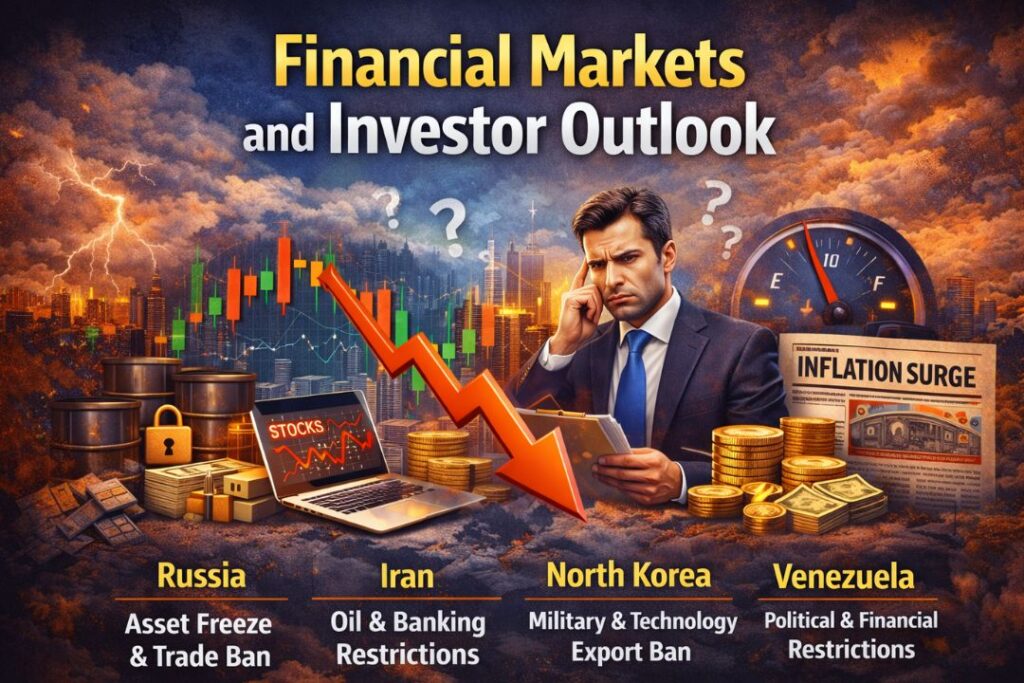
From an investor’s perspective, economic sanctions create both risks and opportunities.
Risks:
- Increased market volatility
- Currency depreciation in affected areas
- Energy and commodities price spikes
- Emerging market instability
Opportunities:
- Defensive sector growth(energy, defense, commodities)
- safe haven assets such as gold
- Diversity into stable economies
Investors closely monitor announcements related to Economic Sanctions because financial markets frequently react immediately. Even rumors of possible sanctions can trigger sharp stock market movements.
Economic Restrictions and currency dynamics
Another important dimension is the impact of Economic Sanctions on global monetary systems. When countries face restrictions on dollar-based transactions, they may endeavor to:
- Use alternative currencies
- Development bilateral trade agreements
- Strengthening regional payment systems
- Explore digital currencies solutions
This shift has sparked debates regarding long-term changes in global reserve currency dominance. Although the US dollar remains dominant, repeated Economic Sanctions have encouraged some countries to reduce reliance on traditional financial systems.
Long-Term Structural Effects
While short-term disruptions are common, the longer-term structural effects of economic Restrictions can reshape economies permanently.
Some countries respond by:
- Expanding domestic production
- Strengthening Local Agriculture
- Building new trade alliances
- Investing in Technological Self-Reliance
In some cases, Economic Sanctions inadvertently accelerate innovation within the targeted country. Domestic industries may grow stronger as dependency on imports decreases.
However, extended sanctions without diplomatic resolution can lead to economic stagnation, declining foreign investment, and reduced living standards.
diplomatic resolution and sanctions removal
Financial sanctions are not always permanent. They are often tied to specific political circumstances. When agreements are reached, sanctions may be partly or completely lifted.
The removal of economic sanctions can result in:
- Rapid foreign investment flows
- Currency appreciation
- Economic recovery
- Enhanced global trade integration
However, rebuilding investor confidence after long-term sanctions may take years.
Final Thoughts
Economic sanctions have become one of the most important instruments of global diplomacy. They allow countries to exert pressure without direct military conflict, yet their humanitarian and economic implications remain controversial.
While Economic Restrictions can disrupt economies and influence policy decisions, they seldom produce immediate political transformation. Their success depends on coordination, enforcement, and clearly defined goals.
In a globalization economy, no nation is completely immune to the ripple effects of Economic Restrictions. Investors, policymakers, and businesses must understand how these measurements shape trade, inflation, and financial markets.
Frequently Asked Questions (FAQ)
1.What are Economic Sanctions in simple terms?
Economic Restrictions are financial or trade restrictions imposed by one country upon another to influence political or economic behavior.
2.Who can impose economic sanctions?
Governments and international bodies such as the United Nations can impose economic sanctions.
3.Do Economic Restrictions hurt ordinary people?
Yes, in many cases Economic Sanctions increase inflation and reduce access to essential products.
4.Are Economic Sanctions better than war?
They are considered a non-military alternative, but they still carry economic and humanitarian implications.
5.Can Economic Sanctions be lifted?
Yes, they can be lifted if political conditions change or agreements are achieved.
6.How long does Economic Restrictions usually last?
Economic Sanctions can last for months or even decades, depending on political negotiations and whether the target country meets the required conditions.
7.Do Economic Sanctions impact global inflation?
Yes, Economic Restrictions can increase global inflation, especially when they target energy, oil, or major export sectors that influence worldwide supply chains.
8.Can businesses operate legally in sanctioned countries?
Businesses can operate only if they strictly follow Economic Sanctions regulations and compliance rules set by their government officials.
Disclaimer
This article is for educational and informative purposes only. This does not constitute financial, legal, or political advice. The discussion of Economic Sanctions is based on publicly available information and global economic analysis as of 2026. Readers should consult professional advisers before making investment or policy-related decisions.
