
Introduction
Running a business today isn’t just about making profits; it’s equally important to understand the risks and properly protect against them. A fire, a theft, a customer lawsuit, an employee injury, a data hack, or a natural disaster all of these events can cause significant financial losses to any business.
That is why business insurance acts as a strong protective shield for every business, big or small.
This guide provides complete and detailed information as of 2026, where you will learn:
- What is business insurance?
- Its main types.
- Benefits.
- What factors determine the cost.
- How to choose the right policy.
- Claims process.
- Common mistakes.
- Future trends.
What is business insurance?
Business insurance is an insurance policy that protects a business against financial losses caused by various risks.
This insurance provides protection against the following:
- Property damage
- Third-party legal claims
- Employee injury
- Cyberattack
- Professional error
- Business interruption
In simple terms, it’s a financial protection plan that keeps your business stable during uncertain circumstances.
Why is business insurance important?
Financial Security
Even a small lawsuit can cost millions. Having insurance reduces this risk.
Legal Requirement
Some insurances, such as workers’ compensation, are mandatory in many states.
Business Continuity
If a business is shut down due to a fire or flood, insurance can compensate for income.
Customer and investor confidence
Insurance increases a company’s credibility.
Employee Safety
Providing employees with security boosts their morale.
Main Types of Business Insurance
General Liability Insurance
This is the most important policy.
Covers:
- Third-party injury
- Property damage
- Legal expenses
Example: A customer falls in a store.
Property Insurance
It covers your physical property:
- Office
- Machinery
- Stock
- Furniture
It provides protection against fire, theft, and natural disasters.
Professional Liability Insurance
A must for service-based businesses.
It covers claims involving professional error or negligence.
Workers’ Compensation Insurance
If an employee is injured on the job:
- Medical expenses
- Salary
- Rehabilitation expenses
Business Interruption Insurance
This covers loss of income if a business is shut down due to a disaster.
Cyber Insurance
Data security is crucial in this digital age.
It covers:
- Data theft
- Hacking
- Ransomware
- IT recovery
Product Liability Insurance
If your product causes harm to someone.
Commercial Vehicle Insurance
If the vehicle is used for business.
Which businesses need it?
- Startup
- Small Business
- E-commerce
- Retail
- Manufacturing
- IT Company
- Freelancer
Almost every business should have some form of business insurance.
What factors determine the cost of commercial insurance?
1.Industry type
2.Business size
3.Location
4.Coverage limits
5.Previous claims record
Higher risk = higher premium.
How to choose the right commercial insurance?
1: Analyze the risk
2: Understand the legal regulations
3: Compare multiple companies
4: Check coverage limits
5: Read the exclusions
Claim Process (Step-by-Step Guide)
- Notify the insurance company immediately
- Gather evidence of the incident
- Fill out the claim form
- Investigation process
- Claim settlement
Filing a claim on time makes the process easier.
Common Mistakes
- Choosing a Cheaper Plan
- Having Less Coverage
- Not Updating the Policy
- Not Reading the Terms
- Delaying Claims
Benefits of commercial insurance
- Financial Stability
- Legal Protection
- Business Continuity
- Employee Satisfaction
- Customer Trust
New Trends in 2026
- Digital Policy
- Online Claims
- AI-Based Risk Assessment
- Increased Cybersecurity Coverage
- Climate Risk Insurance
Is it necessary to get business insurance?
Yeah.
A major accident can shut down the entire business. The potential loss is much larger than the premium. So it is not an expense but a wise investment.
Risk Assessment and the Role of commercial insurance
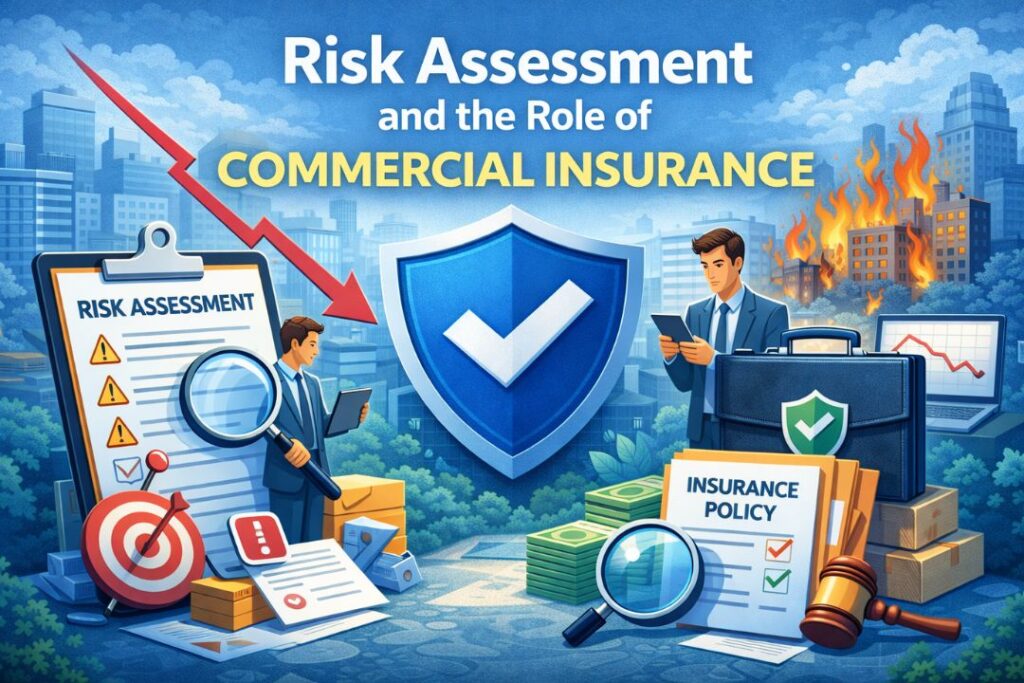
It is crucial to assess the risks properly before choosing the right insurance for any business. Risk Assessment is the process of identifying potential threats that could harm your business.
1 Why is risk assessment important?
- Identifying potential risks
- Estimating financial losses
- Selecting the right coverage
- Avoiding unnecessary premiums
- Better policy terms with an insurance company
If you purchase business insurance without a risk analysis, you may end up with inadequate coverage or paying unnecessarily high premiums.
2 Types of risks
Physical Risk
- Fire
- Flood
- Earthquake
- Theft
- Machine Failure
Legal Risk
- Customer Lawsuits
- Contract Disputes
- Product Damage
Human Resources Risk
- Employee Injury
- Workplace Accident
- Labor Dispute
Cyber Risk
- Data Theft
- Hacking
- Ransomware
- Online Fraud
Financial Risk
- Sudden Revenue Decline
- Market Recession
- Supply Chain Disruption
All these risks must be considered before purchasing the right business insurance coverage.
Business Insurance and Tax Benefits
In many countries, business insurance premium is considered a business expense.
How do I get tax exemption?
- Insurance premiums can be included in company expenses.
- This reduces total taxable income.
- Additional benefits may be available on certain policies.
However, tax rules may vary by country and state. Therefore, it is advisable to consult a tax advisor.
Understanding Business Insurance Policy Terms
Focusing solely on the premium isn’t enough when purchasing insurance. It is very important to understand the terms and conditions of the policy.
Important Terms
- Coverage Limit
- Deductible
- Exclusions (What will not be covered)
- Policy Term
- Renewal Terms
The deductible is the amount you have to pay yourself, after which the insurance company pays the remaining amount.
Business Insurance Renewal Process
An insurance policy is for a fixed period, usually one year.
Points to consider when renewing:
- Has the business expanded?
- Are there new risks involved?
- Were there any claims last year?
- Is the coverage adequate?
If the business has expanded, it may be necessary to increase coverage.
Business Insurance in the Digital Age
The insurance industry is rapidly becoming digital in 2026.
Digital Transformation
- Online Policy Purchase
- Claims via Mobile App
- AI-Based Risk Analysis
- Faster Claim Settlement
- Digital Documentation
This has simplified and made the process transparent.
Special Tips for Small Businesses
Small businesses often overlook insurance due to budget constraints.
What to do?
- Start with basic general liability.
- Choose a bundled policy.
- Get coverage based on risk.
- Review it annually.
Business insurance is future protection for small businesses.
Business Insurance for Startups
Startups grow rapidly, so the risks are greater.
Essential Coverage:
- General Liability
- Cyber Insurance
- Professional Liability
- Directors and Officers (D&O) Insurance
Investors also often examine insurance coverage.
Comprehensive coverage for large businesses
Risks for large companies are more complex.
They may need:
- Comprehensive property insurance
- Supply chain coverage
- International risk coverage
- Environmental liability insurance
Important questions to ask when purchasing business insurance
1.What is the total coverage limit?
2.Are all risks covered?
3.What is the claim settlement time?
4.How much is the deductible?
5.Are there any hidden conditions in the policy?
6.Is 24×7 support available?
Case Study
Suppose a fire breaks out in a manufacturing unit and causes a loss of ₹50 lakh.
If the business is insured:
- Property damage will be covered
- Machinery repair expenses will be covered
- Income will be compensated for business interruption
If there is no insurance:
- You will have to bear the entire loss yourself
- There is a possibility of business closure
The Future of Business Insurance
In the coming years:
- Cyber coverage will increase further
- Climate risk policies will become common
- AI-based premium determination will be available
- Customized microinsurance will become available
Businesses should keep updating insurance to reflect changing risks.
conclusion
Business insurance is not just a legal formality, but it is the foundation of long-term security and stability of the business.
It:
- Prevents financial loss
- Reduces legal risk
- Increases employee and customer confidence
- Ensures business continuity
No business is immune to risk these days. Therefore, getting the right business insurance is a wise and strategic decision.
FAQ
What is business insurance?
Business insurance is an insurance policy that protects businesses against financial losses due to fire, theft, lawsuits, employee injuries, cyberattacks, and other risks. This helps the company maintain financial stability in unforeseen circumstances.
Is business insurance necessary for small businesses?
Yes, business insurance is just as important for small businesses as it is for large companies. Even a small lawsuit or accident can result in a major financial loss for a small business. Therefore, it is beneficial to take basic general liability and property coverage.
How much does business insurance cost?
The cost of business insurance depends on several factors, such as:
- Type of industry
- Size of business
- Number of employees
- Location
- Coverage limits
Premiums may be lower for small businesses, while they are higher for larger and higher-risk industries.
What policies are included in commercial insurance?
The main policies are:
- General Liability Insurance
- Property Insurance
- Professional Liability
- Workers’ Compensation
- Cyber Insurance
- Business Interruption Insurance
Coverage is chosen based on the nature of the business.
What is the claim process?
The claims process typically involves:
- Immediate reporting of the incident
- Submitting the required documents
- Investigation by the insurance company
- Claim acceptance and payment
Timely reporting helps settle the claim quickly.
Does business insurance offer tax benefits?
Often, business insurance premiums are treated as business expenses, which can reduce taxable income. However, this rule may vary by country and region.
How to choose the right business insurance?
To choose the right policy:
- Identify your business’s risks
- Understand the legal requirements
- Compare different insurance companies
- Carefully review coverage and exclusions
- Determine the coverage limits as needed
Seeking expert advice can also be beneficial.
Disclaimer : The information given in this article is for general educational and informational purpose only. This article is not intended to be legal, financial, tax, or insurance advice.
The terms, conditions, coverage, premiums, and claim procedures related to business insurance may vary by insurance company, policy type, country, and state. Therefore, before purchasing any policy, read the official terms and conditions of the concerned insurance company carefully.
The information provided in the article may change over time. We are not responsible for any financial loss, decision or damage that may be incurred based on the information provided in this article.
Always consult a qualified insurance advisor, financial expert or tax advisor before purchasing or changing any type of business insurance.
Stay connected for more such information https://stockhubnews.com
