

Introduction
Financial markets moves in cycles. Sometimes prices increase for years, creating wealth and optimism. At other times, markets fall sharply, fear dominates investor behavior, and losses stack up. This extended period of falling prices is known as a Bear Market.
A market downturn is one of the most misunderstood yet significant phases of the financial market. Many investors panic during market downturns, sell their investments at the wrong time, and missed future recovery opportunities. However, experienced investors know that market downturn are not only unavoidable but also essential for long-term wealth creation.
In this detailed guide, we will explore everything you need to know about market downturns, from their meaning and causes to real examples, investment strategies, psychological impact, and how smart investors turn recessions into opportunities.
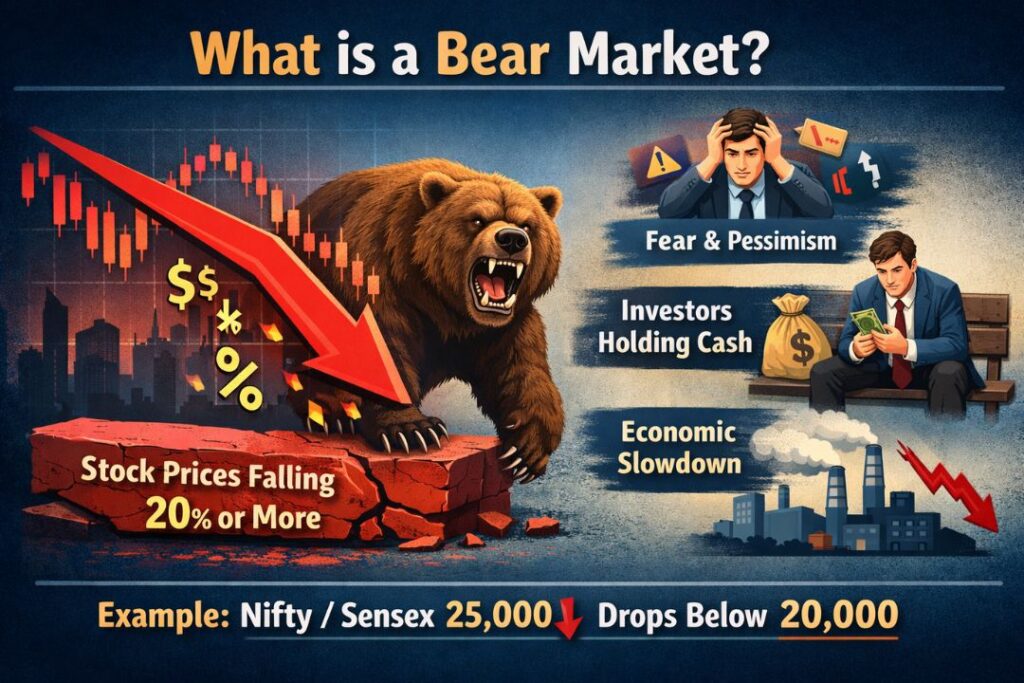
What is a bear market?
A market downturns is a phase in the financial market when prices drop 20% or more from their recent highs and remain low for an extended period. This reflects widespread pessimism, negative investor sentiment, and a weak economic outlook.
Key Features of a Market Decline
- Stock prices declined continuously.
- Investor confidence is low
- Trading volumes may decrease
- Economic growth slows
- Corporate earnings decline
- Unemployment often rises
Prolonged market downturns can occur in stock markets, commodity markets, bond markets, cryptocurrencies, and real estate.
Why Markets in Decline Are Called Bearish?
The term bear market comes from the way a bear attacks it swipes downwards with its claws. This signifies falling prices.
In contrast, a bull market represents increasing prices because a bull attacks by thrusting its horns upward.
Bear Market vs Bull Market
| Feature | Bear Market | Bull Market |
|---|---|---|
| Market Direction | Downward | Upward |
| Investor Mood | Fear & pessimism | Confidence & optimism |
| Economic Growth | Slow or negative | Strong |
| Corporate Profits | Falling | Rising |
| Investment Strategy | Defensive | Aggressive |
Causes of Market Downturn
Market downturns do not occur randomly; they are typically triggered by a combination of economic, financial, and psychological factors.
Economic Recession
When GDP growth turns negative, consumer spending drops, and businesses earn less, stock prices decline.
High Inflation
Rising inflation reduces buying power and increases costs for companies, hurting profits.
Rising Interest Rates
Central banks raise interest rates to control inflation, making borrowing costly and reducing investment.
Financial Crises
Banking failures, credit crunches, or debt crises can seriously impact markets.
Geopolitical Tensions
Wars, trade conflicts, sanctions, and political uncertainty create uncertainty.
Asset Bubbles Bursting
When markets rise too fast without fundamentals, they ultimately crash.
Loss of Investor Confidence
Fear spreads quickly. Even stronger companies get sold during panic.
Types of Market Downturns
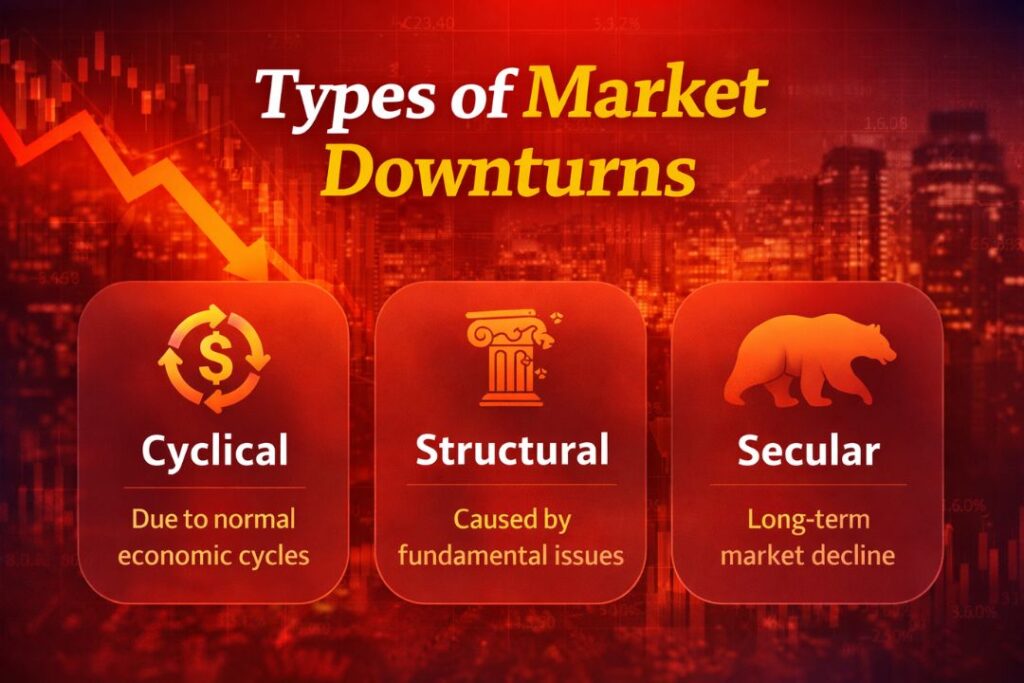
1.Cyclical Market Downturn
- Linked to economic cycles
- Usually lasts a few months to one year
- Followed by recovery
2.Structural Market Downturn
- Caused by deep economic problems.2
- Can last several years
- Requires major reforms
Secular Market Downturn
- Long term period of weak returns.
- Markets move sideways with sharp drops.
Historical examples of bear markets
1.the great depression
- Market fell nearly 90%
- Global economic collapse triggered
2.Dot-Com Crash (2000–2002)
- Technology stocks collapsed
- NASDAQ lost about 78%
3.Global financial crisis (2008)
- Banking system failure
- Markets dropped over 50%
4.COVID-19 Crash (2020)
- Fastest Market Downturn in History
- Followed by rapid recovery
How long does a bear market last?
There is no fixed duration.
- Short bear markets: 3-9 months
- Average bear market: 9–18 months
- Severe bear markets: Many years
Historically, bull markets last longer than Market Downturn, which is why long-term investment works.
Psychology of a Market Downturn
Market Downturn are driven by emotions as much as by numbers.
Common Investor Emotions
- Fear
- panic selling
- Regret
- Loss aversion
- Herd mentality
Why Investors Lose Money
- Selling at the bottom
- Stopping SIPs
- Trying to time the market
- Overreacting to news
Impact of a Market Downturn
On Investors
- Portfolio value declines
- Confidence shaken
- Emotional stress
On Companies
- Lower profits
- Cost cutting and layoffs
- Reduced expansion
On Economy
- Slower growth
- Lower consumption
- Higher unemployment
Is a Market Downturn bad for everyone?
Not necessarily.
Who Suffers
- Short-term traders
- Overleveraged investors
- Panic sellers
Who Benefits
- Long-term investors
- Value investors
- SIP investors
- Cash-rich investors
How to invest during a Market Downturn
1.Stay Calm and Disciplined
Avoid emotional decisions.
2.Continue SIPs
market downturns are the best time for SIP investing because you purchase more units at lower prices.
3.Focus on Quality Stocks
Choose companies with:
- Strong balance sheets
- Low debt
- Consistent cash flows
4.Diversify Portfolio
Includes:
- Equity
- Debt
- Gold
- Cash
5.Avoid Excessive Leverage
Debt amplifies losses.
6.Invest Gradually
Use staggered buying rather than lump sum.
Best assets during a bear market
| Asset | Performance |
|---|---|
| Gold | Usually performs well |
| Government Bonds | Safer |
| Defensive Stocks | Stable earnings |
| Cash | Liquidity advantage |
Common Mistakes to Avoid
- panic selling
- Stopping long term investments
- Believing this time is different
- Listening to rumors
- Overtrading
How Market Downturn Build Future Wealth
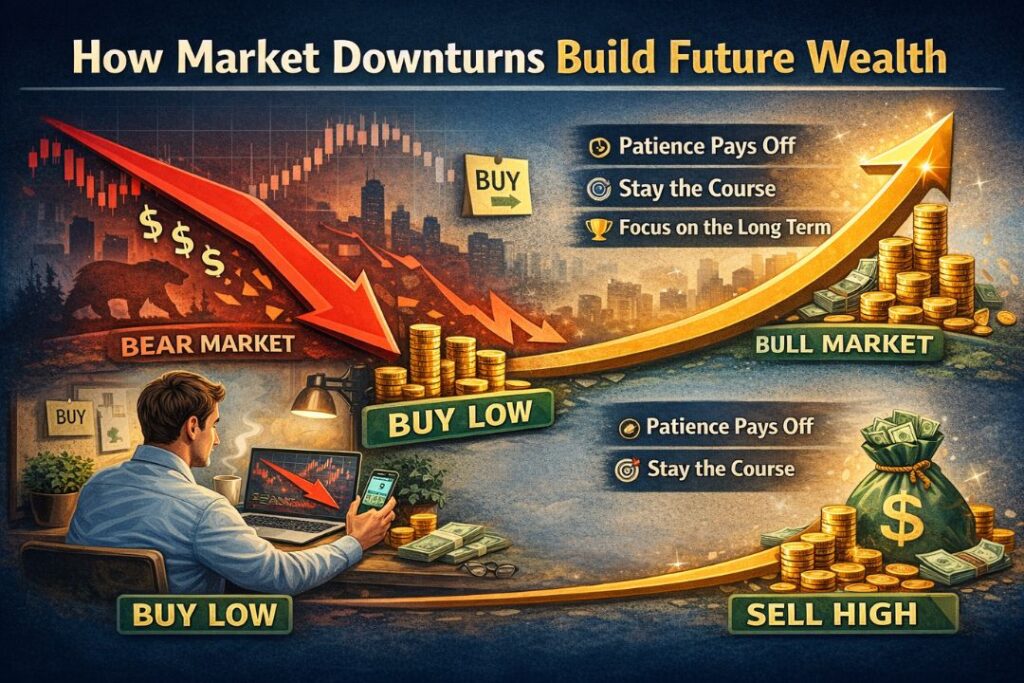
Nearly all great fortunes are built during market downturns.
Why?
- Valuations become attractive
- Risk-reward improves
- Future returns increase
Bull markets make you money, market downturns make you wealthy.
Signs a Market Downturn Might Be Ending
- Inflation starts cooling
- Interest rates stabilize
- Corporate earnings improvement
- Market stops making new lows
- Sentiment is very negative.
No indicator is perfect confirmation comes only in hindsight.
Bear Market in India
Indian markets have faced several bear stages:
- 1992 Scam crash
- 2008 Global crisis
- 2020 COVID fall
Each time, markets recovered and made new all-time highs subsequently.
Bear Markets
If your goal is:
- Retirement
- Wealth creation
- Child education
Market Downturn are temporary noise
Timing the market beats timing the market.
Frequently Asked Questions
Is the bear market good for beginners?
Yes, if they invest systematically and learn patience.
Should I stop investment during a bear market?
No. This is the best time to investment.
Can Bear markets be predicted?
Not accurately.
Is cash better than equities in bear markets?
Cash helps for security, but equity creates long-term wealth.
Conclusion
A bear market is an inevitable stage of the financial market cycle. Whereas it brings fear, uncertainty, and short-term losses, it also offers valuable lessons and powerful long-term opportunities. History has consistently showed that markets recover over time, and investors who remain patient, disciplined, and informed are often rewarded the most.
Rather than viewing a market downturns as a threat, smart investors treat it as a period to reassess their strategy, strengthen their portfolio, and invest in quality assets at reasonable appraisals. Emotional decisions like panic selling or stopping long-term investments can cause lasting damage, while a calm and systematic approach can help build wealth over time.
Ultimately, success in investing does not come from avoiding market downturns but from understanding them and responding appropriately. Those who stay invested, focus on fundamentals, and think long-term are better placed to benefit when the next bull market begins.
Disclaimer
The information provided in this article is for educational and informational purposes alone. This should not be considered as financial, investment, tax, or legal advice. Stock market investments are subject to market risks, including the potential loss of principal.
Past performance of markets or securities does not guarantee future outcomes. Readers are advised to conduct their own research or consult a certified financial advisor before making any investment decisions. The author and publisher shall not be held responsible for any losses incurred as a consequence of using the information presented in this article.
Investment in financial markets requires understanding, discipline, and risk awareness. Always invest according to your financial objectives, risk tolerance, and investment horizon.
Stay connected for more such information https://stockhubnews.com
